
Loading, please wait...
_900x900.jpg "North Western Bronze Short Sword")
_200x200.jpg "North Western Bronze Short Sword")
.jpg "North Western Bronze Short Sword")
LOT 0296
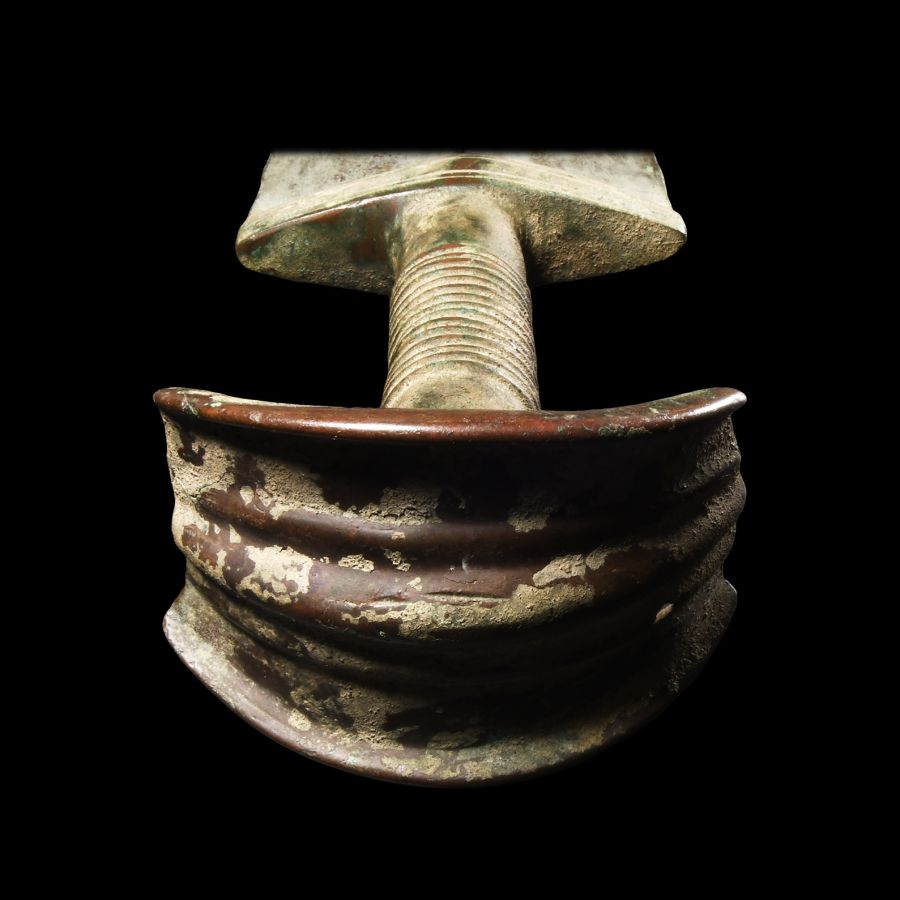
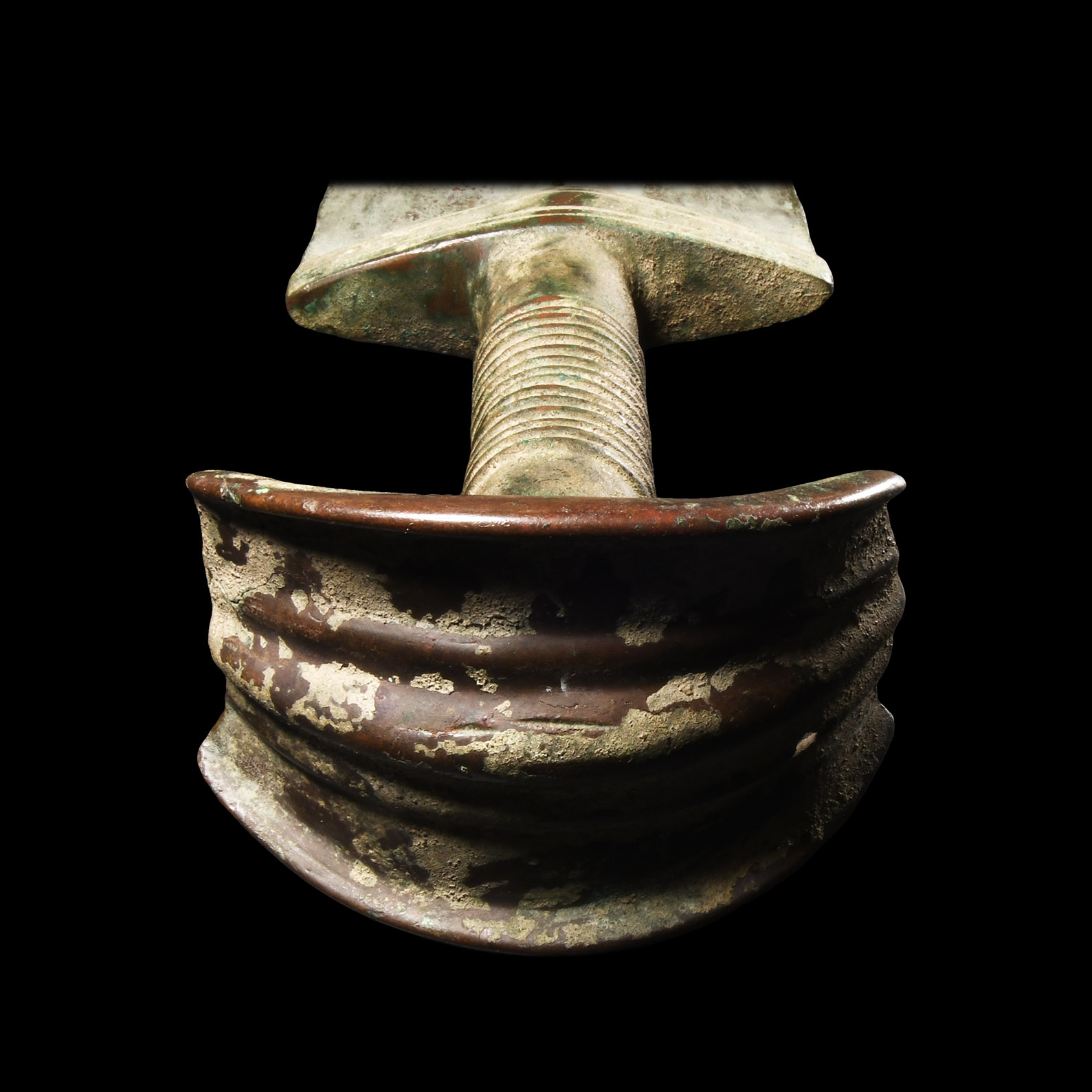
North Western Bronze Short Sword
2ND-1ST MILLENNIUM B.C.
22 7/8 in. (1.05 kg, 58 cm).
Of fine quality, showing an open cast crescentic pommel with raised midrib and two parallel shallow lines across the top; pommel open on both sides to reveal the tip of the blade, tang rising from the grip; the solid cylindrical grip decorated with fourteen circumferential ribs, angular guard and triangular blade with strong midrib.
ProvenanceEx P.A., Hertfordshire, UK, specialist collection of Greek art, 1980-1990s.
LiteratureCf. Khorasani, M.M., Arms and Armour from Iran. The Bronze Age to the End of the Qajar Period, Tübingen, 2006, s. cat 37, for type.
FootnotesThe dirk has its hilt cast onto the blade. Moorey published a very similar piece with fourteen encircling ribs on the grip and attributed similar pieces to the North-West, also based upon examples of similar dirks from the Iranian and Russian Talesh region. He dated these pieces to the late 2nd millennium B.C. Similar examples were excavated at Marlik. Stutzinger attributed these types with a wider dating (13th-9th century A.D.)
CONDITIONTimeLine Auctions follows a vetting process to ensure the authenticity and legality of all items, reinforcing our commitment to integrity and responsible trading. Each antiquity, antique, and coin lot undergoes thorough examination by a vetting committee of at least ten external specialists, professional trade association members, scientists, and archaeologists: Our Vetting Process
AUCTIONS:
TimeLine is a leading auction house specialising in antiquities, ancient art, collectables, natural history, coins, medals, and books. Our auctions offer museums, collectors, historians, and enthusiasts the opportunity to acquire unique and historically significant pieces.
-
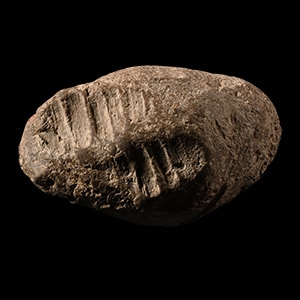
Roman Praetorian Guard Terracotta Sling Shot with Scorpion
1st century A.D.Sold for (Inc. bp): £286
Lentoid section with a raised 'keel' to one end, depicting a stylised scorpion. 25.75 grams, 43 mm
Ex Simmons Gallery, London E11, UK, in the 1990s. From a North London collection.
The sling (funda) with its lead (plumbea pondera) and stone missiles was used by special funditores, illustrated on Trajan’s Column where they are dressed in broad tunics with no armour, but carry a shield. Interestingly, this glans has the emblem usually associated with the Praetorian Guard - the scorpion. It was an emblem also used in Ptolemaic Egypt, and it is not impossible that this bullet could be Ptolemaic or Romano-Egyptian. We believe this bullet could be associated with the Praetorian regiments which means this could be one of the first pieces of evidence for their use. -
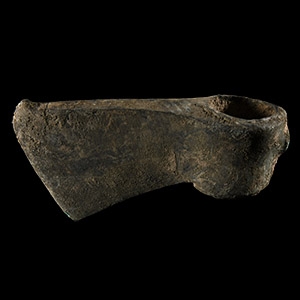
Heavy Western Asiatic Bronze Axehead
Late 3rd millennium B.C.Estimate: £100 - 140 (+bp*)
Opening Bid: £50
With swept blade, large socket with shallow raised circumferential rib and a vertical rib to the rear. 741 grams, 14.5 cm
Acquired 1980-2015. Ex Abelita family collection.
In the middle of the 3rd millennium B.C., the most widespread types of axes were those made for splitting and those for cutting. In the last third of this millennium there emerged a sharp differentiation between such axes. Such a sharp division by function should be associated with the influence of the Syro-Palestinian tradition. Such differentiation, in the absence of some multifunctional forms can be observed from the end of the 4th millennium B.C. and during the 3rd millennium B.C. -
.jpg)
Smith and Wesson Old Model No 2 Revolver
1861-1874 A.D.Sold for (Inc. bp): £780
Also known as 'Model No 2 Army' with hinged frame, six shot .32 calibre rimfire cylinder with 'PATENTED APRIL 3 1855 JULY 5 1859 & DEC 18 1860' and 15cm (6") octagonal barrel marked 'SMITH & WESSON SPRINGFIELD MASS' to top with fixed extractor pin and spur trigger; serial number 47946 to butt strap with plain wood grip scales; action working. 690 grams, 27 cm
Acquired from Bolk Antique Arms, Netherlands, 2016. Ex Kusmirek Collection, UK. Accompanied by an original Bolk invoice.
Sold as an exempt item under Section 58 (2) of the Firearms Act, 1968, to be held as a curiosity or ornament. No license required but buyer must be over 18 years of age. Overseas bidders should note that, due to UK regulations governing export of all firearms, overseas buyers will need to make arrangements for shipping this lot out of the UK directly, by air freight, with a specialist company or agent.
