
Loading, please wait...
LOT 1014
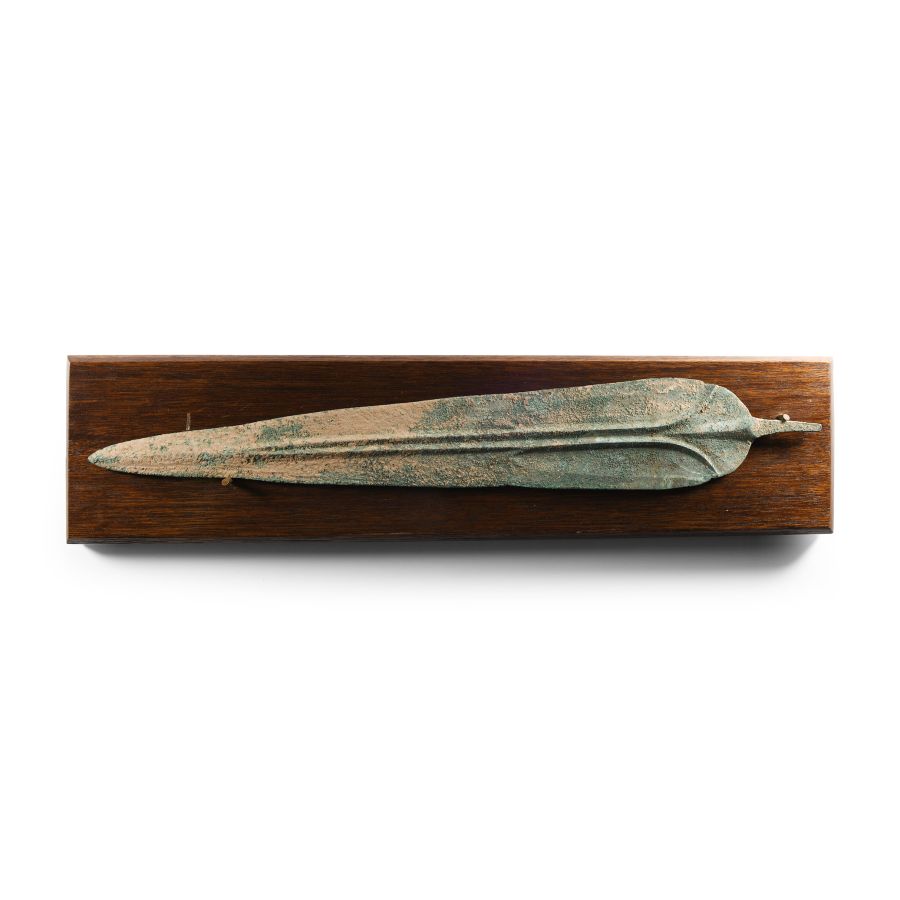
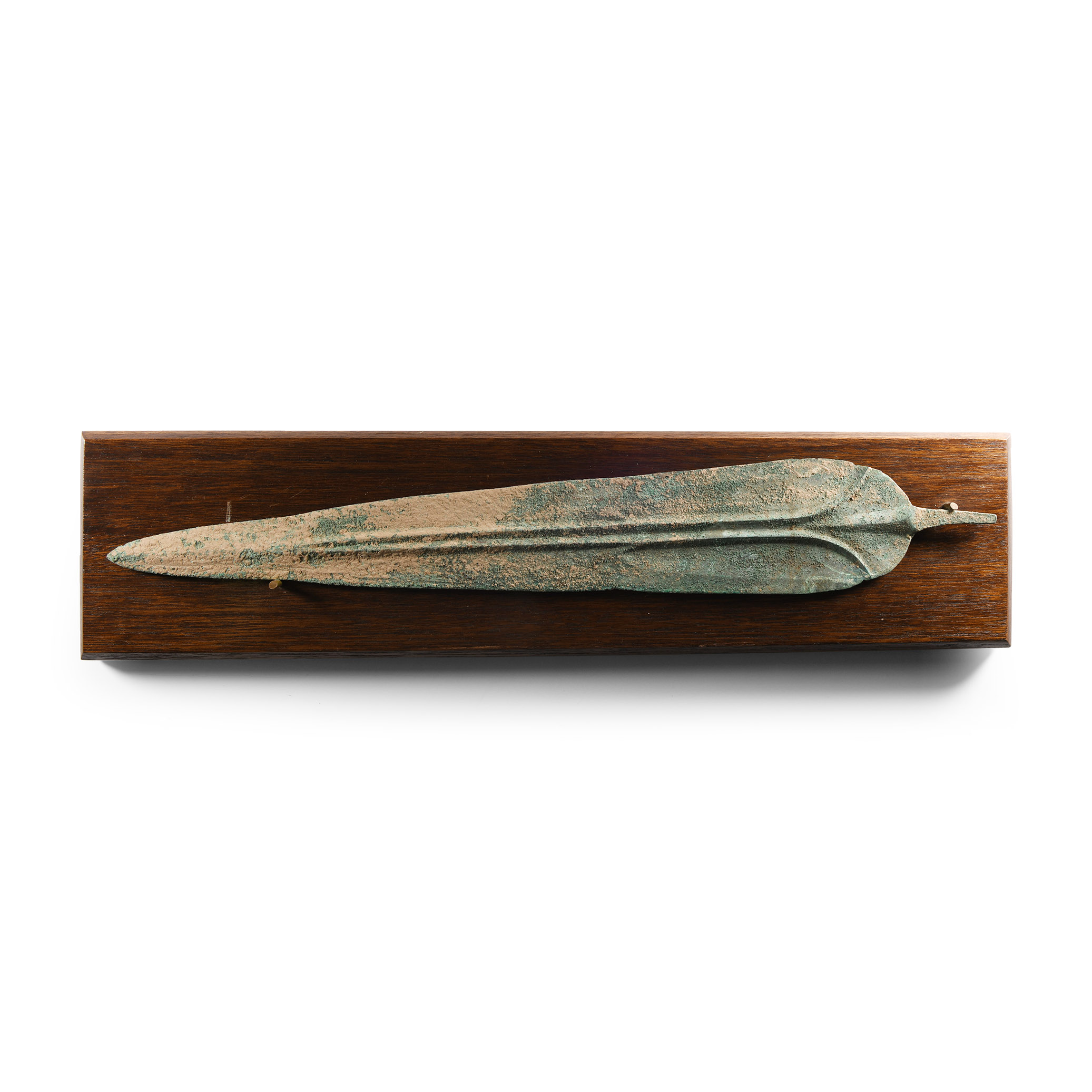
North West Persian Short Sword with Blood Channels
2ND-1ST MILLENNIUM B.C.
18 in. (19 1/4 in.) (1.18 kg total, 45.5 cm (49 cm including stand)).
With short tang for an organic hilt, the blade showing multiple grooves forming a pronounced mid-rib spanning roughly more than three-quarters of the blade; accompanied by a custom-made display stand.
ProvenanceEx P.A., Hertfordshire, UK, specialist collection of Greek art, 1980-1990s.
LiteratureCf. Christie's, The Axel Guttmann Collection of Ancient Arms and Armour, part 2, London, 2004, item 36, p.33.
FootnotesLuristan was hardly an ethnic or political entity, but the people of Luri had relations through warfare and traded with Sumerians, Lullubi, Assyrians, Babylonians and Elamites over a long period of time, spanning from the 3rd to the 2nd millennium B.C. The ruling elites of warrior horsemen were buried with their weapons and horses.
CONDITIONTimeLine Auctions follows a vetting process to ensure the authenticity and legality of all items, reinforcing our commitment to integrity and responsible trading. Each antiquity, antique, and coin lot undergoes thorough examination by a vetting committee of at least ten external specialists, professional trade association members, scientists, and archaeologists: Our Vetting Process
AUCTIONS:
TimeLine is a leading auction house specialising in antiquities, ancient art, collectables, natural history, coins, medals, and books. Our auctions offer museums, collectors, historians, and enthusiasts the opportunity to acquire unique and historically significant pieces.
LOT 1014
North West Persian Short Sword with Blood Channels
Estimate £300 - 400€350 - 460 (for guidance only)$410 - 540 (for guidance only)
-
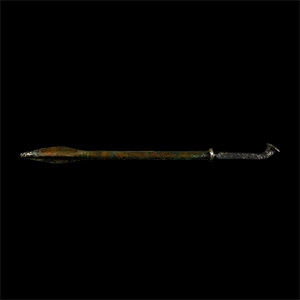
Western Asiatic Bronze Javelin Head
Late 3rd millennium B.C.Estimate: £300 - 400 (+bp*)
Opening Bid: £150
Featuring a tripartite weapon with short, narrow leafy blade, elongated stem decorated by embossed geometric lines and folded tang. 220 grams, 32.3 cm
Acquired 1980-2015. Ex Abelita family collection.
The points within this typology are biconvex or leaf-shaped, not very sharp. These types of spears have been found in the tombs of Palestine from Tell el-'Ajjul (tomb 227) to the sites of the central plains and the banks of Jordan: Yavne, 'Ain Samiya, Jebel Qa'aqir, tombs G 83 and M 13 of Jericho, tombs 2100 and 2111 of Lachish. All are dated to the last two centuries of the 3rd millennium. -
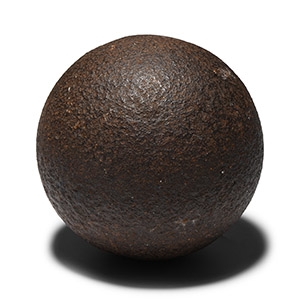
English Civil War Iron Cannon Ball
1642-1651 A.D.Sold for (Inc. bp): £182
Possibly made for a naval long gun, a 'long nine'. 4.3 kg, 98 mm wide
Found in a churchyard in Derbyshire, UK, before 1950. Acquired from the son of the clergyman that found it, in 2004. Property of a Nottinghamshire gentleman. -
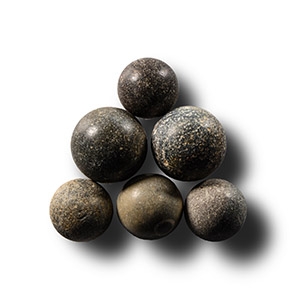
Post Medieval Stone Grapeshot Ammunition Collection
Circa 17th-18th century A.D.Sold for (Inc. bp): £20
Group of spherical grapeshot balls of various sizes. 32 grams total, 14-17 mm
Private collection formed in the 1990s. Acquired from a central London gallery. Property of an Essex gentleman.
