
Loading, please wait...
LOT 1023
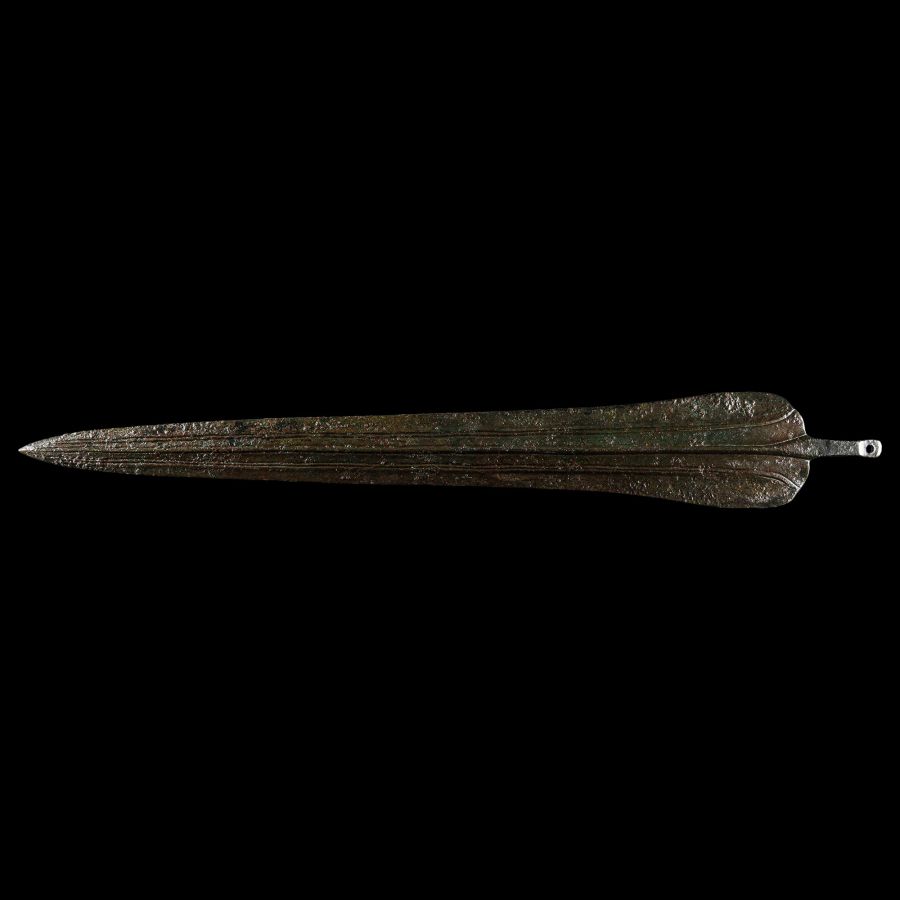
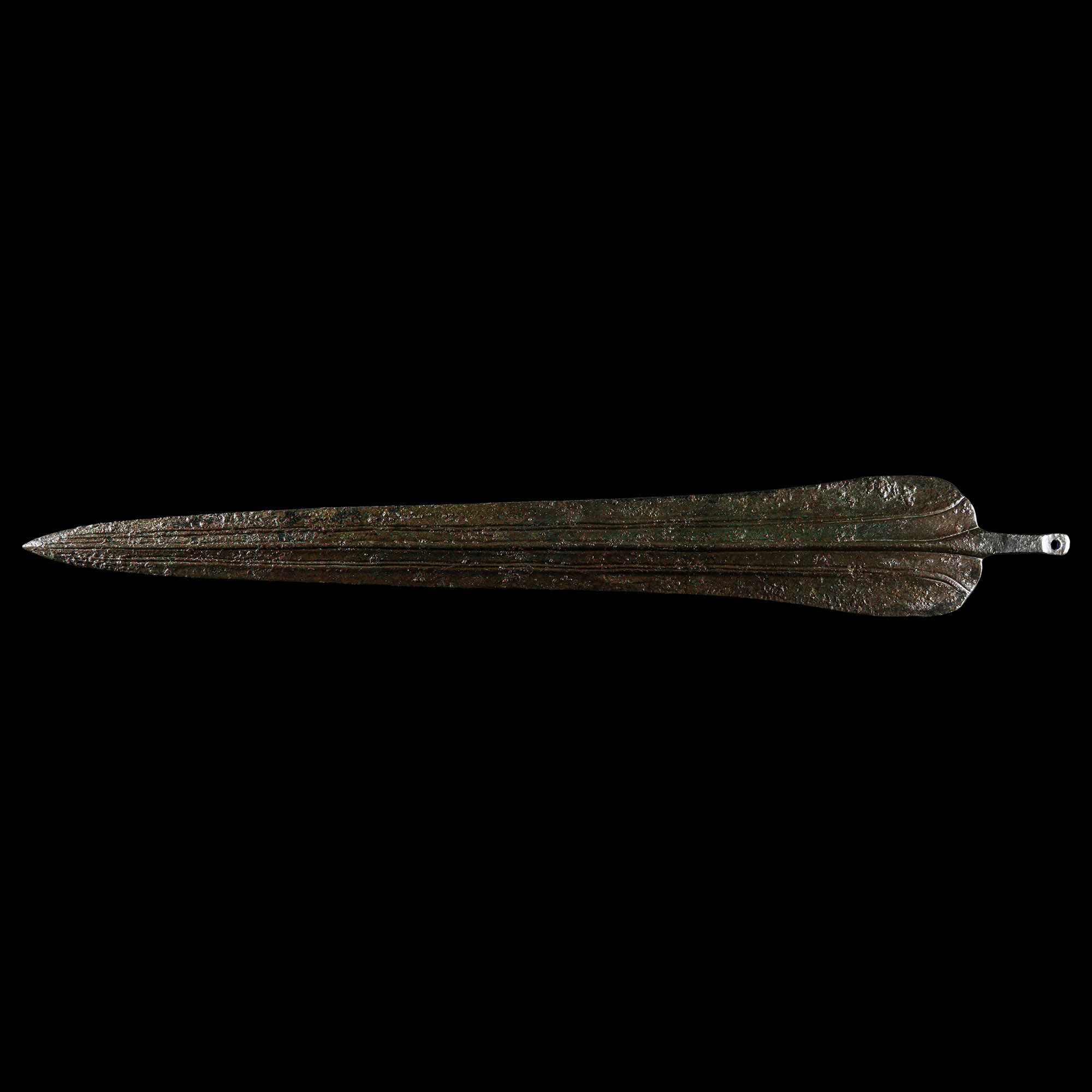
North-West Persian Bronze Short Sword with Blood Channels
2ND-1ST MILLENNIUM B.C.
17 3/8 in. (439 grams, 44.2 cm).
Shaped as a two-edged bronze blade, leaf-shape with short rectangular tang with fastening hole, corrugated midrib extending almost to the tip and flared at the shoulder.
ProvenanceAcquired 1980-2015.
Ex Abelita family collection.
See Christie's, Axel Guttmann collection of Ancient Arms and Armour, Part 1, London, South Kensington, Wednesday 6 November 2002, for similar swords with preserved pommel (lot 24) and without (lot 31).
FootnotesThe metalworking techniques used in making bronze weapons in Luristan were very complex. Surfaces were often finished in repoussé work, and some of the weapons were chased and others engraved. Many of the graves dating from the era of Kassite hegemony contain bronze and iron artefacts, including various type of weapons. These swords with shallow fullers tapering to a sharp tip have been dated by P.R.S. Moorey to the end of the 2nd millennium B.C.
CONDITIONTimeLine Auctions follows a vetting process to ensure the authenticity and legality of all items, reinforcing our commitment to integrity and responsible trading. Each antiquity, antique, and coin lot undergoes thorough examination by a vetting committee of at least ten external specialists, professional trade association members, scientists, and archaeologists: Our Vetting Process
AUCTIONS:
TimeLine is a leading auction house specialising in antiquities, ancient art, collectables, natural history, coins, medals, and books. Our auctions offer museums, collectors, historians, and enthusiasts the opportunity to acquire unique and historically significant pieces.
LOT 1023
North-West Persian Bronze Short Sword with Blood Channels
Estimate £300 - 400€350 - 460 (for guidance only)$410 - 540 (for guidance only)
-
Roman Inscribed Lead Slingshot Group
17 March 45 B.C.Sold for (Inc. bp): £286
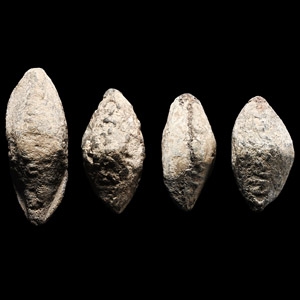
Comprising four scaphoid lead slingshots (glandes), each with traces of low-relief inscription(s) referring to 'CN P[OMPEIUS]'. 216 grams total, 37-50 mm
Ex M.Cummings, UK, 1990s.
These shots (mainly of type IIb of the Völling classification) are marked with the abbreviated name of Cn.Pompeius; they were used in quantity at the Battle of Monda (or Munda) against the Caesarian troops, by the followers of Pompey, on 17th March 45 B.C. Similar missiles were used in the civil war between Pompey and Caesar, and in all Caesar's wars. The projectiles of the slingers could be in lead (glandes) or in pottery or stone (lapides). Sometimes they were signed with the name of the general, or used to report some injuries, for example the sling missile found in Alesia with the name of Labienus. -
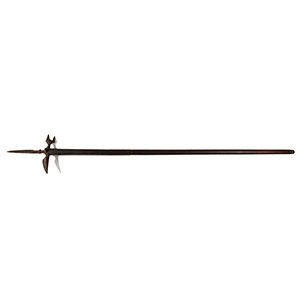
Ceremonial Polearm with Wooden Shaft
Circa 18th century A.D.Sold for (Inc. bp): £442
Iron-headed 'Lucerne hammer' on a short wooden shaft; the hammer-face with three sturdy spikes, square-section spearhead above and curved bec de corbin to the rear with two short lateral spikes, languets extending down the faces of the shaft. 2 kg, 1.8 m
Acquired UK art market, 1980s-1990s. Property of a Suffolk, UK, gentleman collector. -
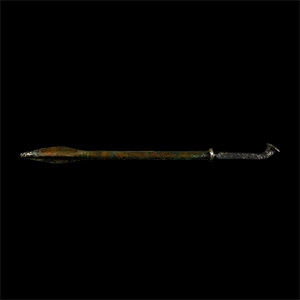
Western Asiatic Bronze Javelin Head
Late 3rd millennium B.C.Estimate: £300 - 400 (+bp*)
Opening Bid: £150
Featuring a tripartite weapon with short, narrow leafy blade, elongated stem decorated by embossed geometric lines and folded tang. 220 grams, 32.3 cm
Acquired 1980-2015. Ex Abelita family collection.
The points within this typology are biconvex or leaf-shaped, not very sharp. These types of spears have been found in the tombs of Palestine from Tell el-'Ajjul (tomb 227) to the sites of the central plains and the banks of Jordan: Yavne, 'Ain Samiya, Jebel Qa'aqir, tombs G 83 and M 13 of Jericho, tombs 2100 and 2111 of Lachish. All are dated to the last two centuries of the 3rd millennium.
