
Loading, please wait...
LOT 1203
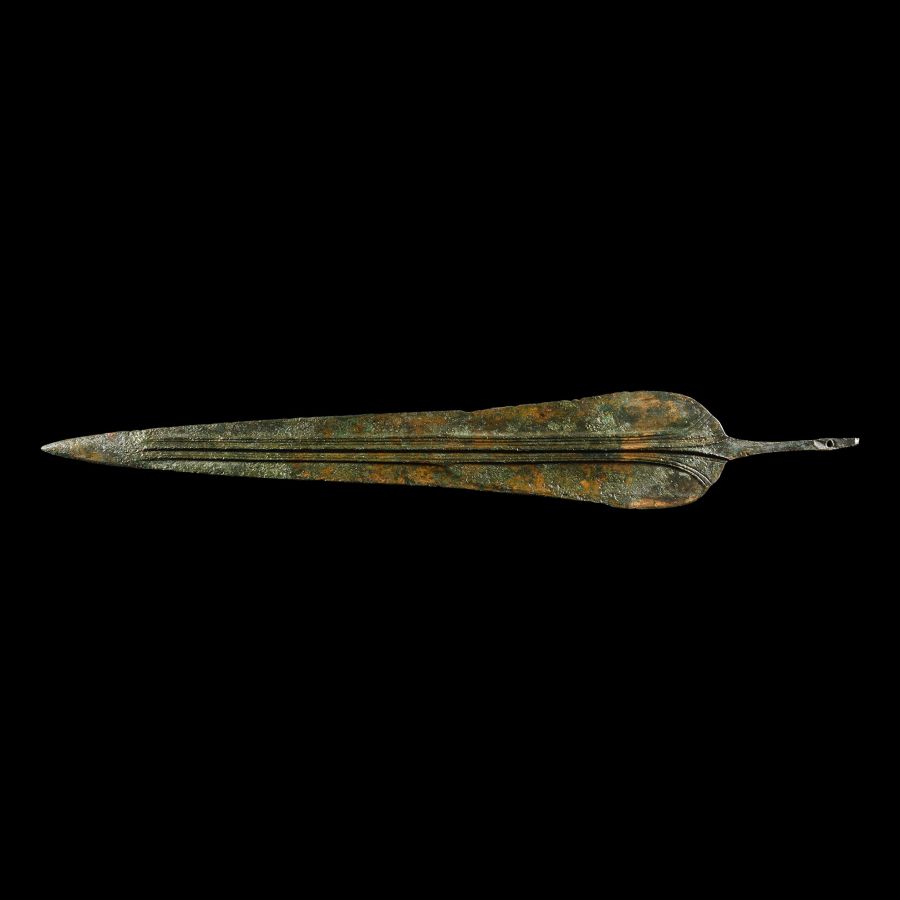
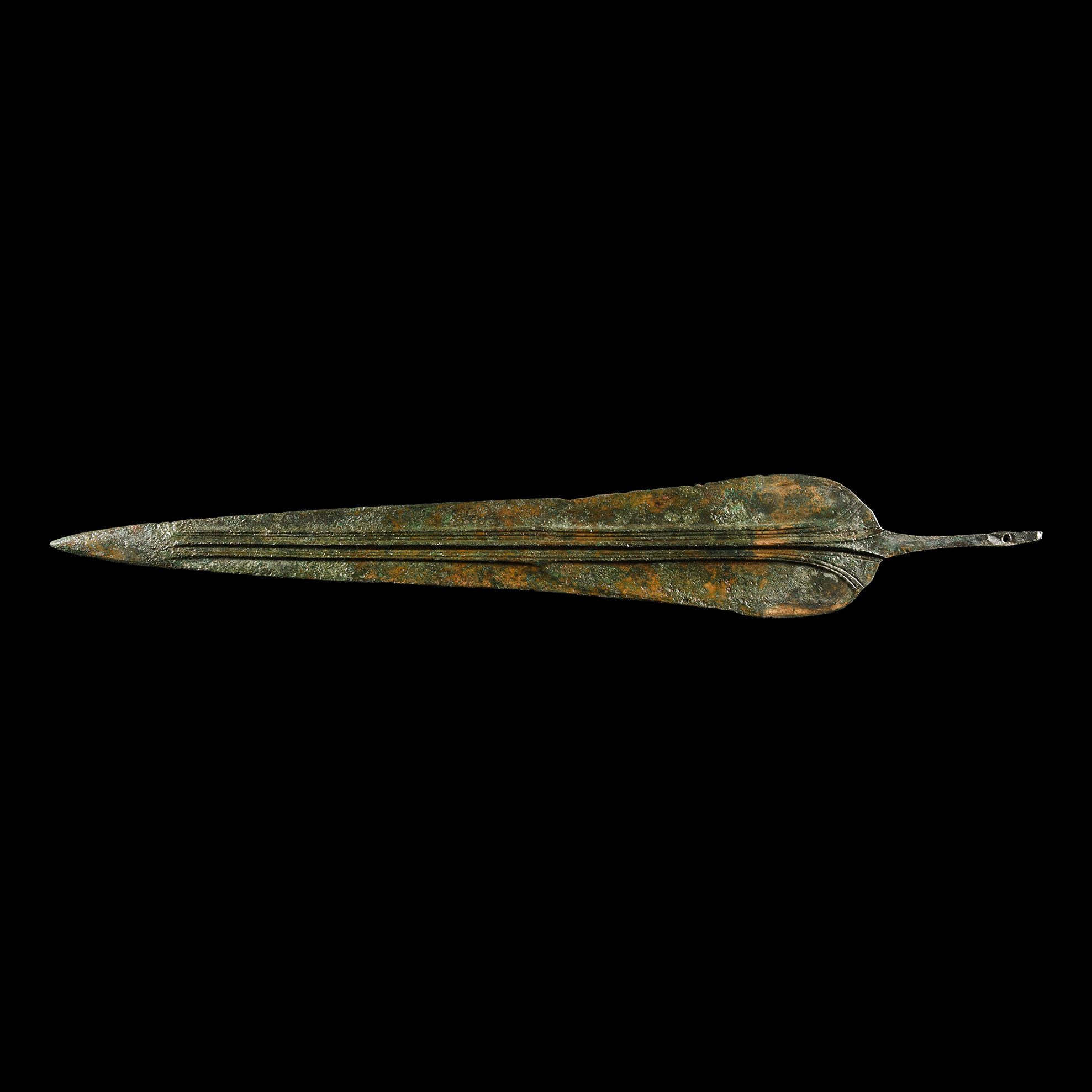
North-West Persian Bronze Short Sword Blade with Blood Channels
LATE 2ND-1ST MILLENNIUM B.C.
18 3/4 in. (347 grams, 47.5 cm).
Leaf-shaped with short rectangular tang, corrugated midrib with five grooves extending almost to the tip and flared at the rounded shoulders.
ProvenanceAcquired 1980-2015.
Ex Abelita family collection.
Cf. Christie's, The Axel Guttmann Collection of Ancient Arms and Armour, part 2, London, 2004, item 36, p.33.
FootnotesThe metalworking techniques used in making bronze weapons in early Iran were very complex. Surfaces were often finished in repoussé work, and some of the weapons were chased, others engraved. The function of the ridges here was not only decorative, but principally to reduce suction and thus allow the blade to be withdrawn speedily. The ruling elites of warrior horsemen were buried in the graves with their weapons and horses.
CONDITIONTimeLine Auctions follows a vetting process to ensure the authenticity and legality of all items, reinforcing our commitment to integrity and responsible trading. Each antiquity, antique, and coin lot undergoes thorough examination by a vetting committee of at least ten external specialists, professional trade association members, scientists, and archaeologists: Our Vetting Process
AUCTIONS:
TimeLine is a leading auction house specialising in antiquities, ancient art, collectables, natural history, coins, medals, and books. Our auctions offer museums, collectors, historians, and enthusiasts the opportunity to acquire unique and historically significant pieces.
LOT 1203
North-West Persian Bronze Short Sword Blade with Blood Channels
Estimate £400 - 600€460 - 700 (for guidance only)$540 - 810 (for guidance only)
-
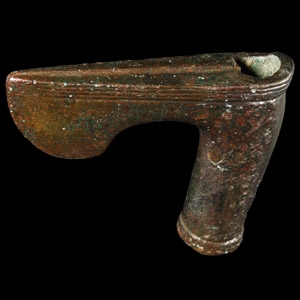
Luristan Bronze Socketted Axe
13th-7th century B.C.Estimate: £180 - 240 (+bp*)
Opening Bid: £90
Composed of a cylindrical socket with channeled lip to upper edge and raised rib to top face, convex cutting edge and raised ridge to butt. 371 grams, 10.2 cm
Acquired 1980-2015. Ex Abelita family collection. -
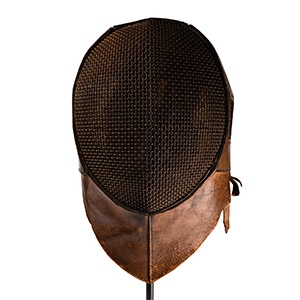
British Leather Fencing Helmet
Circa 1890-1920s A.D.Sold for (Inc. bp): £234
By Lillywhite Frowd Co of London, fitted with neck fringe, stamped buckled securing strap and wire mesh face and ear panels, padded lining internally marked 'broad arrow-over-67' so likely a military issue. 2.0 kg, 39 cm
Acquired from Manfred Schotten Antiques, 2016. The Kusmirek Collection, UK. Accompanied by a copy of Manfred Schotten invoice and listing.
Although masks/helmets of this general form are typically associated with sword fencing, this example is of very heavy construction so possibly for use in protecting while training with a heavier weapon than a foil or epee. -
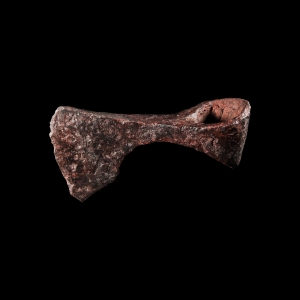
'The Repton' British Viking Iron Bearded Axehead
9th-11th century A.D.Sold for (Inc. bp): £1,061
Hand-forged with triangular-section narrow blade widening to a broad bevelled edge with square chin, socket with rounded extensions to the rear. 464 grams, 15 cm
Found Repton, Nottingham, UK, in the 1960s. Gary Edwards, York, UK. Private collection, Preston, UK. Accompanied by a certificate of authenticity and receipt from Gary Edwards, no.12386.
The bearded axehead were called skeggöks, in Norse language, and had a long edge designated to work split tree-trunks into planks and beams.
