
Loading, please wait...
LOT 0258
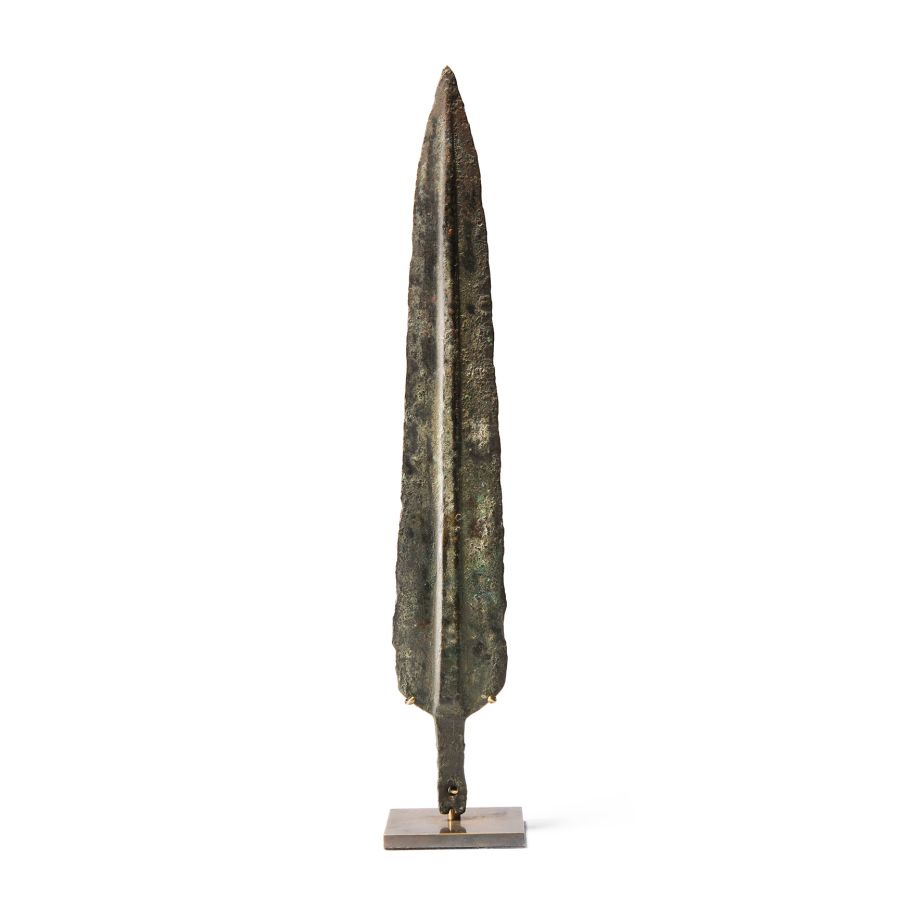
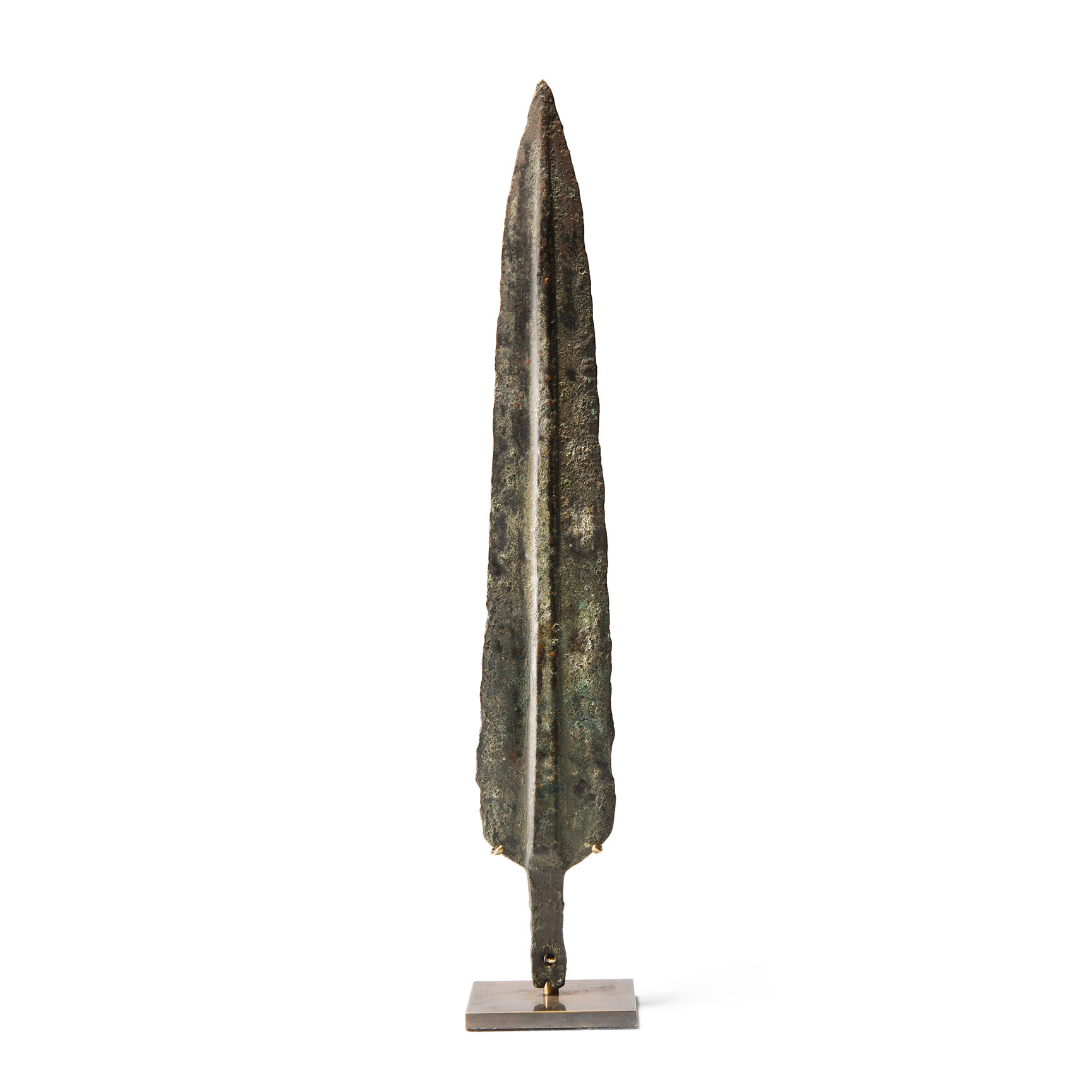
North-West Persian Bronze Dagger
EARLY 1ST MILLENNIUM B.C.
11 1/2 in. (298 grams total, 29.2 cm high including stand).
With long tapered blade, rounded shoulders and broad flattened mid-rib, tapered square sectioned tang pierced at the tip.
ProvenanceDr. T.J. Arne, Sweden, 1934.
Private collection, Sweden, late 1930s.
with Stockholm Auktionsverk, Stockholm, Sweden, 9 June 2014, lot 2613.
Cf. Christie's, The Axel Guttmann Collection of Ancient Arms and Armour, part 1, London, 2002, p.34, no.31.
FootnotesThis tanged bronze blade from Luristan belongs to a category of Luristan swords still in use in the Achaemenid Period, as proved from a blade with a perished handle (probably bone or wood) of the same type, in the National Museum of Iran (2694/15633). Examples without inscriptions like our model have been classified by Grotkamp-Schepers in the Solingen Museum as pieces from Luristan.
CONDITIONTimeLine Auctions follows a vetting process to ensure the authenticity and legality of all items, reinforcing our commitment to integrity and responsible trading. Each antiquity, antique, and coin lot undergoes thorough examination by a vetting committee of at least ten external specialists, professional trade association members, scientists, and archaeologists: Our Vetting Process
AUCTIONS:
TimeLine is a leading auction house specialising in antiquities, ancient art, collectables, natural history, coins, medals, and books. Our auctions offer museums, collectors, historians, and enthusiasts the opportunity to acquire unique and historically significant pieces.
-
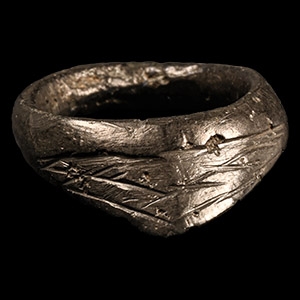
Medieval Child's Bronze Archer's Ring
14th-16th century A.D.Sold for (Inc. bp): £85
Displaying incised dashed lines to the bezel. 3.19 grams, 23.87 mm overall, 14.01 mm internal diameter (approximate size British F 1/2, USA 3, Europe 4.3, Japan 4)
Private collection formed since the 1940s. UK art market. Property of an Essex gentleman. -
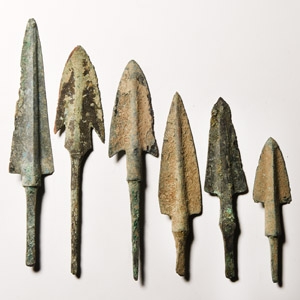
Luristan Bronze Arrowhead Group
12th-10th century B.C.Estimate: £100 - 140 (+bp*)
Opening Bid: £50
Comprising six tanged arrowheads, all with large elongated triangular blades and raised midrib, sharp central groove, cylindrical stem with handle for the shaft; three with barbed shoulders and convex or squared sides, two lanceolate with slightly rounded shoulders, one elongated triangular type. 105 grams total, 6.9-11.7 cm
Acquired 1980-2015. Ex Abelita family collection.
These arrowheads seem to belong to the type V, subcategory types A, B, C and D according to the classification of Khorasani and Negahban. In the four categories of triangular bronze arrowheads from Luristan, Marlik and Northern Iran individuated by Negahban, subtypes C and D of type V are larger arrow or javelin heads, C with barbed shoulders and D with round shoulders. -
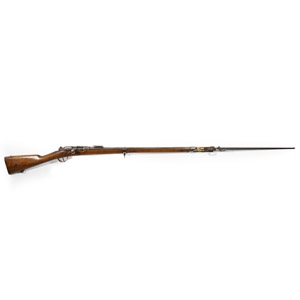
1866/74 Model Gras Rifle and Bayonet
Dated 1868 A.D.Estimate: £500 - 700 (+bp*)
Opening Bid: £250
Round rifled 90cm (35½") barrel of 11mm calibre with folding rear sight (without slide), bolt action with serial no.52431 to breech; fitted with full wood stock with steel butt cap, trigger guard, sling swivels and fore-end, steel cleaning rod; with correct Gras bayonet inscribed 'M[--] d'Armes de St Etienne 8bre 1878' to back and steel scabbard. 4.8 kg, 1.84 m
Acquired from Czerny's Auctions, Italy, 2019. The Kusmirek Collection, UK. Accompanied by a copy of Czerny's invoice and listing.
Sold as an exempt item under Section 58 (2) of the Firearms Act, 1968, to be held as a curiosity or ornament. No license required but buyer must be over 18 years of age. Overseas bidders should note that, due to UK regulations governing export of all firearms, overseas buyers will need to make arrangements for shipping this lot out of the UK directly, by air freight, with a specialist company or agent.
