
Loading, please wait...
LOT 1149
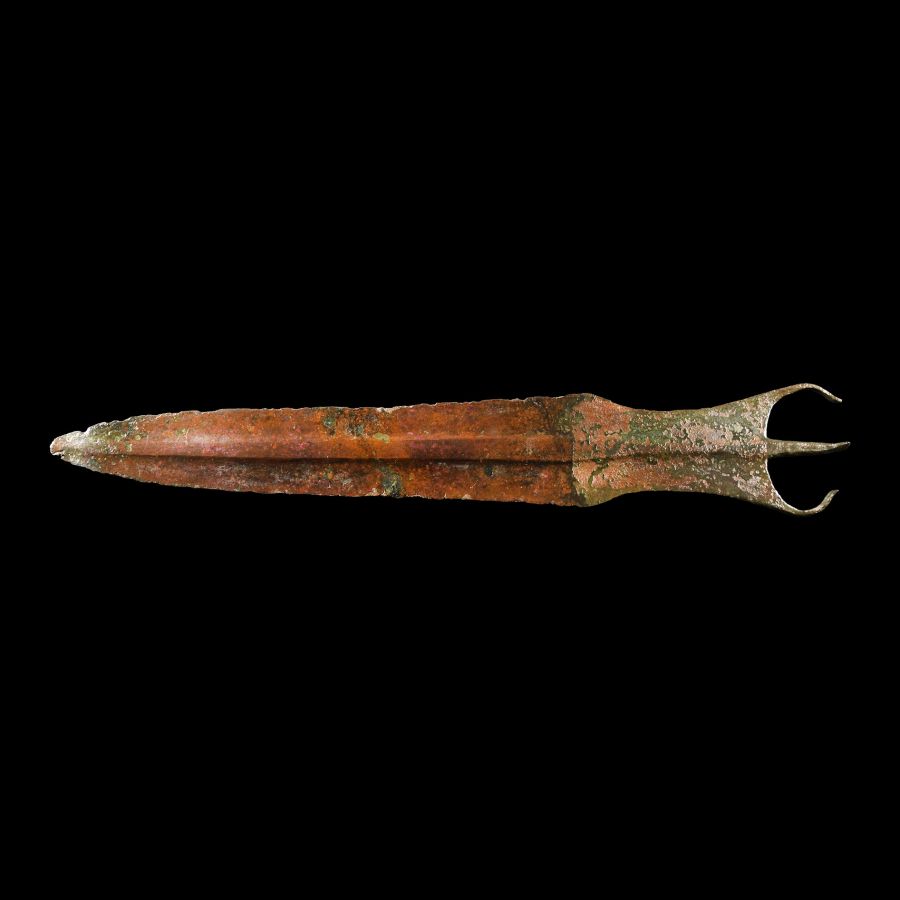
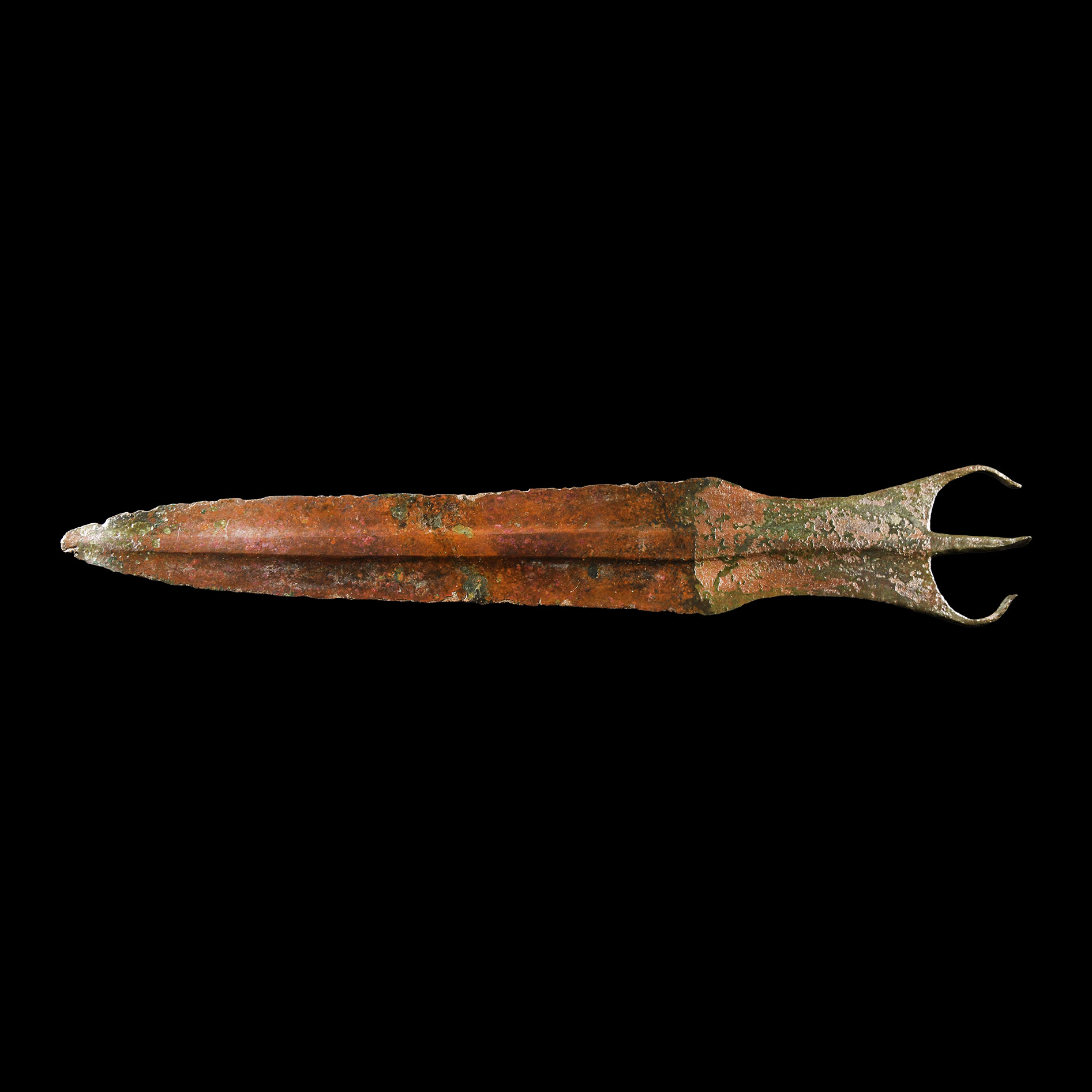
North-West Persian Bronze Dagger with Horns
CIRCA 1ST MILLENNIUM B.C.
16 3/8 in. (249 grams, 41.5 cm).
With curved 'horns' projecting on either side at top of waisted grip, blade with flat mid-rib.
ProvenanceAcquired 1980-2015.
Ex Abelita family collection.
Cf. Christie's, The Axel Guttmann Collection of Ancient Arms and Armour, part 2, London, 2002, p.36, no.40.
FootnotesThe Luristani people produced a quantity of fine metalwork, which according to Dr Khorasani, could be due to a settled period which arose as a result of the defeat of the Elamites by the Babylonians, leaving the Luristani people in relative peace for a period of time after 1200 B.C. According to Khorasani 'A culture of innovation and experimentation flourished, and the repertoire of the Luristan smiths expanded in the period between 1150-1050 BC.'
CONDITIONTimeLine Auctions follows a vetting process to ensure the authenticity and legality of all items, reinforcing our commitment to integrity and responsible trading. Each antiquity, antique, and coin lot undergoes thorough examination by a vetting committee of at least ten external specialists, professional trade association members, scientists, and archaeologists: Our Vetting Process
AUCTIONS:
TimeLine is a leading auction house specialising in antiquities, ancient art, collectables, natural history, coins, medals, and books. Our auctions offer museums, collectors, historians, and enthusiasts the opportunity to acquire unique and historically significant pieces.
LOT 1149
North-West Persian Bronze Dagger with Horns
Estimate £300 - 400€350 - 460 (for guidance only)$410 - 540 (for guidance only)
-
Viking Age Iron Sword with Cocked Hat Type Pommel
10th century A.D.Sold for (Inc. bp): £5,720
Petersen Type L variant with double-edged pattern-welded blade (waving pattern) showing evidence of being employed, tapering fullers and hefty tang; boat-shaped lower guard, cocked hat pommel with traces of silver inlay; some restoration. 996 grams, 90 cm
From the private collection of a London gentleman, from his grandfather's collection formed before the early 1970s. Accompanied by an academic report by Dr Raffaele D’Amato. This lot has been checked against the Interpol Database of stolen works of art and is accompanied by search certificate number no.11816-206858.
This sword shows evidence of beautiful pattern-welding. The great curvature of the hilt, stronger than any other type of Viking swords, characterises the typology of L swords. This is clearly visible on the specimens from Dolven and Nedre (Stokke) published by Petersen (1919, figs.94-95). -
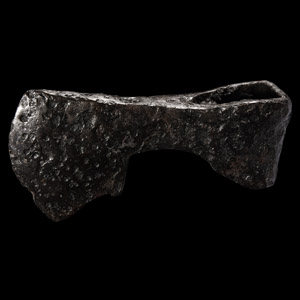
Viking Iron Bearded Axehead
10th-12th century A.D.Sold for (Inc. bp): £208
Featuring a sub-triangular socket, rectangular butt and bearded head with convex cutting edge. 563 grams, 14.6 cm
From the private collection of a London gentleman, from his grandfather's collection formed before the early 1970s. -
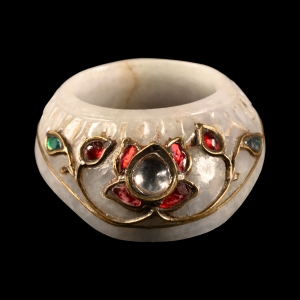
Mughal Jade Archer's Ring with Diamond, Rubies and Emeralds
18th-19th century A.D.Sold for (Inc. bp): £390
Carved in mottled pale grey jade with radiating lotus leaves around the central hole, applied gold wire hoop and tendril detailing with two emeralds and six cabochon rubies inset, the central flower with inset teardrop facetted diamond; with a thin crack to the back of the hoop. 15.5 grams, 44.55 mm overall, 21.86 mm internal diameter (approximate size British Z, USA 12 1/2, Europe 28.77, Japan 27).
Formerly in the family collection of a Hampstead gentleman, from the 1980s. Acquired in TimeLine Auctions sale 119, lot 2518. Property of a Kent collector.
