
Loading, please wait...
_900x900.jpg "Nishapur Blue-Glazed Dish Collection")
_200x200.jpg "Nishapur Blue-Glazed Dish Collection")
.jpg "Nishapur Blue-Glazed Dish Collection")
LOT 0216
Nishapur Blue-Glazed Dish Collection
12TH-13TH CENTURY A.D.
5 3/4 - 6 1/8 in. (599 grams total, 14.5-15.5 cm wide).
A trio of wheel-thrown dishes, each with a shallow foot: a turquoise-glazed example with helical motif around the rim, roundels and central interlace motif to the bowl; a second turquoise-glazed bowl decorated with dark amorphous patches to the rim and an interlace-style motif to the bowl; a dark blue-glazed bowl with black strips to rim, three nodules to bowl, concentric roundels framing an interlace design; iridescent surfaces. [3]
ProvenancePrivate California collection, USA.
With Artemis Gallery, Colorado, USA.
Private collection of Professor Kenneth Graham, London, UK.
Accompanied by a certificate of authenticity from Artemis Gallery.
TimeLine Auctions follows a vetting process to ensure the authenticity and legality of all items, reinforcing our commitment to integrity and responsible trading. Each antiquity, antique, and coin lot undergoes thorough examination by a vetting committee of at least ten external specialists, professional trade association members, scientists, and archaeologists: Our Vetting Process
AUCTIONS:
TimeLine is a leading auction house specialising in antiquities, ancient art, collectables, natural history, coins, medals, and books. Our auctions offer museums, collectors, historians, and enthusiasts the opportunity to acquire unique and historically significant pieces.
LOT 0216
Nishapur Blue-Glazed Dish Collection
Estimate £500 - 700€580 - 810 (for guidance only)$680 - 950 (for guidance only)
-
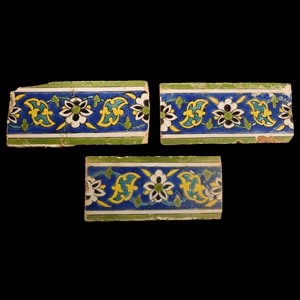
Western Asiatic Glazed Tile Collection
16th-17th century A.D.Sold for (Inc. bp): £208
A group of three glazed ceramic tiles each with green border enclosing white bands and median deep-blued band with tendrils, flowers and leaves in white, yellow, black and turquoise; Iranian workmanship. 2.4 kg total, 24-25 cm
Ex Hagop Kevorkian, 1979. Important North West London collection. -
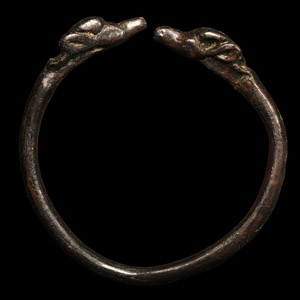
Luristan Zoomorphic Bracelet
Circa 8th-6th century B.C.Sold for (Inc. bp): £78
A copper-alloy bracelet composed of a round-section hoop and horned animal head terminals. 40 grams, 69 mm
with a London, UK gallery 1971-early 2000s. -
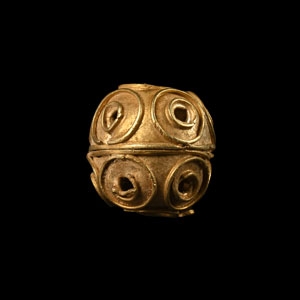
Western Asiatic Gold Filigree Bead
11th-12th century A.D.Sold for (Inc. bp): £72
An ovoid gold bead with filigree gold wire to the equator, five piercings to each hemisphere, each enclosed by concentric gold wire circlets, repeated at both terminals; hollow-formed. 0.82 grams, 10 mm
Acquired 1969-1999. London collection of the late Mr S.M., thence by descent.
