Loading, please wait...

Neoclassical Citrine Gemstone with Putto and Goose Neoclassical Citrine Gemstone with Putto and Goose Neoclassical Citrine Gemstone with Putto and Goose
Use mousewheel to zoom in and out, click to enlarge
Details

LOT 0389

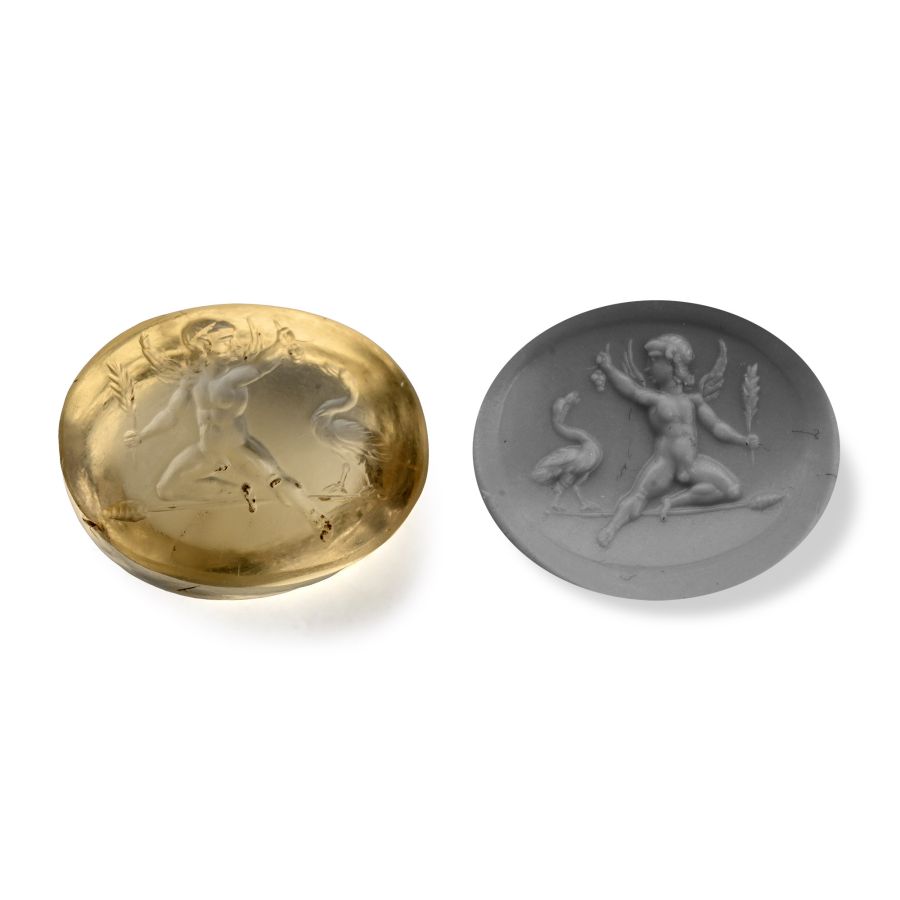
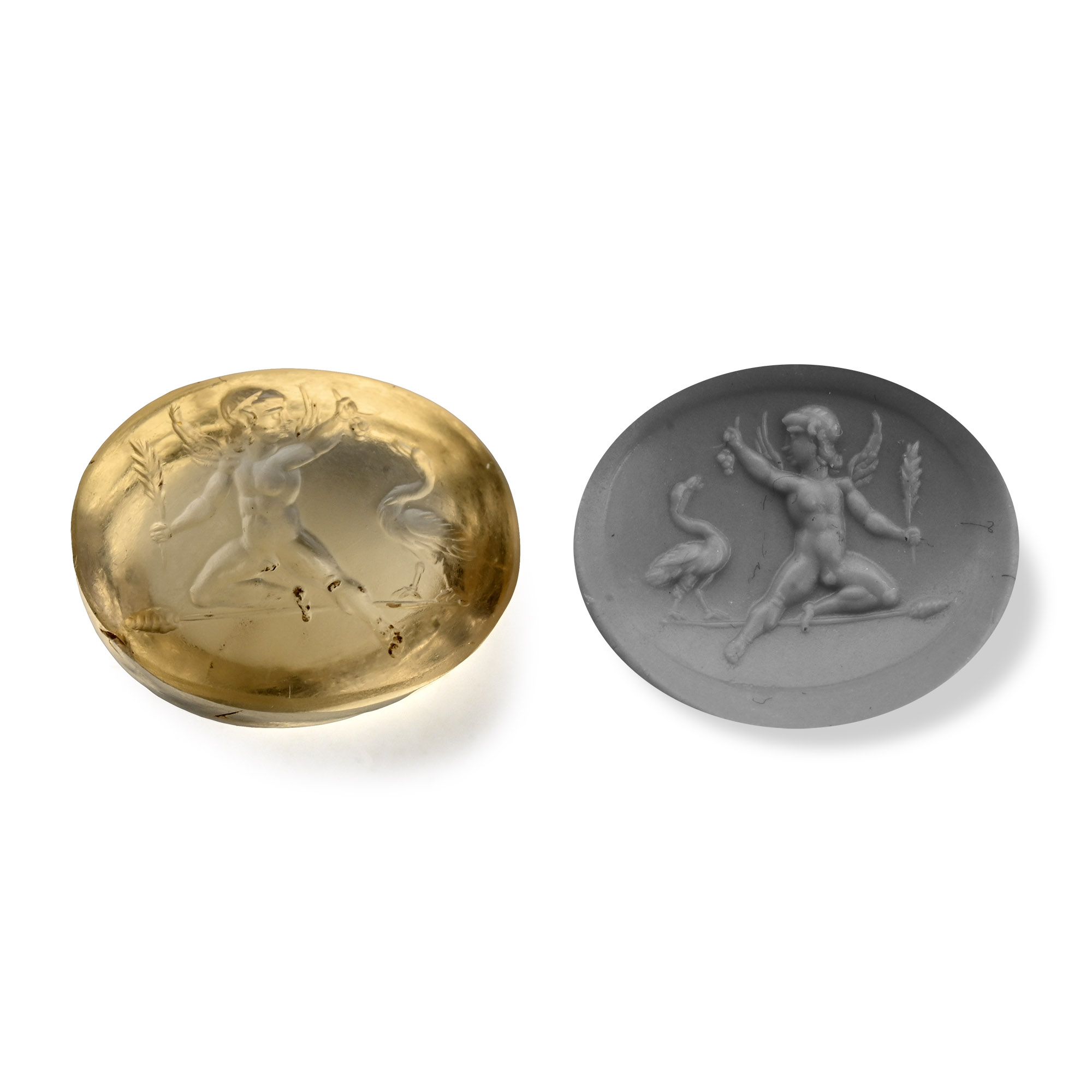
Neoclassical Citrine Gemstone with Putto and Goose

18TH-19TH CENTURY A.D.

1/2 in. (1.32 grams, 12 mm).

Plano-convex type with incuse scene of a putto kneeling on an arrow with one leg extended over it, holding the flight-feather of a bird in one hand and encouraging a goose to feed from the other hand; with traces of copper tooling; supplied with a museum-quality impression.

Provenance

Private English collection, formed between the late 1970s and early 1990s.
Private collection, London, UK.

Footnotes

Perhaps the putto is encouraging the goose to approach him so that he can pluck its flight-feathers for use on the shafts of his arrows.

CONDITION
VETTING:

TimeLine Auctions follows a vetting process to ensure the authenticity and legality of all items, reinforcing our commitment to integrity and responsible trading. Each antiquity, antique, and coin lot undergoes thorough examination by a vetting committee of at least ten external specialists, professional trade association members, scientists, and archaeologists: Our Vetting Process


AUCTIONS:

TimeLine is a leading auction house specialising in antiquities, ancient art, collectables, natural history, coins, medals, and books. Our auctions offer museums, collectors, historians, and enthusiasts the opportunity to acquire unique and historically significant pieces.

LOT 0389

Neoclassical Citrine Gemstone with Putto and Goose

Sold for (Inc. bp): £1,430

Print page

RELATED LOTS
  • Bronze Grand Tour Statue of The Dying Gaul from the Capitoline Museum
    Bronze Grand Tour Statue of 'The Dying Gaul' from the Capitoline Museum
    Italy, circa 1880 A.D.

    Sold for (Inc. bp): £1,040

    Copy of a Greek sculpture (now lost) from the Hellenistic period (323-31 BC) thought to have been made in bronze; a young Galatian warrior, wounded in the chest by a sword blow and dying, half-lying with his face turned downwards; with typical features of the idealised Celtic warrior: the high cheekbones, the hairstyle with thick and long locks, and the moustache (mytax); resting on a discarded shield with short sword under his right hand, straps and two tubular war-horns. 4 kg, 32 cm


    From the private collection of a S.W. London gentleman, acquired in the 1970s.

    The Dying Gaul statue was rediscovered in Rome in the early 17th century, specifically in the 1620s, during excavations for the Villa Ludovisi. It was initially part of the Ludovisi collection and later acquired by Pope Clement XII for the Capitoline Museums. Except for a torque around the neck (a metal necklace typical of Celtic warriors), the figure is completely naked. It is possible to identify the figure tentatively as the ‘Trumpeter of Epigonos’ mentioned by Pliny (Natural History 34.88).

    Lot Details

  • Tudor Period Lead Horn Book Teaching Aid
    Tudor Period Lead 'Horn Book' Teaching Aid
    1600-1633 A.D.

    Sold for (Inc. bp): £3,510

    A rare complete and undamaged rectangular plaque bearing raised, moulded text on the obverse; with hatched three horizontal bars and two pelletted between five registers, framing the letters of the alphabet '+ABCDE / FGHIKL / MN[reversed]OPq / RSTVW / +Y[Z]'; tree with berries on a hatched field to the reverse. 26.8 grams, 53 mm


    Found whilst searching with a metal detector near Kniveton, Derbyshire Dales, UK. Accompanied by a copy of the British Museum's Portable Antiquities Scheme (PAS) report no.WMID-341C6A.

    The letter 'U' has been omitted from the alphabet, as is common with such objects, as has the letter 'J', suggesting that the book was produced prior to the publication of Charles Butler's English Grammar (1633), which first distinguished between I and J. The letter Z is reversed. Hornbooks were employed as learning aids and commonly made from paper mounted onto wood, together with a transparent sheet of horn. Smaller, more portable lead-alloy examples such as this one are generally believed to have been mass-produced, whilst still falling within the genre of 'hornbooks'.

    Lot Details

  • Chinese Enamelled Bronze Ewer for the Indian Market
    Chinese Enamelled Bronze Ewer for the Indian Market
    Late 19th century A.D.

    Estimate: £400 - 600 (+bp*)

    Opening Bid: £200

    Piriform in profile with detachable lid, curved strap andle and spout, hexagonal base; white enamelled surface with painted tendrils and flowers. 1.5 kg, 31 cm


    Private collection, UK.

    Lot Details

Stay up-to-date with the latest from TimeLine Auctions by joining our mailing list