Loading, please wait...

Use mousewheel to zoom in and out, click to enlarge

Details

LOT 2048

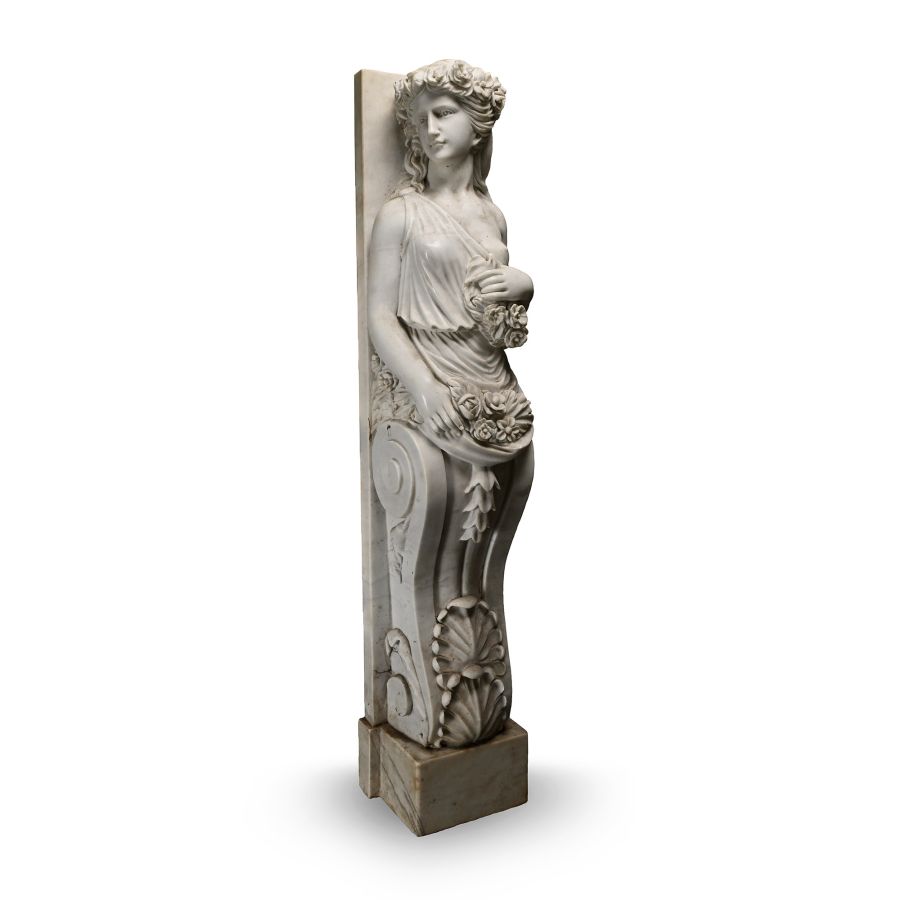
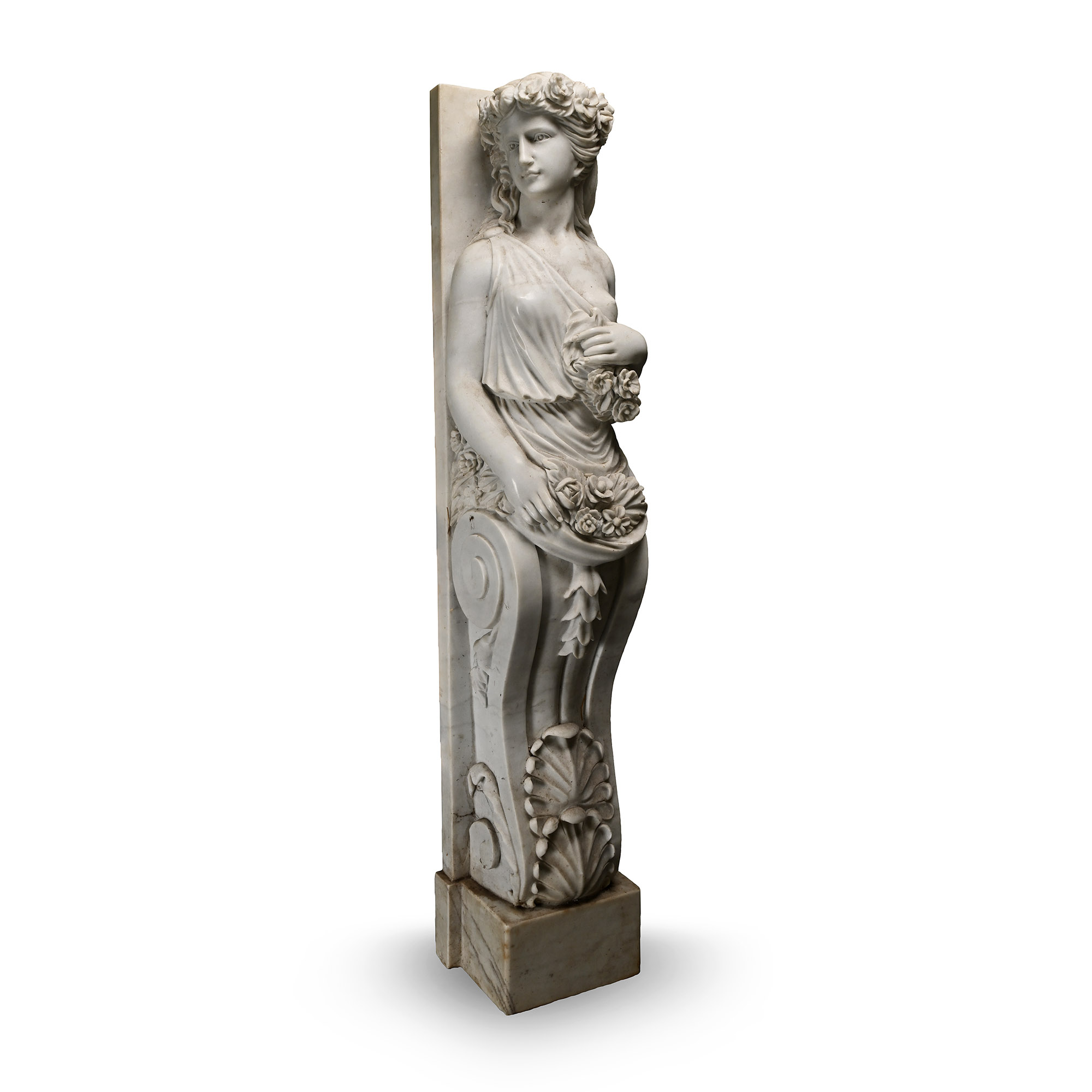
Neo-Classical Marble Column

20TH CENTURY A.D.

47 1/2 in. (118 kg, 120.5 cm).

Carved in high-relief female figure with floral wreath to the brow, peplos robe draped from one shoulder, holding posies in each of her hands; lower body developing to a swept panel with lateral scroll detailing, palmettes to the obverse, rectangular block to the foot; after the antique.

Provenance

From a London, UK, gallery, 1990s.
This lot is accompanied by an illustrated lot declaration signed by the Head of the Antiquities Department, Dr Raffaele D'Amato.

CONDITION

VETTING:

TimeLine Auctions follows a vetting process to ensure the authenticity and legality of all items, reinforcing our commitment to integrity and responsible trading. Each antiquity, antique, and coin lot undergoes thorough examination by a vetting committee of at least ten external specialists, professional trade association members, scientists, and archaeologists: Our Vetting Process


AUCTIONS:

TimeLine is a leading auction house specialising in antiquities, ancient art, collectables, natural history, coins, medals, and books. Our auctions offer museums, collectors, historians, and enthusiasts the opportunity to acquire unique and historically significant pieces.

LOT 2048

Neo-Classical Marble Column

Sold for (Inc. bp): £260

Print page

RELATED LOTS

  • Georgian Pewter Plate with Monogram and Makers Marks
    Georgian Pewter Plate with Monogram and Maker's Marks
    London, 18th century A.D.

    Sold for (Inc. bp): £13

    A shallow plate with wide everted rim and engraved stylised monogram; three maker's marks to the underside: 'Thomas' with dove holding an olive branch between two towers, crowned X with Tudor rose, T Caster R London with standing figure in a structure. 568 grams, 25 cm wide


    From the private family collection of Ersula Barter-Hemmerich, the longest serving member of staff working at the United Nations, her private collection formed in the 1950s and 1960s; thence by descent to her grandson. This lot is accompanied by an illustrated lot declaration signed by the Head of the Antiquities Department, Dr Raffaele D'Amato.

    Lot Details

  • Bronze Grand Tour Spelter Bartolomeo Colleoni Statue
    Bronze Grand Tour Spelter Bartolomeo Colleoni Statue
    Italy, circa 1900 A.D.

    Sold for (Inc. bp): £338

    Miniature statue based on Venetian Renaissance Captain General Bartolomeo Colleoni by Andrea del Verocchio; the figure in upright pose, seated astride his advancing horse; wearing a sallet and full harness with baton of command in his right hand, straight legs and feet thrust into the stirrups; the horse with minimal caparison and plume to the bridle, reins cast separately and attached with fine wire; mounted on a hollow-formed rectangular base. 2.44 kg, 26 cm


    From the private collection of a S.W. London gentleman, acquired in the 1970s. This lot is accompanied by an illustrated lot declaration signed by the Head of the Antiquities Department, Dr Raffaele D'Amato.

    The celebrated equestrian monument to the warlord Bartolomeo Colleoni is a bronze statue at a height of 395 cm, without the base, by Andrea del Verrocchio, made between 1480 and 1488 and located in Venice in the Campo San Zanipolo. It is only the third known equestrian statue of the Renaissance, after the monument to Gattamelata by Donatello in Padua, from 1446-1453 and the statue of Nicolò III d'Este by Leon Battista Alberti (1451). In 1479, the Republic of Venice decreed the construction of an equestrian monument for the leader Bartolomeo Colleoni, who died in 1475, to be placed in Campo Santi Giovanni e Paolo. In 1480, it entrusted the task to Andrea Verrocchio, who began the work in his workshop in Florence. In 1481, the wax model was sent to Venice, where the lost-wax casting of the bronze took place. Andrea died in 1488 with the work unfinished and in his will he had named the Florentine Lorenzo di Credi as heir and executor of the unfinished work, but the Venetian Signoria preferred Alessandro Leopardi, a local artist. The reassignment was justified due to the fact that Lorenzo was essentially a painter: it was customary in a multipurpose workshop like Verrocchio's for students to acquire practice in different artistic techniques. Although Venice officially prohibited personal commemorative monuments, an exception was made for Bartolomeo Colleoni, who left a sum of money to the Republic on condition that a monument should be erected to his memory.

    Lot Details

  • Caravaca de la Cruz Bronze Cross Pendant
    Caravaca de la Cruz Bronze Cross Pendant
    17th-18th century A.D.

    Estimate: £200 - 300 (+bp*)

    Opening Bid: £75

    Bifacial double cross with two angels at the base carrying the cross, applied figures of Corpus Christi and Virgin Mary to one side with an inscription 'CAR VACA'; separately made reverse panel with openwork panels and foliate decoration; made as a reliquary. 101 grams, 13.7 cm


    Acquired on the UK art market, early 2000s. This lot is accompanied by an illustrated lot declaration signed by the Head of the Antiquities Department, Dr Raffaele D'Amato.

    The Caravaca Cross, also known as the Cross of Caravaca, originated in the Spanish town of Caravaca de la Cruz and according to tradition, first appeared in the 13th century during the Christian reconquest of Spain. According to a legend, during the rule of the Muslim king Abu Zeid in 1231, a miraculous event occurred. A Christian priest lacking a cross celebrated Mass and was not able to continue as the cross is an essential element for the Eucharist. Miraculously, two angels bearing the Caravaca Cross appeared thus enabling the Mass to proceed. This event is considered the foundational miracle of the Caravaca Cross.

    Lot Details

Stay up-to-date with the latest from TimeLine Auctions by joining our mailing list