
Loading, please wait...


LOT 1265
Neo-Assyrian Rock Crystal Cylinder Seal
CIRCA 700-600 B.C.
3/4 in. (3.17 grams, 20 mm).
Translucent seal with stylised winged figures; supplied with a museum-quality impression. [No Reserve]
ProvenanceFrom the private collection of a European gentleman (1942-2024), formed since the 1970s.
Accompanied by a previous typed catalogue slip with collection no.75.
See a cylinder in similar material and style in Niederreiter, Z., Catalogue of the cylinder seals in the Royal Museums of Art and History, I, Neo-Assyrian and Neo-Babylonian Periods (circa 1000-500 B.C.), Budapest, 2020, no.28.
CONDITIONTimeLine Auctions follows a vetting process to ensure the authenticity and legality of all items, reinforcing our commitment to integrity and responsible trading. Each antiquity, antique, and coin lot undergoes thorough examination by a vetting committee of at least ten external specialists, professional trade association members, scientists, and archaeologists: Our Vetting Process
AUCTIONS:
TimeLine is a leading auction house specialising in antiquities, ancient art, collectables, natural history, coins, medals, and books. Our auctions offer museums, collectors, historians, and enthusiasts the opportunity to acquire unique and historically significant pieces.
-
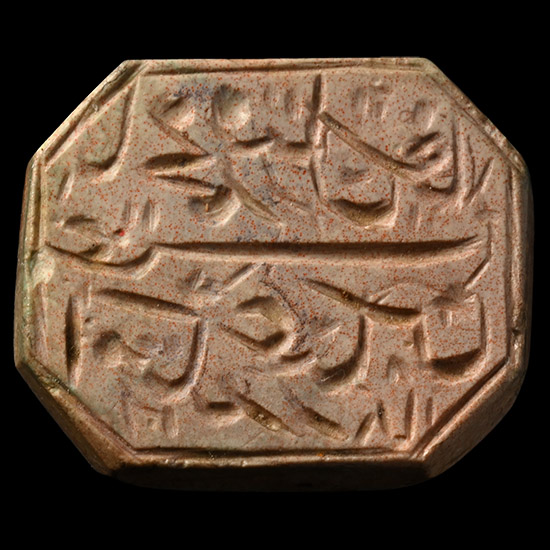
Western Asiatic Agate Bifacial Named Calligraphic Gemstone
Circa 15th century A.D.Sold for (Inc. bp): £598
Octagonal tabular bifacial panel with incised borders; dense nastaliq script to each face; with old collector's note with transliteration and translation 'Constant hearing with the blessing of the name Muhammed / Sakander Abbas'. 1.63 grams, 17 mm
From the private collection of a European gentleman (1942-2024), formed since the 1970s.
The Nastaʿlīq was one of the most important and widespread calligraphic styles used to write Persian. It was developed in Iran in the 8th and 9th centuries. It was also occasionally used to write the original Arabic language, known as taʿliq, for the titles and headings of books or printed publications, but its use was predominant in Persian, Ottoman Turkish, Urdu, and other languages of Perso-Indian influence. Nastaʿlīq is still widespread in Iran, Pakistan, and Afghanistan for written poetry and as a form of artistic expression (arabesque). -
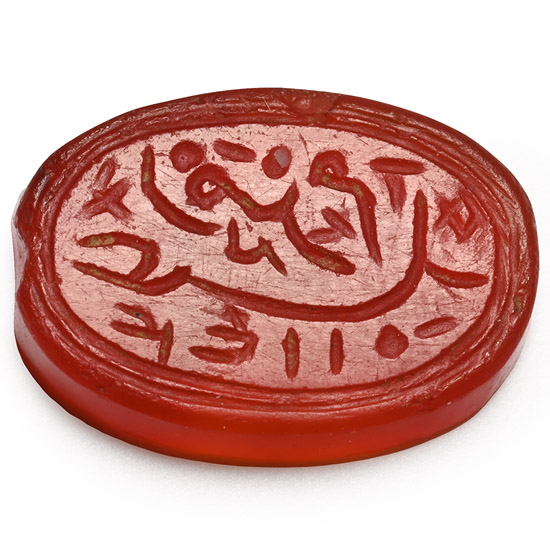
Western Asiatic Engraved Carnelian Calligraphic Intaglio
Late 19th-20th century A.D.Sold for (Inc. bp): £33
An oval intaglio with a calligraphic inscription. 1.27 grams, 16 mm
Acquired in the late 1980s-early 1990s. Private collection, London. -
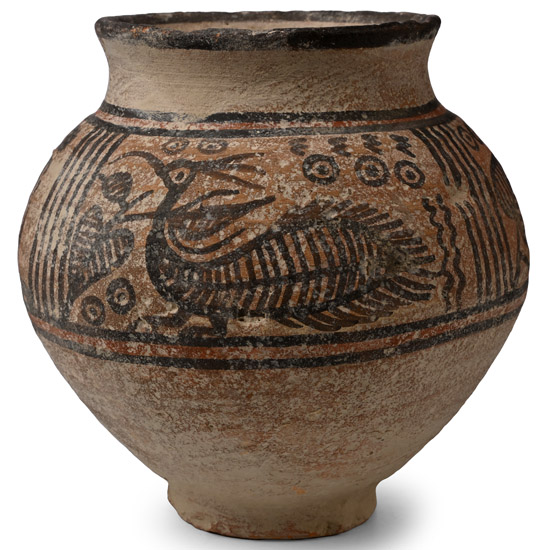
Western Asiatic Terracotta Vessel with Zebu and Peepal Leaves
1st millennium B.C.Sold for (Inc. bp): £416
Bulbous body with a narrow foot and short tubular neck, polychrome band with a peacock, peepal leaves, and a standing zebu. 505 grams, 13.9 cm
Ex Abelita collection, 1990s.
