
Loading, please wait...

LOT 2788
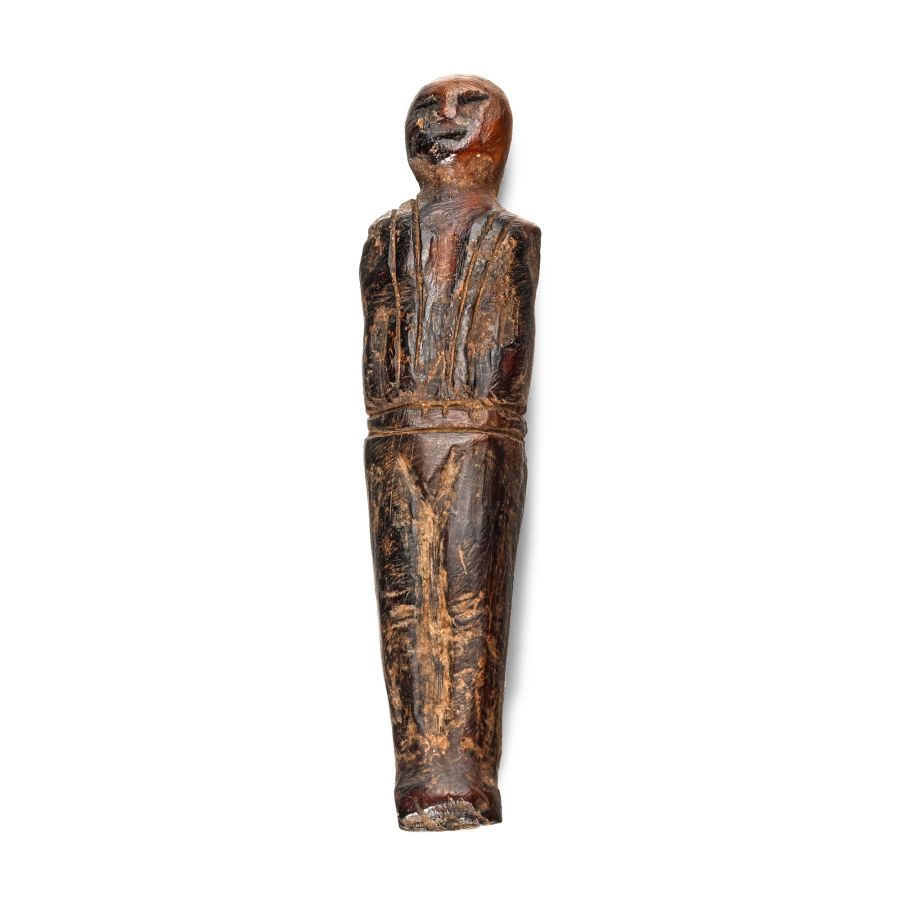
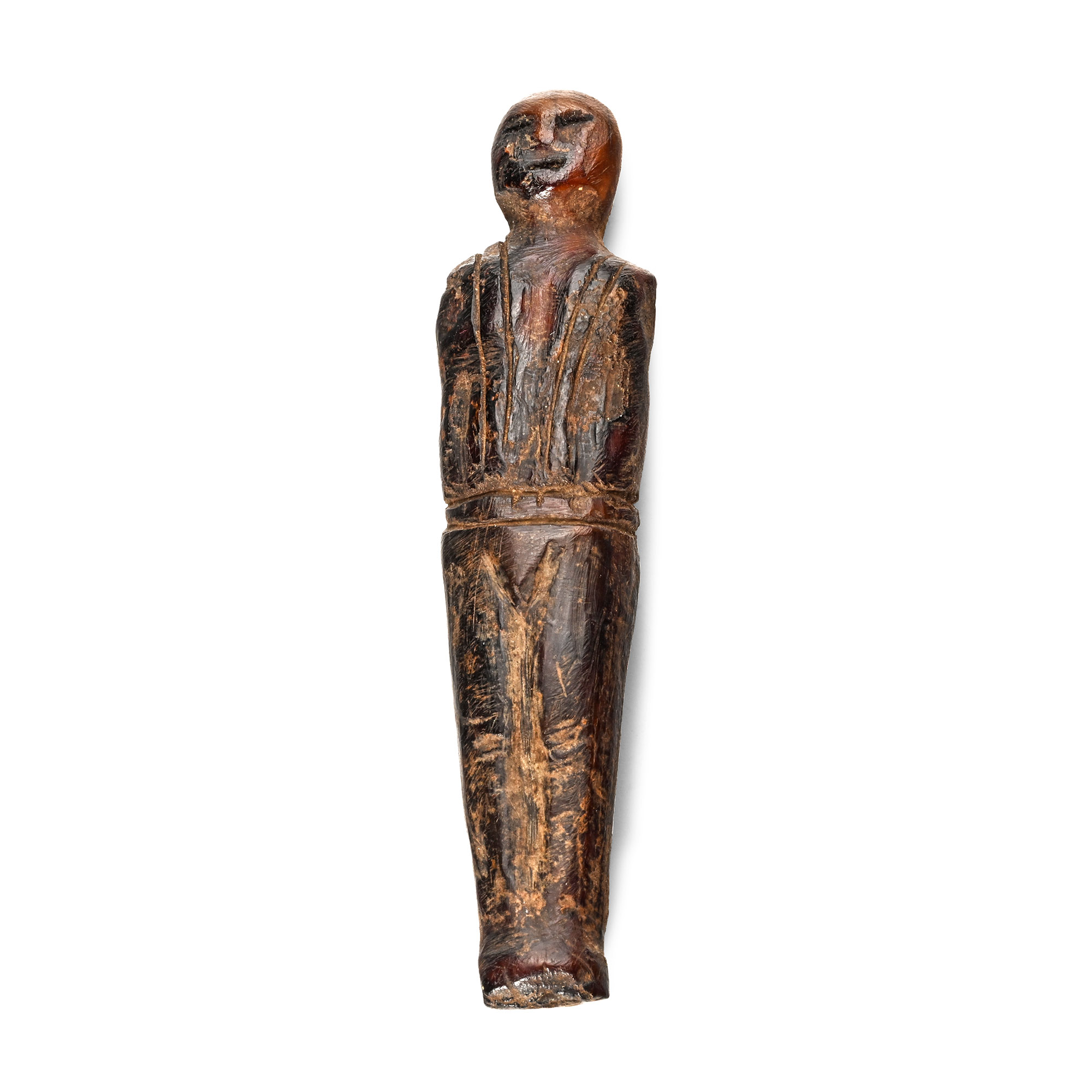
Native North American Carved Fossilized Walrus Bone Figure
ALASKA, CIRCA 1,000 A.D.
3 1/8 in. (19.4 grams, 79 mm).
Modelled in the round as a standing female figure with a rounded bald head, incised eye and mouth, wearing a waistband above hips and straps(?) to the torso, emphasised carved vulva detail; with a hand-written tag reading 'Ivory doll, ca. 1000 AD, Exc. Wales, Alaska'.
ProvenanceEx Wales, Alaska.
Ex John and Valerie Arieta, 1993.
Dr Alan Black collection.
From the collection of Mr Carlos Bahamonde, Manchester, UK.
See The Metropolitan Museum of Art, items no. 1979.206.520 and 2001.760.
CONDITIONTimeLine Auctions follows a vetting process to ensure the authenticity and legality of all items, reinforcing our commitment to integrity and responsible trading. Each antiquity, antique, and coin lot undergoes thorough examination by a vetting committee of at least ten external specialists, professional trade association members, scientists, and archaeologists: Our Vetting Process
AUCTIONS:
TimeLine is a leading auction house specialising in antiquities, ancient art, collectables, natural history, coins, medals, and books. Our auctions offer museums, collectors, historians, and enthusiasts the opportunity to acquire unique and historically significant pieces.
LOT 2788
Native North American Carved Fossilized Walrus Bone Figure
Estimate £400 - 600€460 - 700 (for guidance only)$540 - 810 (for guidance only)
Opening Bid
£200 (EUR 232; USD 270) +BP*
-
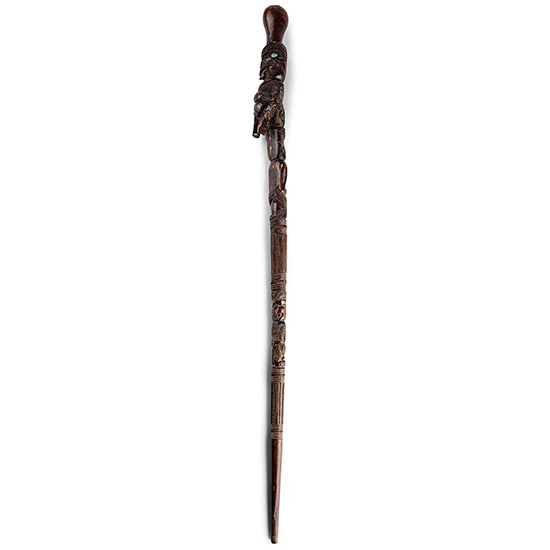
Oceanic Wooden Maori Walking Stick Tokotoko
New Zealand, early 20th century A.D.Estimate: £500 - 700 (+bp*)
Opening Bid: £200
Carved with a seated tiki and two kneeling tiki figures, with inset abalone shell eyes and bands of linear and notch carving, the pear-shaped handle with a metal plaque inscribed: 'J.L. LD. N.Z. 1903'. 545 grams, 93.8 cm
From the collection of Mr Carlos Bahamonde, Manchester, UK.
A tokotoko is a traditional Māori carved ceremonial walking stick, and a symbol of authority and status for the speaker holding it. The tokotoko were beautifully carved. The most elaborate, like this one, shows a well-nourished, naked Paikea-type male figure lying flat, with his legs in the air to form a handle. The sticks have two distinctive female faces further down, one with a moko on the lips and the other with a moko kauae. All faces have pāua-shell eyes. The body of the tokotoko is intricately carved with a three-dimensional curved shape. It is less than a metre in length, pointing to its use as a ‘talking stick’ rather than an aid to walking. -
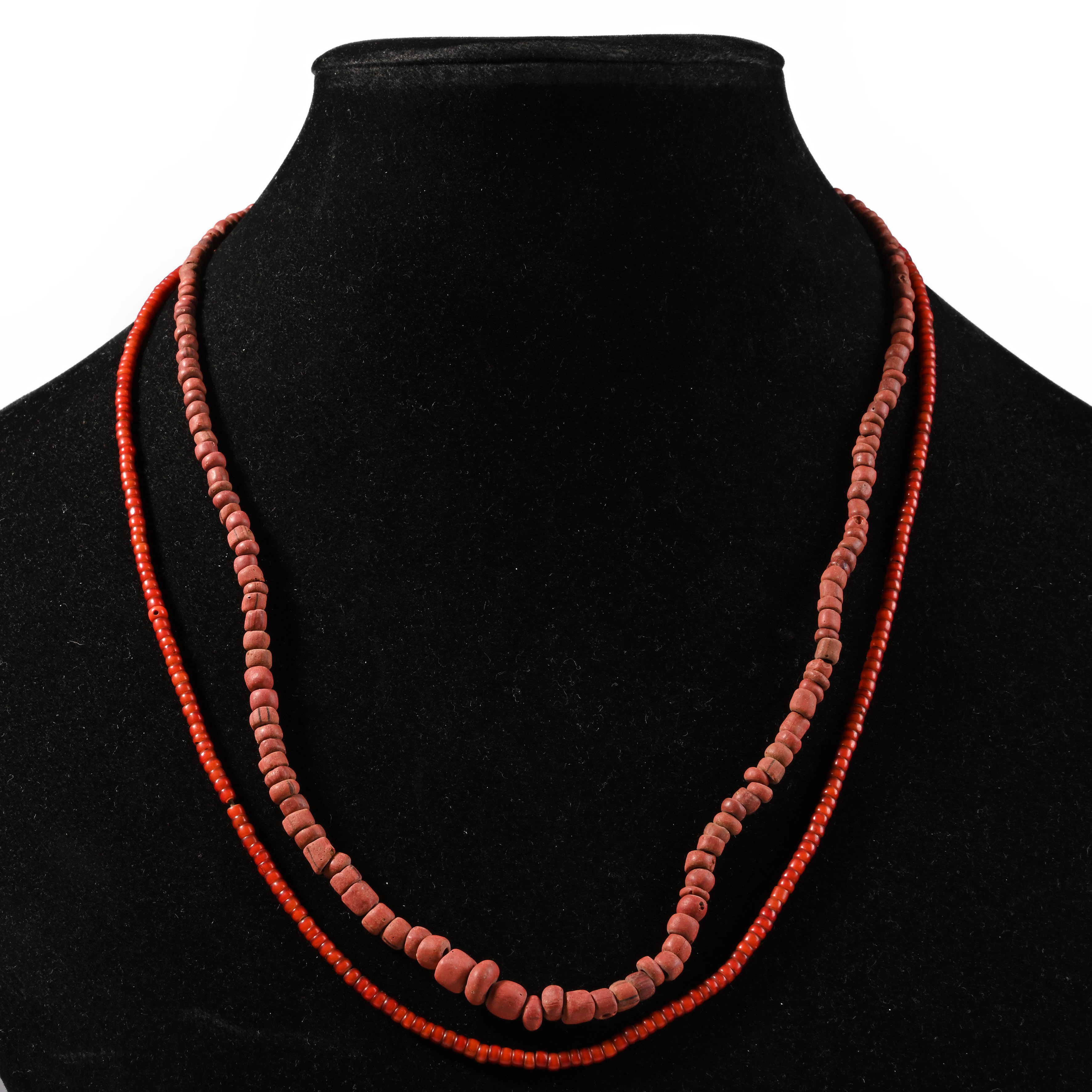
Javanese Trade Beads
Majopahit, circa 13th century A.D.Estimate: £20 - 30 (+bp*)
Opening Bid: £5
Two strings of red glass beads; old collector's cards: 'Majopahit 13th c. opaque red glass beads. Java 1293-1520 and its maritime empire. Beads used trading in E. Indies' and 'Majopahit 1293-1520 Kingdom of East Java (Sumatra, S. Malaysia = coastal Borneo.) These 13 c.' 23.7 grams total, 58-59 cm
From a specialised collection of trade items and money formed in the 1970s. -
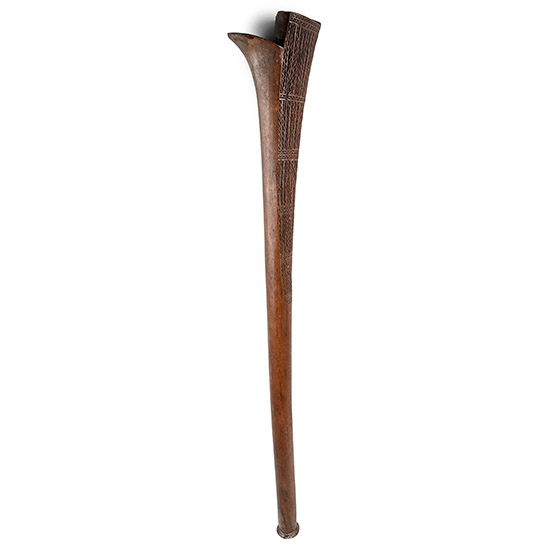
Oceanic Honey-Coloured Wooden 'Gunstock' Sali War Club
Melanesia, Fiji, late 19th-early 20th century A.D.Estimate: £500 - 700 (+bp*)
Opening Bid: £200
Comprising a round-section haft with a flanged butt, a lozenge-section head with a stepped beak on one face, panels of dense chip-carved geometric ornament to the rear. 1.61 kg, 95 cm
From the collection of Mr Carlos Bahamonde, Manchester, UK.
