
Loading, please wait...

LOT 0541
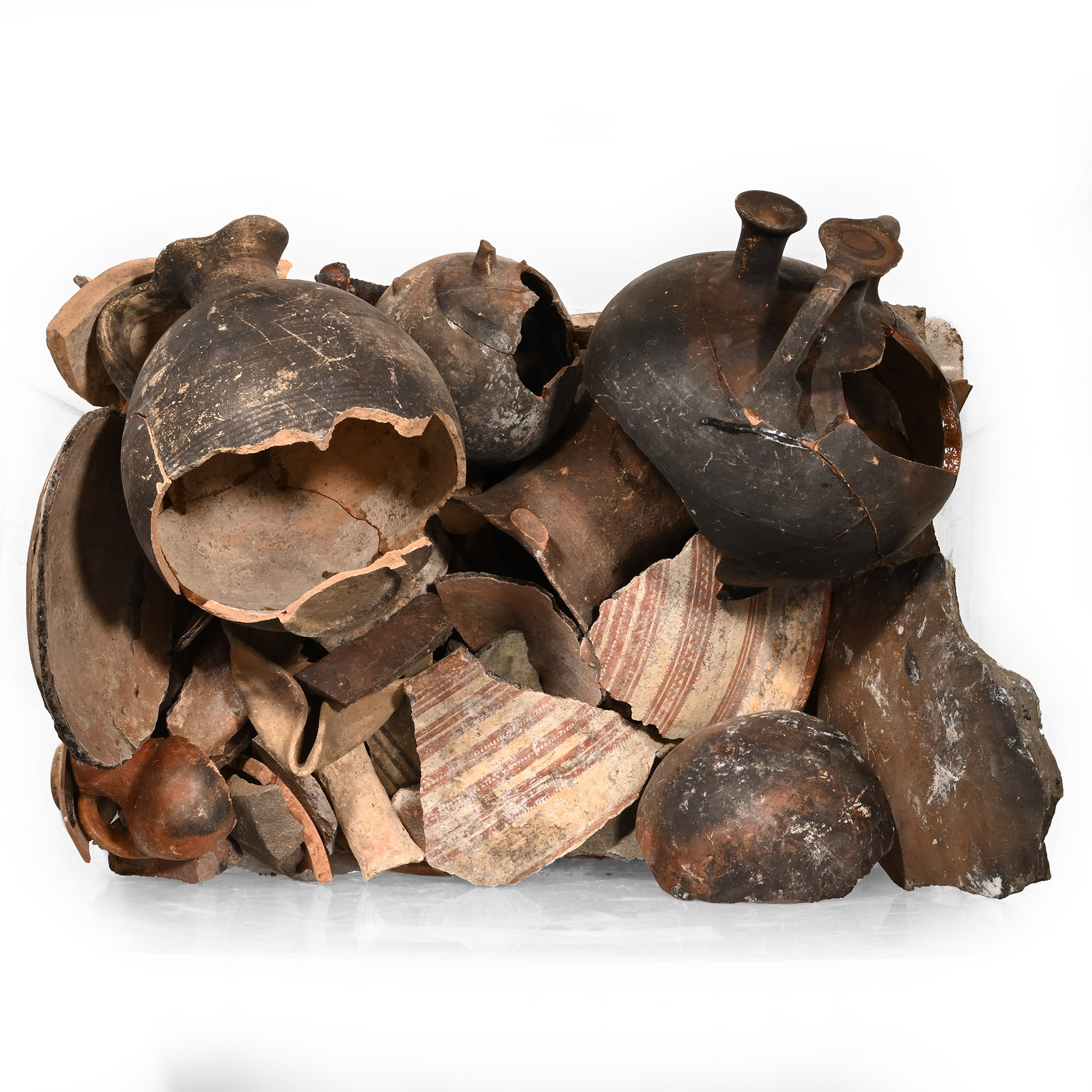
Mycenaean and Cypriot Pottery Sherd Group
2ND-1ST MILLENNIUM B.C.
1/2 - 8 1/2 in. (7.9 kg total, 1.5-21.5 cm).
Including fragments of ewer and jar, some with painted decoration, partly re-assembled, and other items. [150, No Reserve]
ProvenanceFrom a collection acquired on the UK art market from various auction houses and collections mostly before 2000.
From an important Cambridgeshire estate; thence by descent.
TimeLine Auctions follows a vetting process to ensure the authenticity and legality of all items, reinforcing our commitment to integrity and responsible trading. Each antiquity, antique, and coin lot undergoes thorough examination by a vetting committee of at least ten external specialists, professional trade association members, scientists, and archaeologists: Our Vetting Process
AUCTIONS:
TimeLine is a leading auction house specialising in antiquities, ancient art, collectables, natural history, coins, medals, and books. Our auctions offer museums, collectors, historians, and enthusiasts the opportunity to acquire unique and historically significant pieces.
-
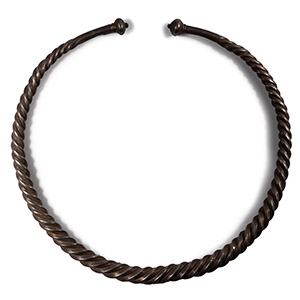
Thracian Twisted Silver Torc
4th-2nd century B.C.Estimate: £2,000 - 3,000 (‡+bp*)
Opening Bid: £1,000
Formed of twisted rods, each square in section, tapering towards the hammered finials, each with an onion-knop terminal. 157 grams, 15 cm
with Christie's, New York, 5 June 1998, no.209. Private collection, Europe. Accompanied by an academic report by Dr Raffaele D'Amato. Accompanied by copies of the relevant Christie's catalogue pages. This lot has been checked against the Interpol Database of stolen works of art and is accompanied by a search certificate number no.12381-226710. -
.jpg)
Scythian Gold Clad Ribbed Torc with Decorated Terminals
4th-3rd century B.C.Sold for (Inc. bp): £13,000
Round in section with ribbing, rectangular finials with billeting to the borders and edges, rows of impressed roundels. 481 grams, 28 cm
Swiss private collection, 1987. Private collection, London. This lot has been checked against the Interpol Database of stolen works of art and is accompanied by a search certificate number no.12389-226870. -
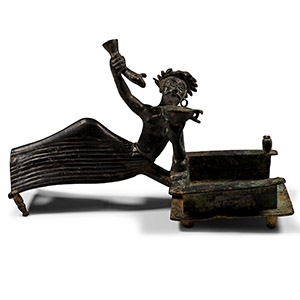
Parthian Reclining Banqueteer Holding a Skyphos and Rhyton
3rd-1st century B.C.Estimate: £8,000 - 10,000 (+bp*)
Opening Bid: £4,000
Furniture fitting comprising a square panel with raised border and four stub feet, poppy head finials (one absent); hollow-formed banqueteer reclining with weight on his left elbow and proper right leg bent beneath his pleated robe; right hand raised supporting a ram's head rhyton, left hand supporting a skyphos; wreath of laurel leaves around his bearded head. 1.58 kg, 25 cm
Private New York collection, formed in the 1960s. Acquired on the North American art market, 1990s. with Cahn Auktionen AG, Basel, Switzerland, 13 November 2015, no.84 (CHF 18,000). Accompanied by an academic report by Dr Raffaele D'Amato. This lot has been checked against the Interpol Database of stolen works of art and is accompanied by a search certificate number no.12379-226873.
The Greek 'συμπόσιον' 'symposion' was the later part of a formal banquet which took place after the food had been consumed, when the serving of strong drink was accompanied by music, dancing, poetic composition or recital or earnest conversation. The custom has similarities with the Roman convivium and with the customs of many Mediterranean and Western Asiatic people. The Parthian Empire was culturally diverse and included many Hellenic groups; the Arsacid court adopted a range of aspects of contemporary Greek culture, among them Greek military structures and the Greek language as a lingua franca alongside the Parthian (Iranian) language and Aramaic.
