
Loading, please wait...
LOT 1173
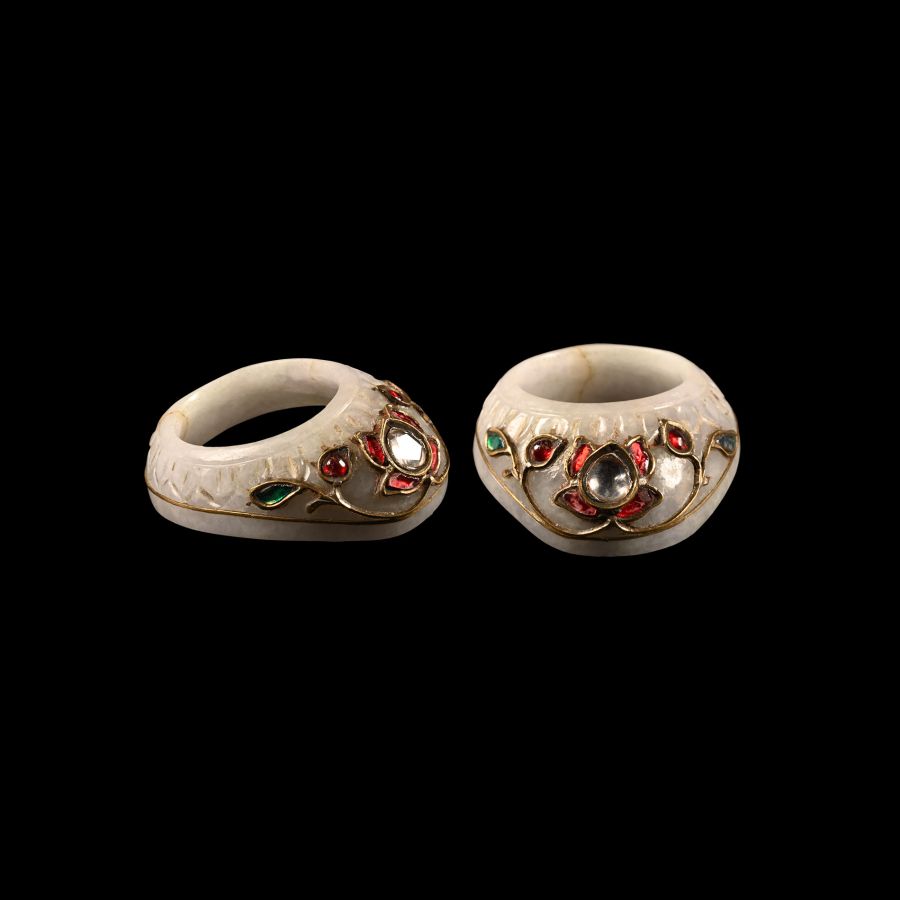
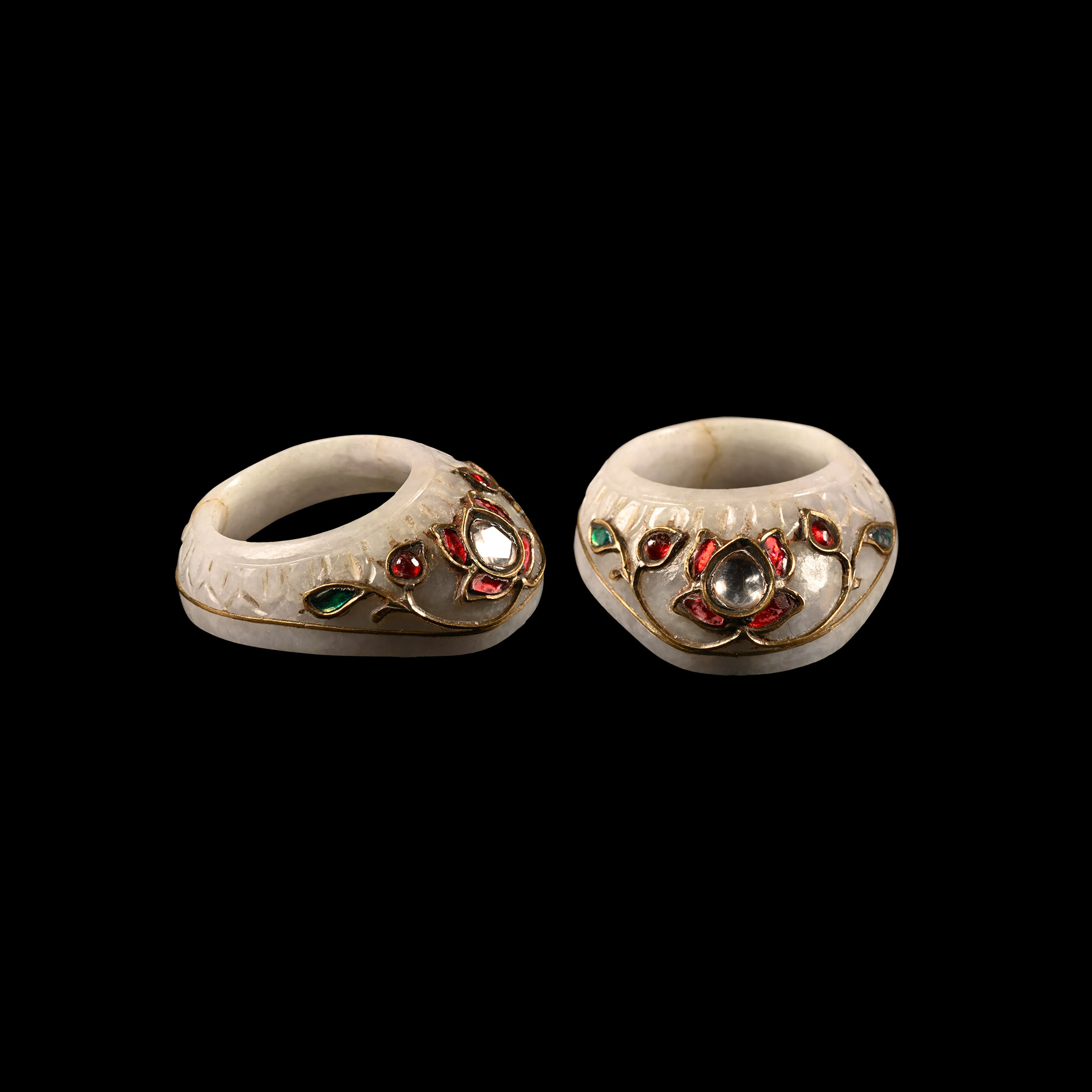
Mughal Jade Archer's Ring with Diamond, Rubies and Emeralds
18TH-19TH CENTURY A.D.
1 3/4 in. (15.5 grams, 44.55 mm overall, 21.86 mm internal diameter (approximate size British Z, USA 12 1/2, Europe 28.77, Japan 27).).
Carved in mottled pale grey jade with radiating lotus leaves around the central hole, applied gold wire hoop and tendril detailing with two emeralds and six cabochon rubies inset, the central flower with inset teardrop facetted diamond; with a thin crack to the back of the hoop.
ProvenanceFormerly in the family collection of a Hampstead gentleman, from the 1980s.
Acquired in TimeLine Auctions sale 119, lot 2518.
Property of a Kent collector.
See Mohamed, B., The Arts of the Muslim Knight, Milan, 2008, nos.381-385, for similar examples.
CONDITIONTimeLine Auctions follows a vetting process to ensure the authenticity and legality of all items, reinforcing our commitment to integrity and responsible trading. Each antiquity, antique, and coin lot undergoes thorough examination by a vetting committee of at least ten external specialists, professional trade association members, scientists, and archaeologists: Our Vetting Process
AUCTIONS:
TimeLine is a leading auction house specialising in antiquities, ancient art, collectables, natural history, coins, medals, and books. Our auctions offer museums, collectors, historians, and enthusiasts the opportunity to acquire unique and historically significant pieces.
LOT 1173
Mughal Jade Archer's Ring with Diamond, Rubies and Emeralds
Sold for (Inc. bp): £390
-
Elizabethan and Later 'Essex' Bronze Petronel Collection
Late 16th-early 17th century A.D.Sold for (Inc. bp): £169
Exhibiting a range of petronel types, including example with ring-and-dot detailing. 106 grams total, 4.8-12 cm
Found Essex, UK. -
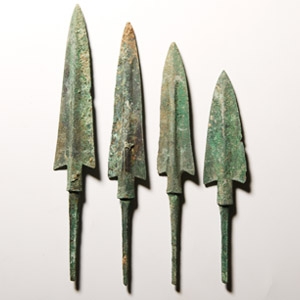
Luristan Arrowhead Group
13th-9th century B.C.Sold for (Inc. bp): £143
Comprising four tanged arrowheads, having large elongated triangular blades and raised midrib, sharp central groove, rectangular section stem with handle for the shaft, barbed shoulders and convex or squared sides. 161 grams total, 13-17 cm
From the private collection of the late Mr S.M., London, UK, 1969-1999; thence by descent.
These arrowheads seem to belong to the type V, subcategory types A and C according to the classification of Khorasani and Negahban. In the four categories of triangular bronze arrowheads from Luristan, Marlik and Northern Iran individuated by Negahban, subtypes A and C of type V are larger arrow heads with barbed shoulders and triangular heads. These types of arrowheads were commonly used in Anatolia and Mesopotamia from the 2nd millennium B.C., but apparently their employment began earlier in this area, where types like these occur alongside the non-barbed, predominantly ribbed and tanged types. -
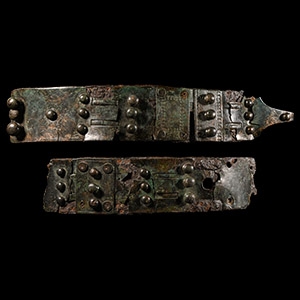
Assyrian Belt Fragment Group
9th-7th century B.C.Sold for (Inc. bp): £442
Comprising two bronze belt sections, each with a ferrous backing; applied sheet-bronze rectangular plates held in place with domed rivets and washers, some decorated with a border of pelleted triangular punchmarks topped with a pellet or ring-and-dot motif; one fragment with finial with remains of a riveted hook, the other with corresponding hole. 609 grams total, 23-30 cm
Ex Axel Guttmann collection.
