
Loading, please wait...
_900x900.jpg "Monumental Greek Apulian Red-Figure Calyx-Krater")
_200x200.jpg "Monumental Greek Apulian Red-Figure Calyx-Krater")
_900x900.jpg "Monumental Greek Apulian Red-Figure Calyx-Krater")
_200x200.jpg "Monumental Greek Apulian Red-Figure Calyx-Krater")
.jpg "Monumental Greek Apulian Red-Figure Calyx-Krater")
.jpg "Monumental Greek Apulian Red-Figure Calyx-Krater")
LOT 0092
Monumental Greek Apulian Red-Figure Calyx-Krater
LATE 4TH CENTURY B.C.
22 in. (7.6 kg, 56 cm high).
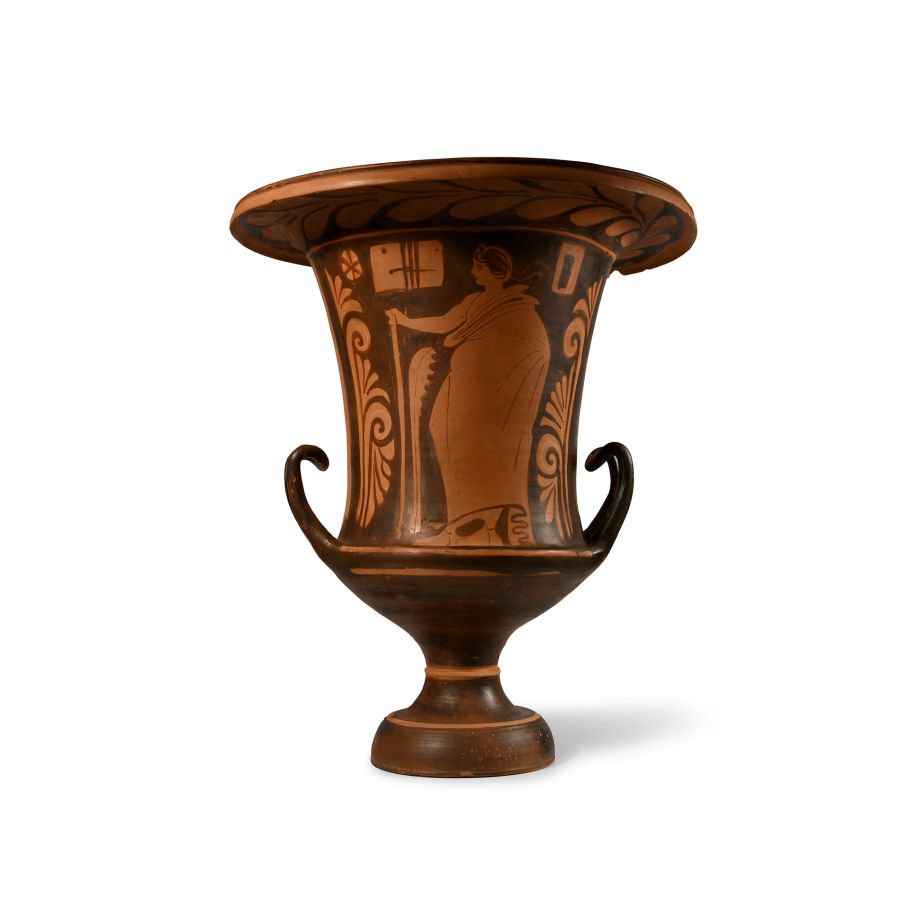
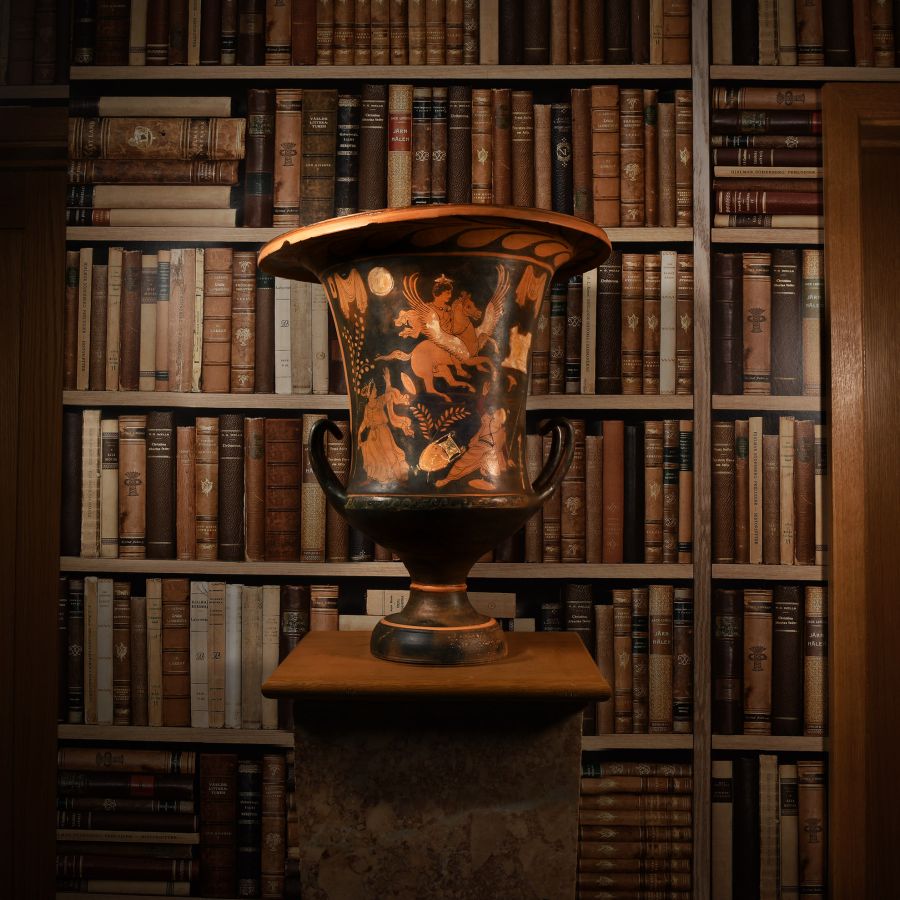
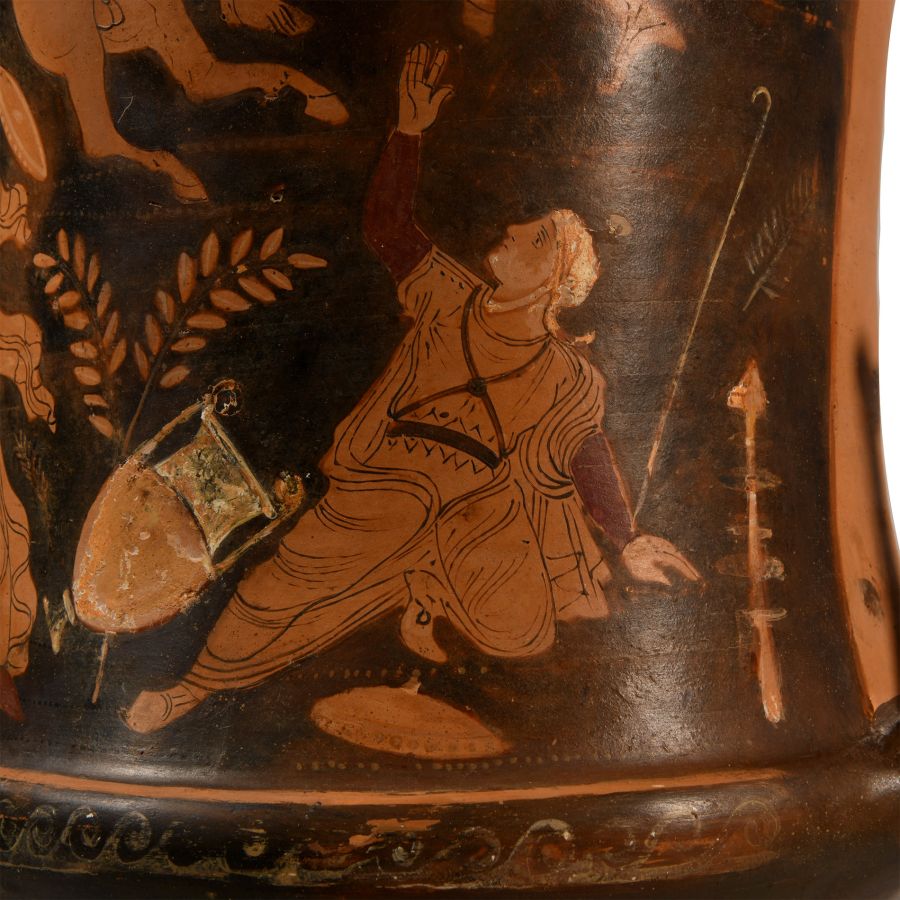
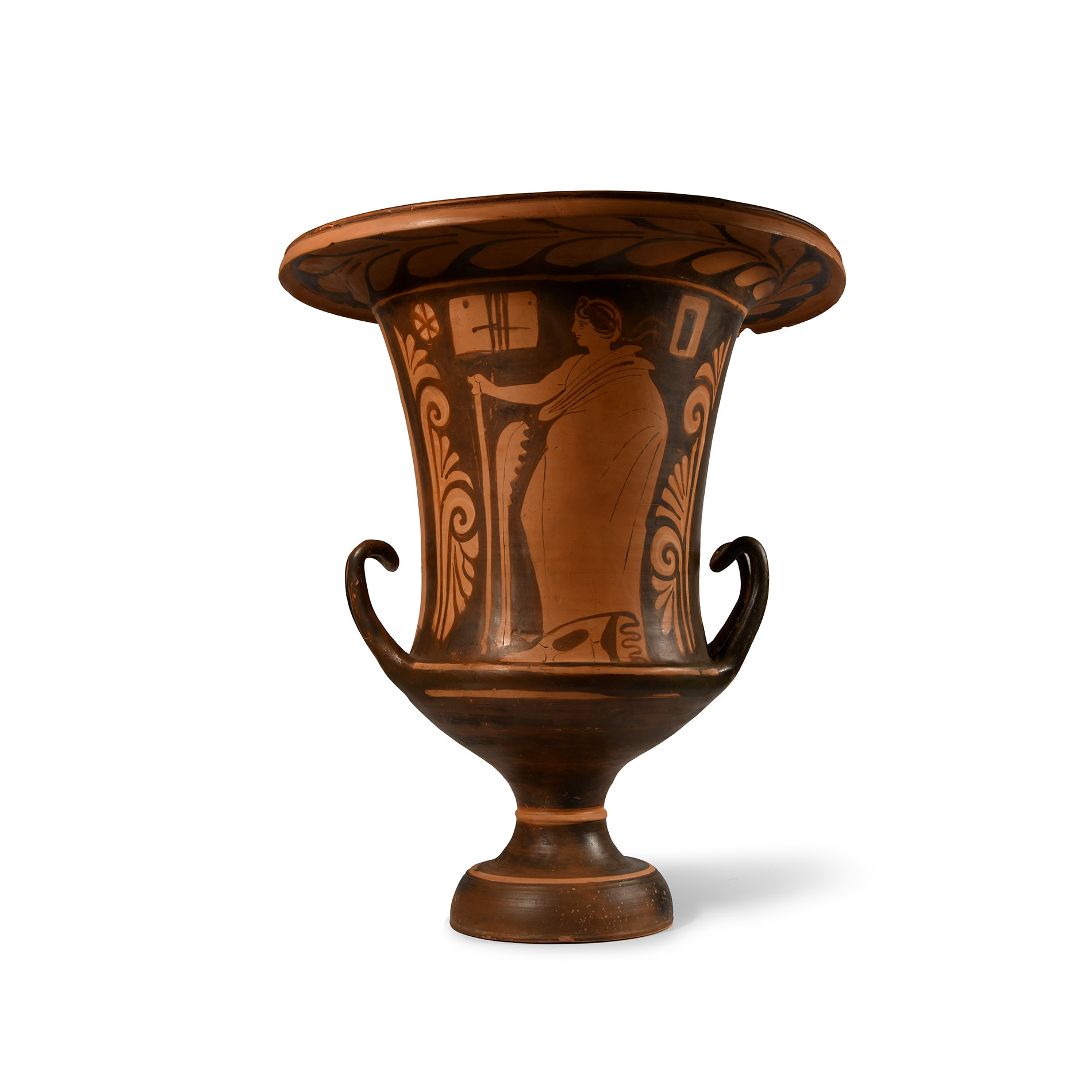
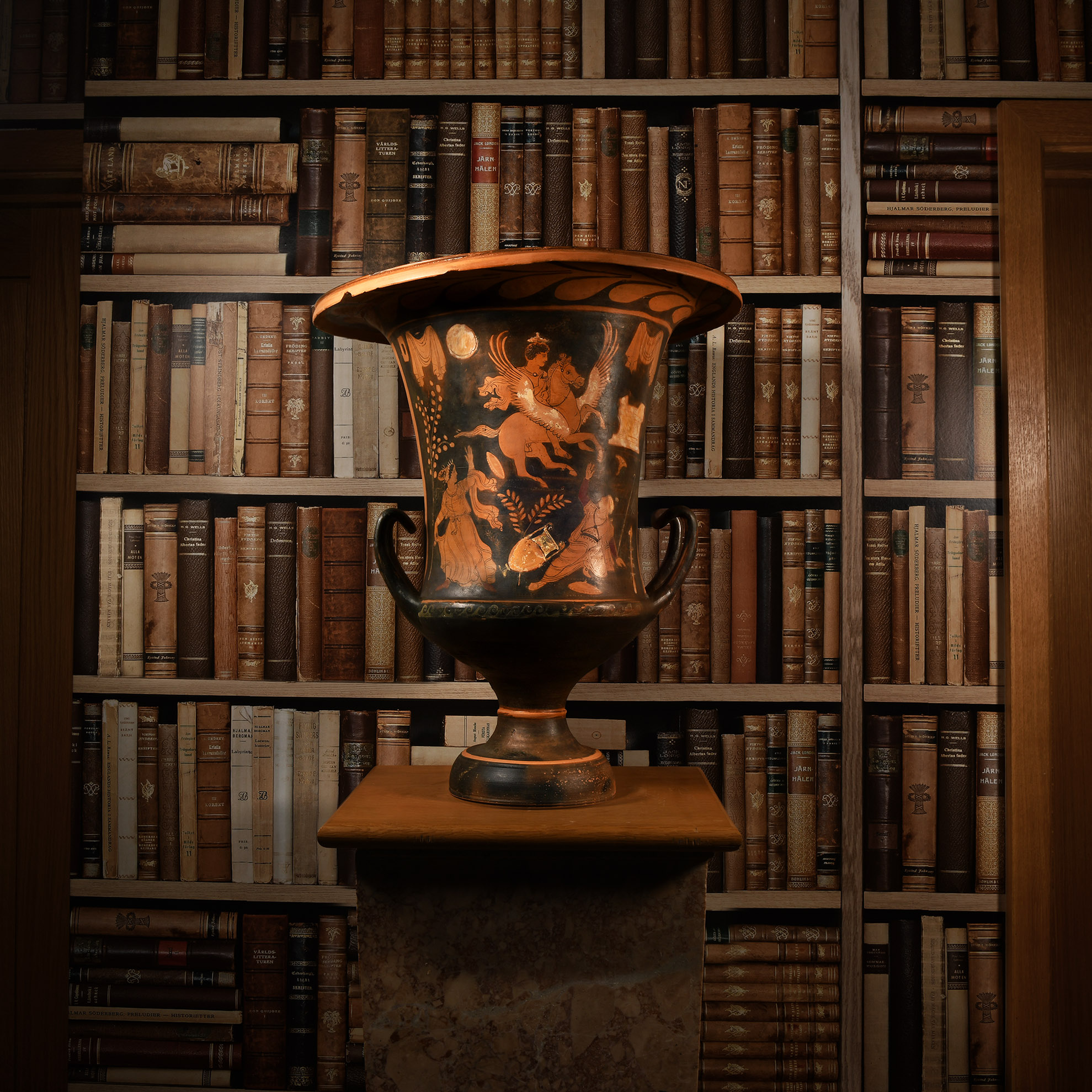
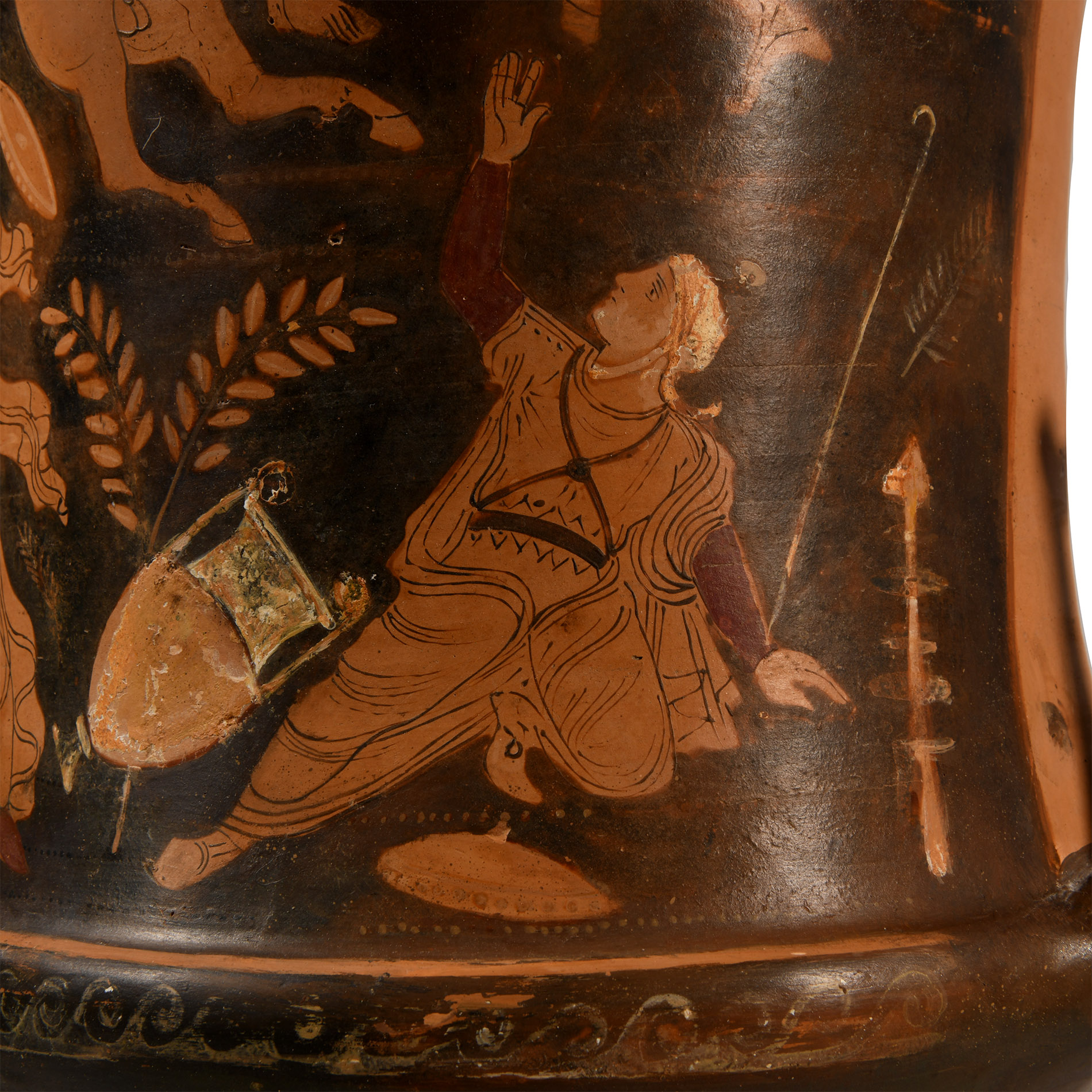
With elegant fluted body, drum foot and elaborate up-swung handles, displaying polychrome panels on both sides, between a laurel wreath below the rim and a band of Greek meander motif; Side A: the hero Bellerophon riding Pegasus, wearing a Thessalian hat (petasos), depicted nude except for a cloak fastened at the centre of the neck by a round clasp, the hero towering above the other two mythological characters beneath him: Princess Filinoe, on the left, crowned and dressed in a long chiton, and King Iobates of Lycia, dressed in Persian fashion with a long sleeved red tunic worn under a long dress, the field with a representation of an altar, two palm branches over a volute krater, a shield, a javelin, a lotus flower, and above the hero a hanging shield and two clamydes; Side B: figure of a young beardless man, wrapped in a large cloak and holding a staff, with windows and floral scrolls on the background.
ProvenanceAcquired in the mid 1980s-1990s.
From the family collection of Mr S.A., Switzerland, thence by descent.
Private collection since the late 1990s.
Accompanied by an academic report by Dr Raffaele D’Amato.
This lot has been checked against the Interpol Database of stolen works of art and is accompanied by a search certificate number no.12068-218200.
Cf. Trendall, A.D., ‘Paestan Pottery: a Revision and a Supplement’, in Papers of the British School at Rome, 1952, no.20, pp.1-53, pls. I-III, for similar bell-kraters but with different iconography; see also British Museum accession no.1867,0508.1335, in Walters, H.B., Forsdyke, E.J., Smith, C.H., Catalogue of Vases in British Museum, London, 1893-1925, no.F270.
FootnotesThe decoration is very different on the two sides: on the main one, the painter has created a large mythological scene as if it was a summary. The scene comprising the famous hero Bellerophon riding Pegasus, the winged horse, flying above Iobates and his daughter (who will become the hero's wife). The king sent Bellerophon to perform impossible mission, among which the best known is the fight against the Chimera (monster with the body of a lion and a goat, with a snake's tail and two heads, one of a lion and the other of a goat).
CONDITIONTimeLine Auctions follows a vetting process to ensure the authenticity and legality of all items, reinforcing our commitment to integrity and responsible trading. Each antiquity, antique, and coin lot undergoes thorough examination by a vetting committee of at least ten external specialists, professional trade association members, scientists, and archaeologists: Our Vetting Process
AUCTIONS:
TimeLine is a leading auction house specialising in antiquities, ancient art, collectables, natural history, coins, medals, and books. Our auctions offer museums, collectors, historians, and enthusiasts the opportunity to acquire unique and historically significant pieces.
LOT 0092
Monumental Greek Apulian Red-Figure Calyx-Krater
Estimate £18,000 - 24,000€20,880 - 27,840 (for guidance only)$24,300 - 32,400 (for guidance only)
-
Greek Apulian Red-Figure Pottery Lekanis
Apulian South Italy, 4th century B.C.Sold for (Inc. bp): £546
With black-glazed pale tan body and original matching lid decorated with two heads of ladies of fashion, palmettes between, radial lines on the knob handle and a waveband around the rim. 182 grams total, 9.3-14.2 cm wide
Old Belgian private collection, thence André Munter Archéologie, Brussels, Belgium. Property of a Bristol, UK, gentleman. -
Monumental Apulian Red-Figure Volute Krater Attributed to the Licurgus Painter
Circa 330 B.C.Estimate: £50,000 - 70,000 (‡+bp*)
Opening Bid: £22,222
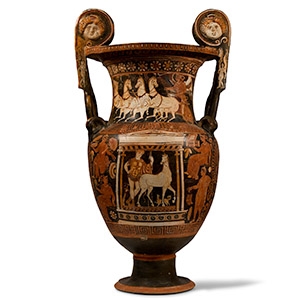
With a flared and carinated foot, meander patterns around the lower body, band of rosettes encircling the neck, gusseted handles with masks to the outer faces opening to two columnar legs, broad shoulder with loops flanking the handles; red-figure scenes to the neck and body: Side a: above, a quadriga with Nike at the reins, wings spread; below, naiskos with flanking columns, hero standing beside his horse, resting on his spear, wearing a muscled armour, surrounded by seated and reclining females and youths in various poses, one of the youths holding the hero's pointed boots in his hand; Side b: above, a palmette, below column with decorative ribbons flanked by two seated males and two females offering votive gifts; some restoration. 13.85 kg, 78.5 cm high
Private collection, Neuchâtel, Switzerland. Ex collection H.& P. Payot, Clarens, by descent. Accompanied an academic report by Dr Raffaele D’Amato. This lot has been checked against the Interpol Database of stolen works of art and is accompanied by a search certificate number no.12066-218199.
Monumental kraters such as this one are typical of the Apulian red-figure production that developed between circa 440 and 300 B.C. in the region of the Greek colonies of Taranto and Metaponto in Southern Italy, where they were used as tomb markers in cemeteries. Here the painter focuses on the celebration of the hero-warrior, surrounded by young women and men, the image of the victorious leader is emphasised by the full panoply and iconography of Nike. -
Cypriot Painted Terracotta Storage Vessel
Circa 7th-5th century B.C.Sold for (Inc. bp): £182
With broad bulbous body and high flared neck, painted horizontal bands of geometric ornament. 894 grams, 17 cm wide
Acquired 1980-2015. Ex Abelita family collection.
