
Loading, please wait...
LOT 1074
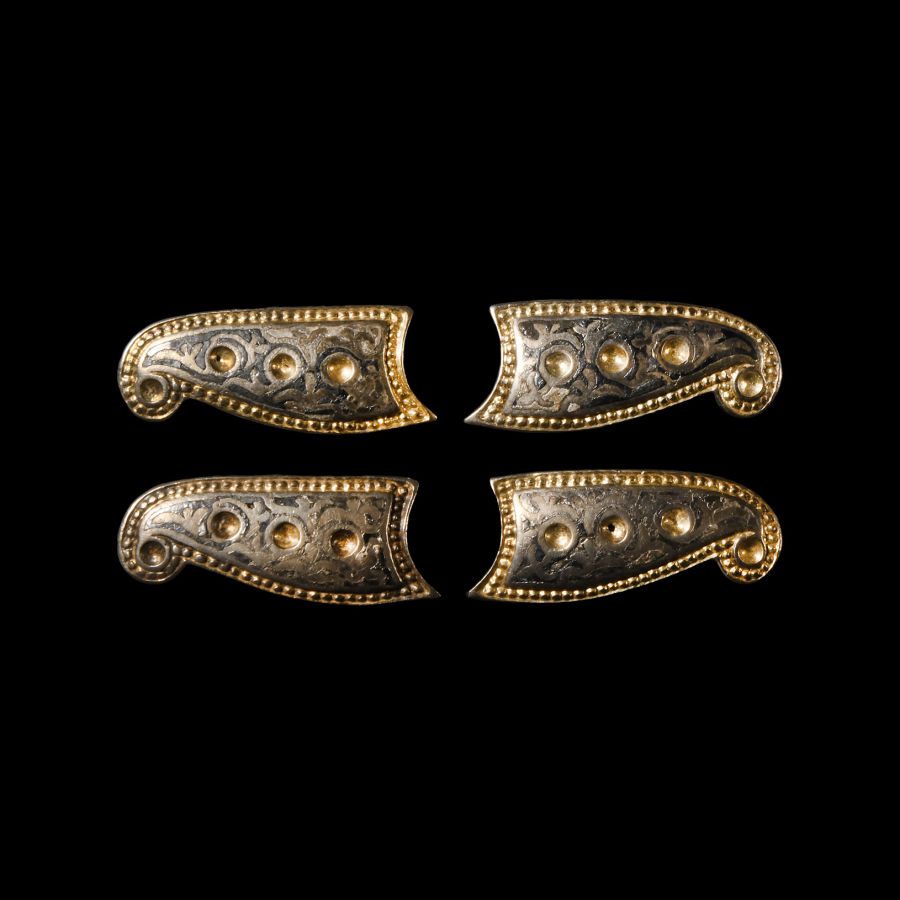
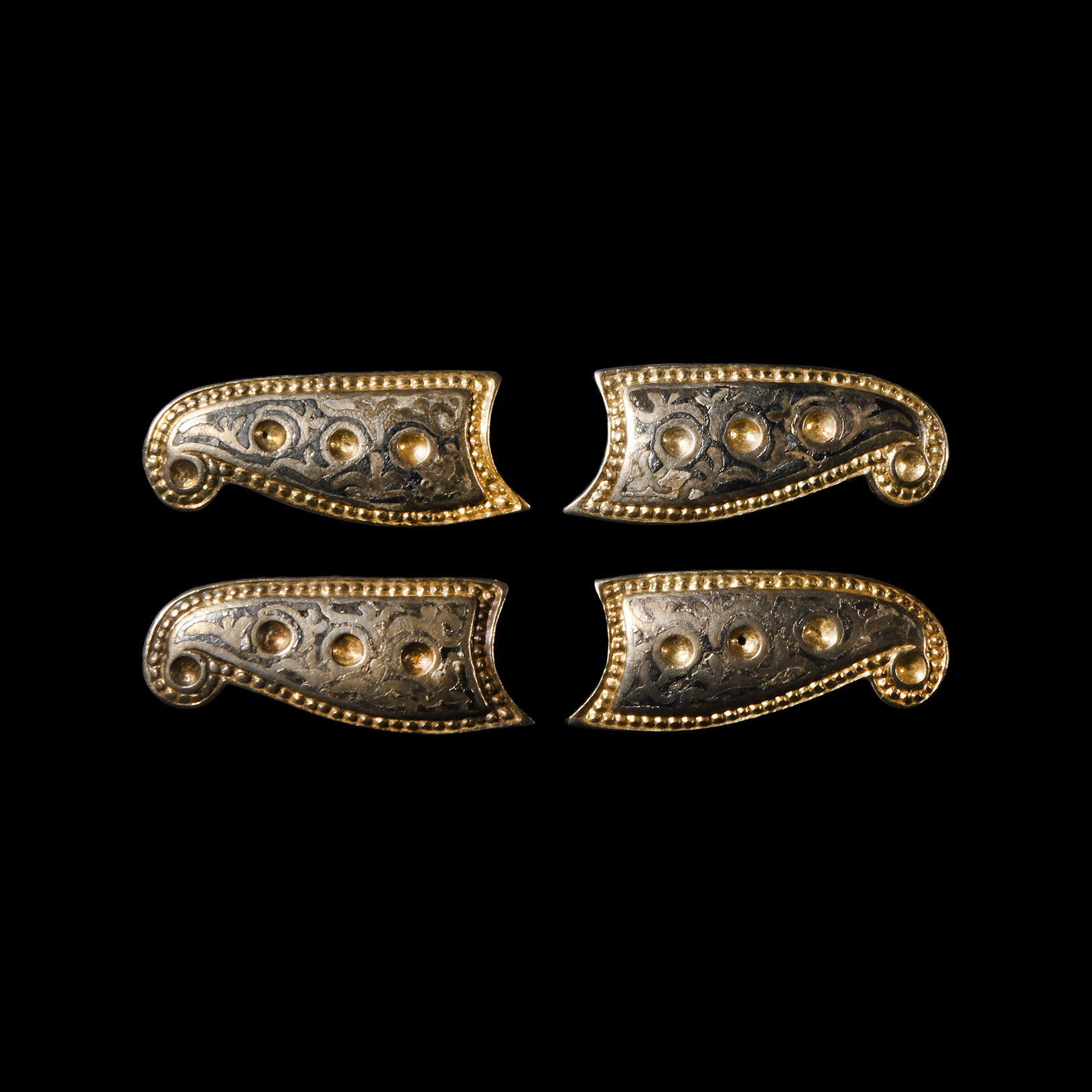
Mongol Silver Belt Mount Group
13TH CENTURY A.D.
1 5/8 in. (25.7 grams total, 40-41 mm).
Each with a broader scooped edge tapering to a volute flourish, pellets adorning the perimeter, three medial circular dimples, fourth dimple to the scrolled end, against a field of foliate scrolls and niello fill; each with a set of mounting lugs to the reverse. [4]
ProvenanceAcquired in the 1980s-1990s.
Ex an important central London gallery, London W1.
Cf. Ohkonko, N.A., 'A Mongolian Burial Group near Novopavlovka settlement in Stavropol Krai' in Batyr, Traditional Military Culture of the Peoples of Eurasia, no.1, 2010, pp.88-96, fig.7, no.3.
FootnotesSimilar plaques have been found in the burial graves of Mongol commanders and their wives, probably once part of a waist belt from which the sabre and other weapons were hanging. They were found together with arms, unique elements of the costume of fabric and leather, and splendid jewellery of gold and silver.
CONDITIONTimeLine Auctions follows a vetting process to ensure the authenticity and legality of all items, reinforcing our commitment to integrity and responsible trading. Each antiquity, antique, and coin lot undergoes thorough examination by a vetting committee of at least ten external specialists, professional trade association members, scientists, and archaeologists: Our Vetting Process
AUCTIONS:
TimeLine is a leading auction house specialising in antiquities, ancient art, collectables, natural history, coins, medals, and books. Our auctions offer museums, collectors, historians, and enthusiasts the opportunity to acquire unique and historically significant pieces.
-
Byzantine Iron Lamellar Armour Group
Circa 12th-13th century A.D.Sold for (Inc. bp): £650
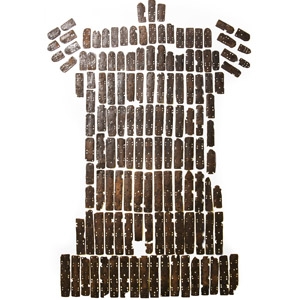
A Byzantine or Eastern European armour group comprising 138 plates from a klivanion in forty different shapes; originally the plates would have been interlaced and attached to an undergarment to form a compact cuirass. 1.43 kg total, 4-12 cm
Good condition, extremely rare
From the private collection of a London gentleman, from his grandfather's collection formed before the early 1970s. Accompanied by an academic report by Dr Raffaele D'Amato. This lot has been checked against the Interpol Database of stolen works of art and is accompanied by search certificate no.11929-209662.
The lamellar protection was particularly effective when used by mounted troops as it provided not just protection but enabled free movement due to its loose construction. A similar type of armour was already used by the Assyrians in the 9th century B.C. Its use increased in the west during the 4th and 5th centuries A.D. As a result of changes in warfare techniques, where the archer’s role in the initial stages of the battle was of utmost importance, the use of lamellar armour was widespread amongst the Roman army and Germanic peoples. There are various ways in which the present suite of plates could have been assembled, although it was likely a short (thigh-length) form of lamellar armour. -
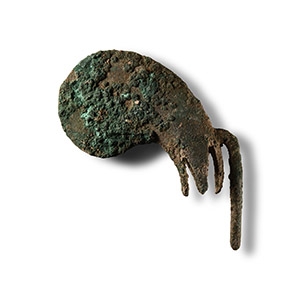
Bactrian Bronze Ceremonial Claw Mace
2nd-1st millennium B.C.Sold for (Inc. bp): £117
Egg-shaped with spiked sleeves or prongs, the top of the weapon with narrow edge, the sleeves with small internal tangs for mounting. 237 grams, 14 cm
Acquired 1980-2015. Ex Abelita family collection.
The 'claw mace' was an enigmatic ancient bronze weapon from the Bronze Age Near East. The hollow bulbous head was trailed by tines of varying lengths. It is believed that it was affixed over a wooden shaft and used like a club in combat, and not necessarily used as ceremonial weapon. The knife edge bulb end could have broken bones and proven to be a formidable striking weapon requiring no skill to wield. The tines would have not only been decorative, but have served to add strength below the striking end to prevent breakage. In battle, maces were often used by commanders to display rank when giving orders in battle and leading soldiers, inspiring leadership and power. -
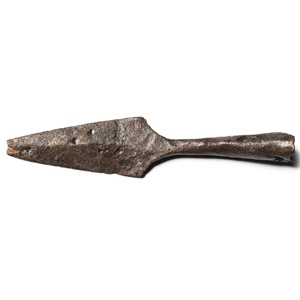
Anglo-Saxon Iron Socketted Arrowhead
Circa 6th-8th century A.D.Sold for (Inc. bp): £72
Comprising a triangular leaf-shaped blade with tapering socket. 10 grams, 87 mm
Found Cambridgeshire, UK.
