
Loading, please wait...
LOT 2276
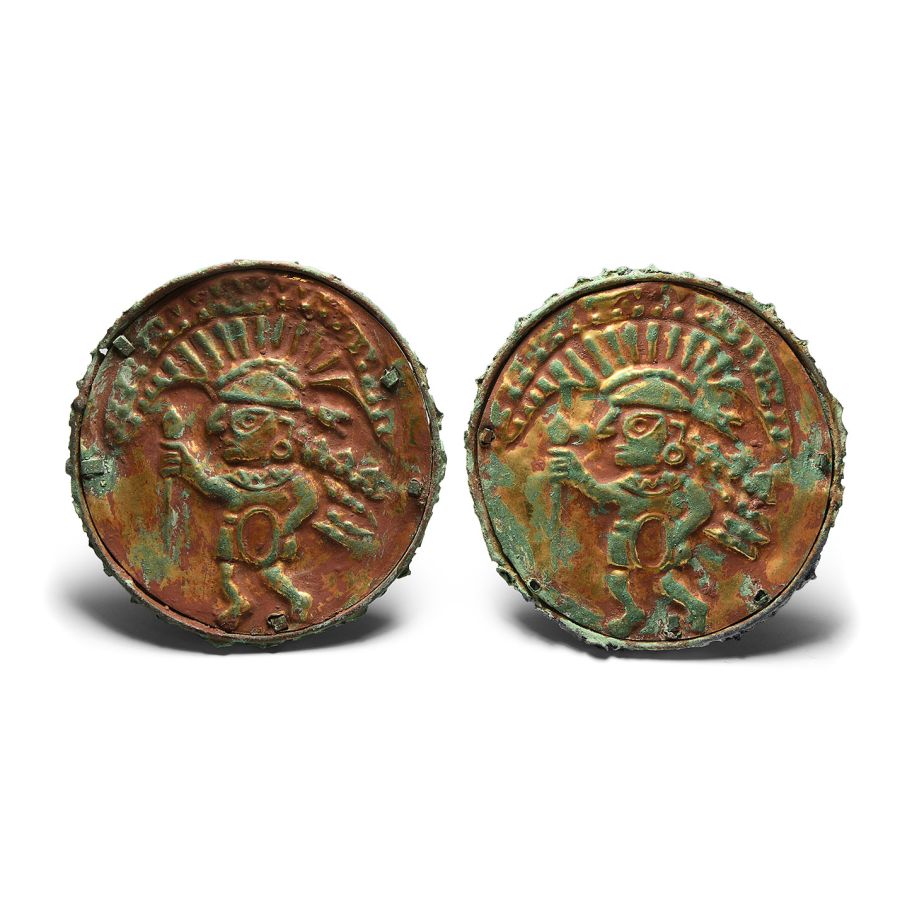
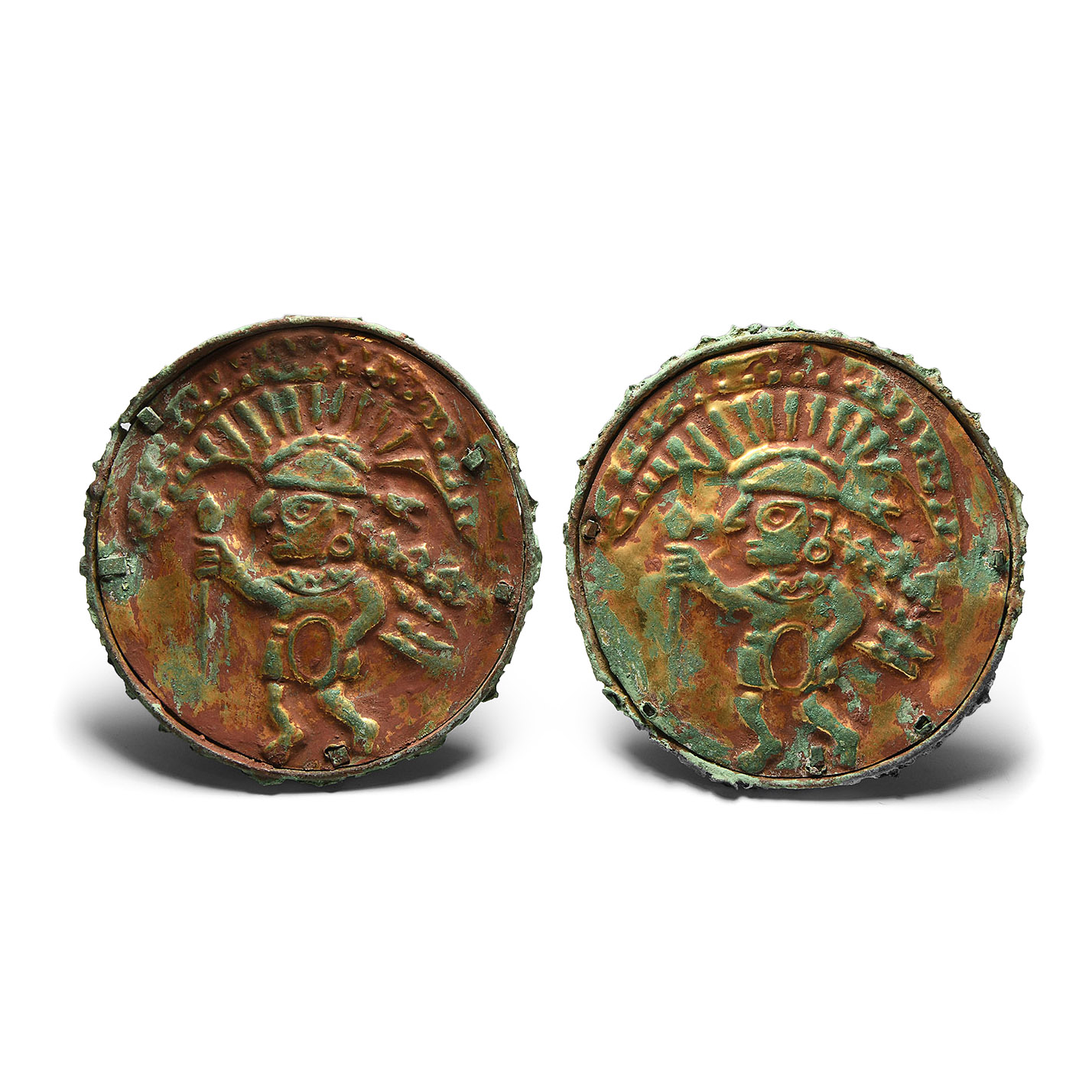
Moche-Sican Style Gilded Ear Spools with Warriors
20TH CENTURY A.D. OR EARLIER
4 1/4 in. (173 grams total, 10.7 cm each).
Each with a gold surface and red-brown cinnabar colouration; the spools are discoid with raised bands and a capped and pierced central cylindrical neck to the reverse; the discs present almost identical scenes of a standing warrior wearing a headdress and holding a club and shield; in the style of the Lambayeque Valley, circa 200-500 A.D. [2, No Reserve]
ProvenanceFormerly acquired before 1950.
From the collection of Mr Razeto, acquired in the 1950s-1960s.
Ex private American collection, circa 1960s.
Acquired from Gloria Lisset Reyes Garcia, Florida, USA.
From the private collection of Mr Michael J. Vaupel, Miami, USA.
See Pillsbury, J. et al., Golden Kingdoms: Luxury Arts in the Ancient Americas, Los Angeles, J. Paul Getty Museum, 2017, no.21; cf. Jones, J., and Heidi, K., Gold of the Americas, The Bulletin of the Metropolitan Museum of Art vol, 59, no.4, Spring 2002, p.16.
FootnotesThe age of the Moche people has been lauded as the 'Master Craftsman Period' by archaeologists. Alongside other developments and innovations, the Moche excelled at metalwork, such as this pair of earrings, which may have been worn by high-status men or women. The pair would likely have been deposited as grave goods. The Moche culture existed between 200 and 850 AD, before the advent of the Inca. Although they never formed a single centralised political entity, they built thriving cultural regional centres stretching from the Nepeña River Valley in the south to the Piura River, close to the modern border with Ecuador, developing coastal regions into fertile farmlands and exploiting the maritime resources of the Pacific Ocean's Humboldt Current.
CONDITIONTimeLine Auctions follows a vetting process to ensure the authenticity and legality of all items, reinforcing our commitment to integrity and responsible trading. Each antiquity, antique, and coin lot undergoes thorough examination by a vetting committee of at least ten external specialists, professional trade association members, scientists, and archaeologists: Our Vetting Process
AUCTIONS:
TimeLine is a leading auction house specialising in antiquities, ancient art, collectables, natural history, coins, medals, and books. Our auctions offer museums, collectors, historians, and enthusiasts the opportunity to acquire unique and historically significant pieces.
-
Russian Orthodox Enamelled Bronze Triptych Icon with Christ, Virgin Mary and Saint John
Circa 1820 A.D.Estimate: £350 - 450 (+bp*)
Opening Bid: £140
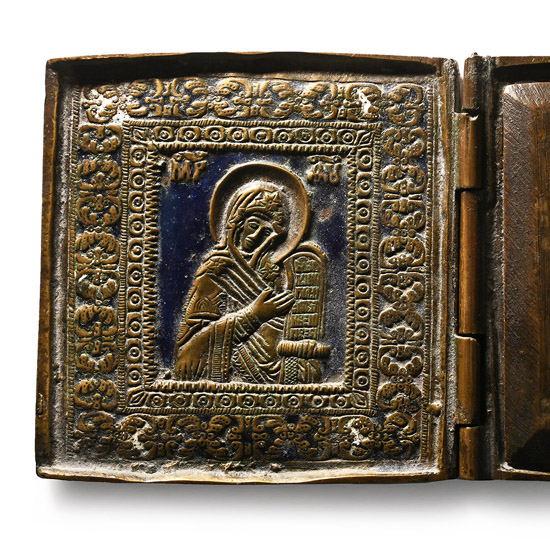
Depicting the Deesis divided in three panels, with Jesus Christ at the centre, Saint Mary on the left panel and Saint John the Baptist on the right; God holding the Gospel in his left hand and raising his right hand in blessing; Mary with veiled head and mantle, wearing a maphorion mantle over an embroidered robe and holding a scroll; Saint John, portrayed as an elderly man, wearing a camel-skin robe, winged and holding a bowl containing an infant with flexed legs and raised right hand, the saint’s right hand pointing toward the infant Jesus, his left hand holding a scroll with the prophecy of Isaiah, while the right hand is raised in blessing gesture; Old Slavic inscription around the figures: 'ΙC ΧΡ' (Jesus Christ); 'ΜΡ ϴΥ'(Mother of God), ‘Saint John the Precursor’ (Иоа́нн Предте́ча); the images framed by a pseudo-vegetal and abstract decorations; the instruments of the Passion and the city of Jerusalem on the cover. 553 grams, 10 cm
Ex David Miller, Hemel Hempstead, London, UK. From the private collection of a West London, UK, gentleman, formed since the early 2000s.
The Deisis or Deesis (Деисус, Gk. for “supplication”) was the depiction of the Virgin, John the Baptist and possibly many more saints interceding with Christ on behalf of mankind. -
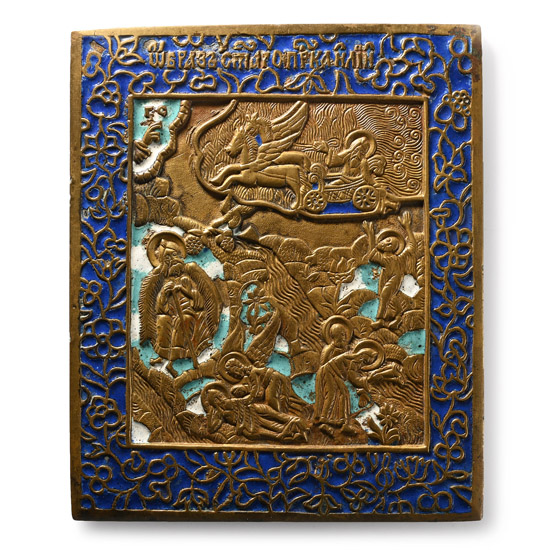
Russian Orthodox Enamelled Bronze Travel Icon with Scenes of the Life of the Prophet Elijah
19th century A.D.Estimate: £250 - 350 (+bp*)
Opening Bid: £108
With blue champlevé enamel, depicting scenes of the life of Prophet Elijah: on the bottom right Elijah rolling up his mantle and dividing the waters of the Jordan, in front of his disciple Elisha; on the bottom left Elijah watched over by the Angel; on the top right Elijah ascending to heaven on a Chariot of Fire, assisted by the hand of God; on the left Elijah, covered by his mantle, fed by ravens; frame with blue enamel over gilded pseudo-vegetal decorations. 585 grams, 14.3 cm
Acquired from Chris Martin-Zakheim, Iconastas, 5 Piccadilly Arcade, London SW1. From the private collection of a West London, UK, gentleman, formed since the early 2000s.
The icon represents the Ascension of the prophet Elijah and other scenes from his life. Elijah is ascending to heaven in a fiery chariot drawn by horses, leaving his mantle to the disciple Elisha, symbolising the transmission of his prophetic mission. Among the great figures of the Bible, the prophet Elijah was one of the most venerated figures in history in Orthodoxy. -

Post Medieval Bronze and Other Artefact Group
Circa 16th-19th century A.D.Sold for (Inc. bp): £39
Comprising: a large circular mount fragment depicting a classical scene; an edge fragment from the same mount; a button with an eagle; a silver coin; a mount depicting a nude boy emerging from a flower; a kneeling figure holding a basket on their head with a socket above and below; a figurine of god Pan with his arms raised. 235 grams total, 13-78.4 mm
From the private collection of a European gentleman (1942-2024), formed since the 1970s.
