Loading, please wait...
Details
LOT 1518
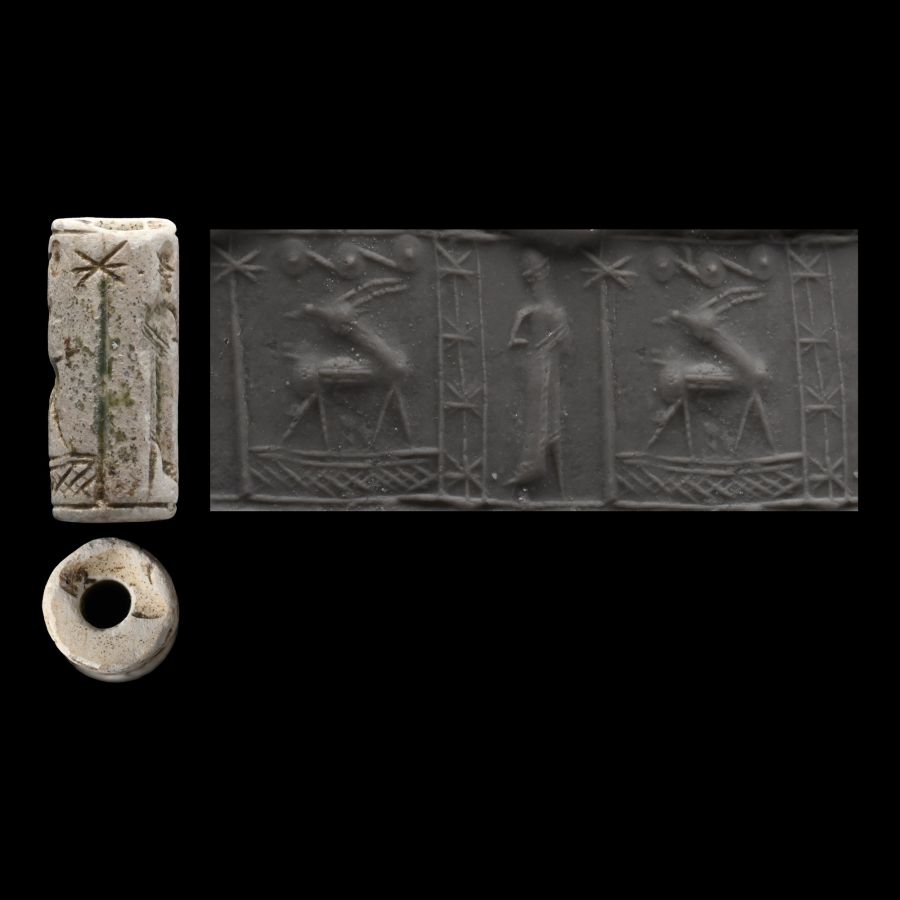
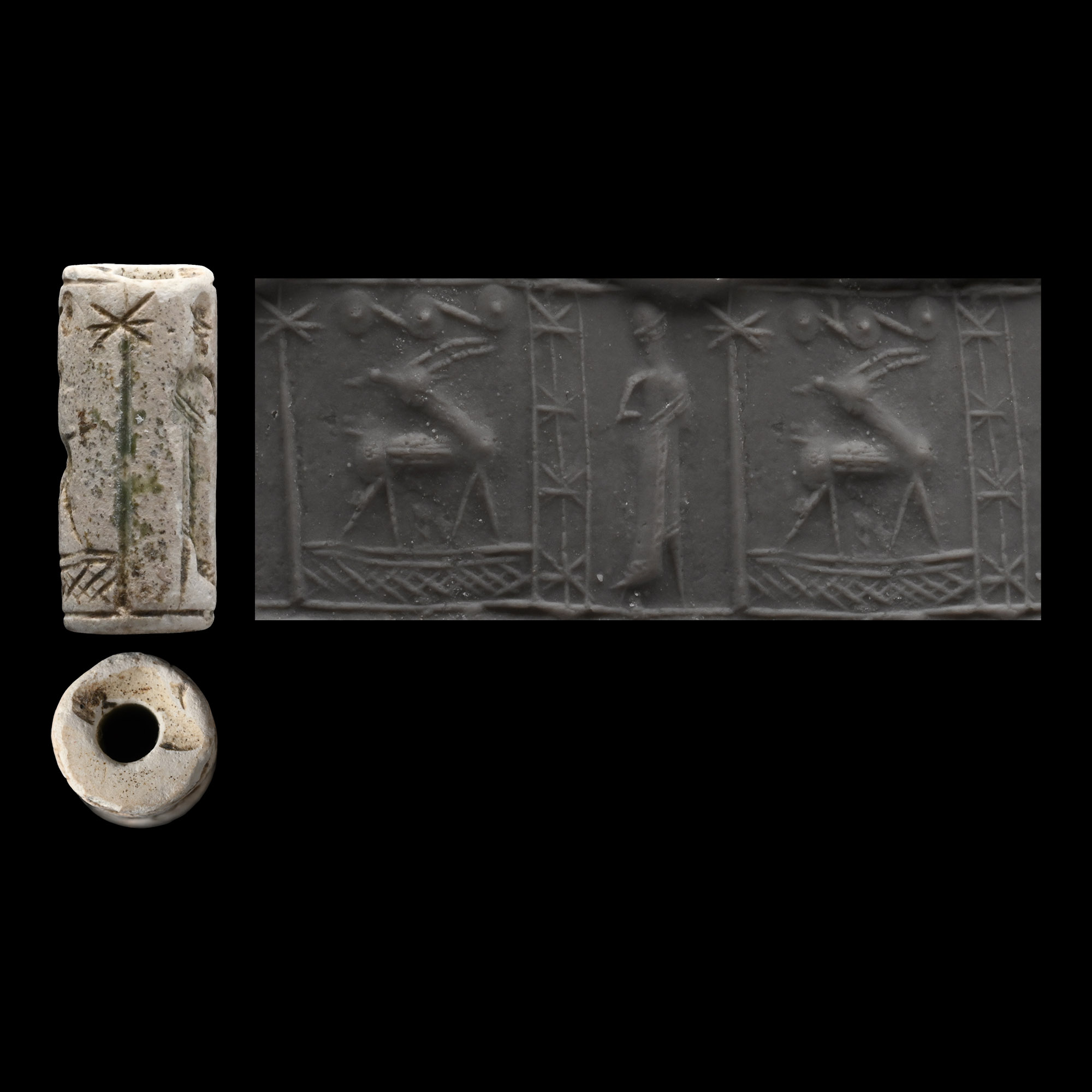
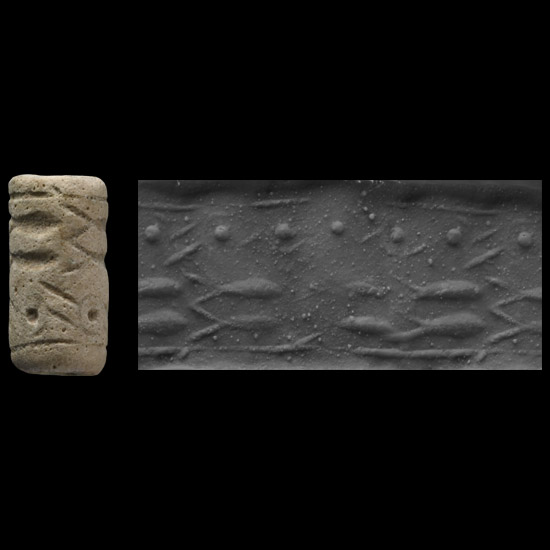
Mitanni Faience Cylinder Seal with Man and Beast
CIRCA 1400 B.C.
3/4 in. (1.6 grams, 21 mm).
Cylindrical seal with a standing, robed figure wearing a headdress, before him a standing ibex with curved horns, facing back; supplied with a museum-quality impression. [No Reserve]
Provenance
From a late Warwickshire numismatic collector, his collection formed from the early 1980s.
CONDITIONVETTING:
TimeLine Auctions follows a vetting process to ensure the authenticity and legality of all items, reinforcing our commitment to integrity and responsible trading. Each antiquity, antique, and coin lot undergoes thorough examination by a vetting committee of at least ten external specialists, professional trade association members, scientists, and archaeologists: Our Vetting Process
AUCTIONS:
TimeLine is a leading auction house specialising in antiquities, ancient art, collectables, natural history, coins, medals, and books. Our auctions offer museums, collectors, historians, and enthusiasts the opportunity to acquire unique and historically significant pieces.
RELATED LOTS
-
South Arabian Carving of a Nude Couple in Erotic Embrace with Inscription
1st century B.C.-1st century A.D.Estimate: £4,000 - 6,000 (‡+bp*)
Opening Bid: £2,222
Modelled in the round as two figures embracing, the upper figure with a pseudo inscription to the back; mounted on a custom-made stand. 380 grams total, 13.3 cm including stand
Formerly in the collection of Mr K. Ex collection of Mr H., acquired in Switzerland in the early 2000s. Private collection, Switzerland, acquired in 2010. This lot has been checked against the Interpol Database of stolen works of art and is accompanied by a search certificate number no.12875-241696. -
Royal Elamite Cuneiform Brick for King Shihak-Insusinak I
1150-1120 B.C.Sold for (Inc. bp): £4,420
A fired clay brick with seven lines of cuneiform text referring to King Shihak-Insusinak I; accompanied by a scholarly note by Dr Manuel Ceccarelli, PhD earned at the University of Tübingen, Germany, which states: 'Brick with Elamite cuneiform inscription of Shilhak-lnshushinak, king of Elam (South-West Iran), ca. 1150-1120 BCE. This royal inscription celebrates the restoration of the temple of the goddess Kirisha. The inscription can be reconstructed thanks to similar bricks.'I, Shilhak-lnshushinak, son of Shutruk-Nahhunte, beloved servant of Kiririsha and Inshushinak, King of Anzan and Susa: Humbanumena built the temple of Kiririsha-of-Liyan with unbacked mudbricks, and, as it threatened ruin, I restored it to its original state: with backed bricks, I (re)built it, and for my life, for the life of Nahhunte-Utu, of Hutelutush-lnshushinak, of Shilhina-hamru-Lakamar, of Kutir-Huban, of lshnikarab-huhun, of Urutuk -EI-halahu and of Utu-ehihi-Pinigir, with this intention,for our sake(?), I gave it to Kiririsha, my goddess.''; mounted on a custom-made stand. 2.96 kg total, 34.5 cm wide including stand
Private UK collection. with Bonhams, London, 22 September 1998, no.140. Private collection, UK. Acquired on the UK art market. Accompanied by copies of the relevant Bonhams catalogue pages and Dr Manuel Ceccarelli's notes. This lot has been checked against the Interpol Database of stolen works of art and is accompanied by a search certificate number no.13233-250320.
The name of this king, like that of many kings of Elam, was linked to a deity. Inshushinak was one of the major gods of the Elamites and the protector of the city of Susa in the state of Elam. He played an important role as a deity associated with royal power in the official ideology of many Elamite dynasties. King Atta-Hushu of the Sukkalmah dynasty called himself 'the shepherd of the god Inshushinak’. Many rulers dedicated new building projects to Inshushinak, using the formula 'or his (i.e., the king's) life.' The Shutrukids commonly used the title '(king) whose kingdom Inshushinak loves.' -
Western Asiatic Votive Terracotta Dagger
1st century B.C.Estimate: £250 - 350 (‡+bp*)
Opening Bid: £133
Model dagger with two-lobed pommel and similar guard, applied bands to the scabbard, two attachment points. 5.83 grams, 88 mm
Japanese private collection, assembled in the 1990s. Acquired from the above in 2010. European private collection.