
Loading, please wait...
_900x900.jpg "Minoan Rock Crystal Gemstone with Ship")
_200x200.jpg "Minoan Rock Crystal Gemstone with Ship")
.jpg "Minoan Rock Crystal Gemstone with Ship")
LOT 0090
Minoan Rock Crystal Gemstone with Ship
1500-1200 B.C.
5/8 in. (3.1 grams, 16 mm).
Discoid body, on one face engraving of a ship with curved body, paddles and cross-hatched sail; pierced vertically for suspension. [No Reserve]
ProvenanceFrom an old London, UK, collection formed before 1975.
Property of a Middlesex, UK, gentleman antiquarian.
This lot is accompanied by an illustrated lot declaration signed by the Head of the Antiquities Department, Dr Raffaele D'Amato.
Cf. Michael C. Carlos Museum, object no. 2010.013.001; Ashmolean Museum, AN1938.761.
CONDITIONTimeLine Auctions follows a vetting process to ensure the authenticity and legality of all items, reinforcing our commitment to integrity and responsible trading. Each antiquity, antique, and coin lot undergoes thorough examination by a vetting committee of at least ten external specialists, professional trade association members, scientists, and archaeologists: Our Vetting Process
AUCTIONS:
TimeLine is a leading auction house specialising in antiquities, ancient art, collectables, natural history, coins, medals, and books. Our auctions offer museums, collectors, historians, and enthusiasts the opportunity to acquire unique and historically significant pieces.
-
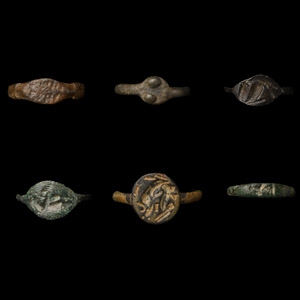
Greek and Other Bronze Ring Collection
4th century B.C.-2nd century A.D.Sold for (Inc. bp): £104
Including discoid, scaphoid, pelletted and other bezel types. 10.12 grams total, 18-24 mm
Ex London, UK, gentleman 1980-1990s. This lot is accompanied by an illustrated lot declaration signed by the Head of the Antiquities Department, Dr Raffaele D'Amato. -
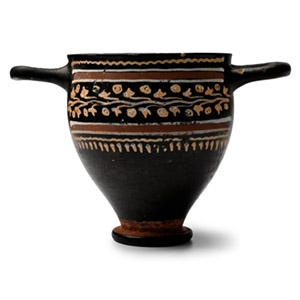
Greek Apulian Gnathian Ware Skyphos
Magna Graecia, 5th-3rd century B.C.Sold for (Inc. bp): £390
With tiered foot and two square handles; to one face a garland of ovolo below the rim, in white with ivy leaves; bands of pellets to the reverse. 96 grams, 12.7 cm wide
From the private collection of a Canadian gentleman living in Essex, UK, formed since the 1920s-circa 1990. Property of an Essex lady until the late 1990s; thence by descent. From the private collection of an Essex gentleman since the late 1990s. This lot is accompanied by an illustrated lot declaration signed by the Head of the Antiquities Department, Dr Raffaele D'Amato. -
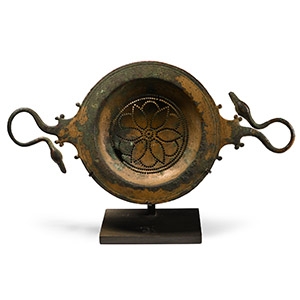
Greek Bronze Wine Strainer with Swan-Head Handles
4th-3rd century B.C.Estimate: £7,000 - 9,000 (‡+bp*)
Opening Bid: £3,889
Comprising a shallow bowl and broad flange rim, two integral scalloped handles with lateral scrolled flourishes, each tapering to a S-curved handle with swan-head terminals with incised eye and beak detailing; perforated whirl within roundel to interior base; accompanied by a custom-made display stand with mirror. 402 grams total, 19.7 cm including stand
with Hôtel des ventes de Belfort Sarl, October 2011, no.16. Acquired by the present owner at the above sale. Accompanied by an academic report by Dr Raffaele D'Amato. This lot has been checked against the Interpol Database of stolen works of art and is accompanied by search certificate number no.12209-222140. This lot has been cleared against the Art Loss Register database, and is accompanied by an illustrated lot declaration signed by the Head of the Antiquities Department, Dr Raffaele D'Amato.
Elaborate gilded strainers, such as this present example, were used at symposia and festive occasions for the purpose of preventing the dregs of wine from entering the wine cup. This and other related silver utensils became popular in the later 4th and 3rd century B.C. These highly decorated wine strainers were fitted with dual handles forming loops in the shape of twisting animals, here a swan. Usually they took the form of a shallow dish complete with four rings of perforations in the centre in order to drain the wine. Strainers of this type were used to separate out sediments which could be found in the thick Greek wine. Examples similar to this one have been found in royal tombs in northern Greece, as well as the tomb of a monarch in Sudan.
