
Loading, please wait...
_900x900.jpg "Military Button Group")
_200x200.jpg "Military Button Group")
.jpg "Military Button Group")
LOT 1417
Military Button Group
MAINLY 20TH CENTURY A.D.
5/8 - 1 5/8 in. (240 grams total, 15-41 mm).
A mixed group of bronze military buttons with repoussé heraldic motifs, and a cap badge of the Royal Artillery Corp. [90, No Reserve]
ProvenanceFound by John Harrison whilst searching with a metal detector in South Yorkshire, UK.
CONDITIONTimeLine Auctions follows a vetting process to ensure the authenticity and legality of all items, reinforcing our commitment to integrity and responsible trading. Each antiquity, antique, and coin lot undergoes thorough examination by a vetting committee of at least ten external specialists, professional trade association members, scientists, and archaeologists: Our Vetting Process
AUCTIONS:
TimeLine is a leading auction house specialising in antiquities, ancient art, collectables, natural history, coins, medals, and books. Our auctions offer museums, collectors, historians, and enthusiasts the opportunity to acquire unique and historically significant pieces.
-

Bactrian Style Lapis Lazuli Bead Necklace
20th century A.D.Sold for (Inc. bp): £59
A bead necklace composed of graduated lapis lazuli beads of various types, including tubular, biconical, oblate and other types. 143 grams, 48 cm long
Acquired 1980-2015. Ex Abelita family collection. -
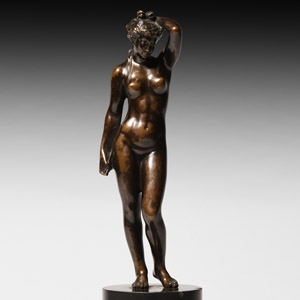
Renaissance Bronze Female Figure
16th-17th century A.D. or earlierSold for (Inc. bp): £3,900
A naturalistic bronze female figure modelled standing contrapposto, nude, looking down towards her feet, one arm reaching over her head towards her neck, the other resting by her side, her weight placed on her right leg, hair tied into an elaborate bun with a ribbon, short ringlets falling down her nape and the end of the ribbon cascading over her shoulder, along the side of her right breast and down to her thigh, where she is holding the end; mounted on a custom-made display base. 754 grams, 20.5 cm high
English private collection.
With stylistic similarities to work by Giovanni Bologna; possibly Italian or Northern European. -
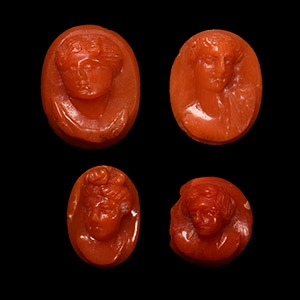
Naples Cameo Group
Late 19th century A.D.Sold for (Inc. bp): £72
A group of four coral cameos displaying ladies of fashion in relief, each individual in pose, character and detail. 1.49 grams total, 8-12 mm
From the collection of G.M.R.H., London, UK.
