
Loading, please wait...
LOT 0232
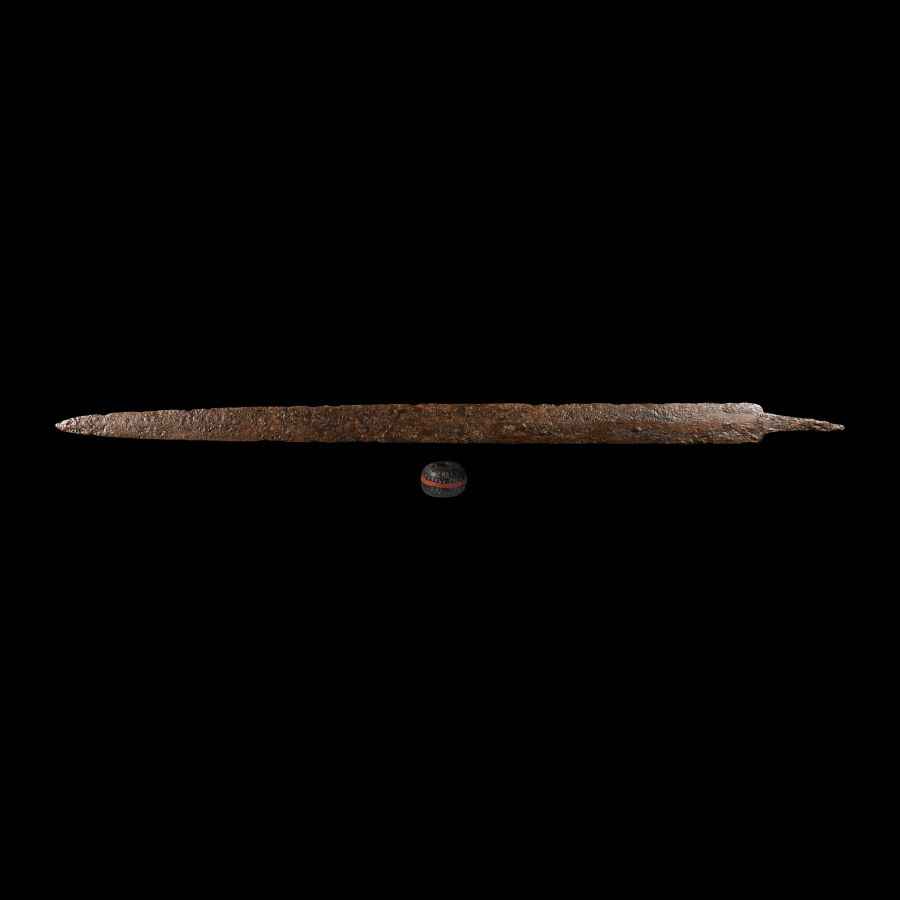
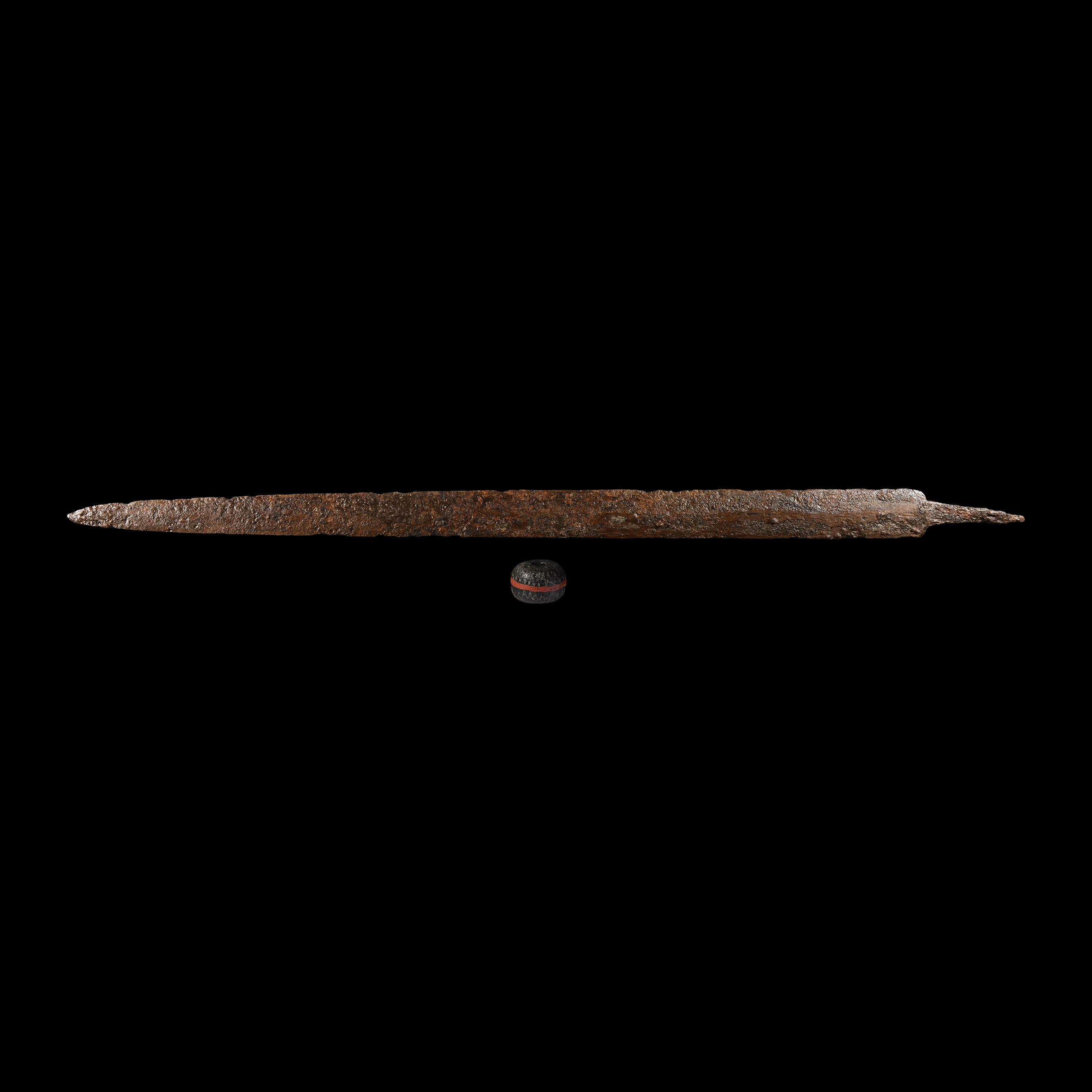
Migration Period Sword Blade with Agate Pommel
CIRCA 5TH-6TH CENTURY A.D.
1 3/8 - 32 5/8 in. (823 grams total, 3.5-83 cm).
A two-edged parallel-sided iron blade with broad pointed tip, battle nicks to both cutting edges; accompanied by a discoid agate pommel. [2, No Reserve]
ProvenanceAcquired 1971-1972.
From the collection of the vendor's father.
Property of a London, UK, collector.
Accompanied by an academic report by Dr Raffaele D’Amato.
See Behmer, E., Das zweischneidige Schwert der germanischen Völkerwanderungszeit, Stockholm, 1939; Lebedinsky, I., Armes et guerriers barbares au temps des grandes invasions, Paris, 2001; Spier, J., Treasures of the Ferrell collection, Wiesbaden, 2010.
CONDITIONTimeLine Auctions follows a vetting process to ensure the authenticity and legality of all items, reinforcing our commitment to integrity and responsible trading. Each antiquity, antique, and coin lot undergoes thorough examination by a vetting committee of at least ten external specialists, professional trade association members, scientists, and archaeologists: Our Vetting Process
AUCTIONS:
TimeLine is a leading auction house specialising in antiquities, ancient art, collectables, natural history, coins, medals, and books. Our auctions offer museums, collectors, historians, and enthusiasts the opportunity to acquire unique and historically significant pieces.
-
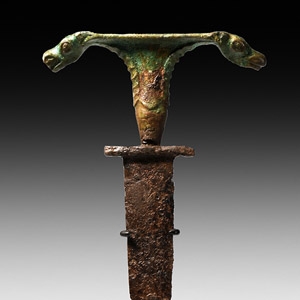
Heniochi Dagger with Beast Heads
4th-2nd century B.C.Sold for (Inc. bp): £520
A short iron dagger with triangular blade, short straight guard surmounted by a bronze pommel characterised by twinned beast heads projecting from each side; accompanied by a custom-made display stand. 170 grams, 28 cm (753 grams total, 39 cm high including stand)
Acquired 1971-1972. From the collection of the vendor's father. Property of a London, UK, collector.
The tribe of the Heniochs, according to Artemidorus of Ephesus, existed during the 5th-1st century B.C., on the Black Sea littoral that is part of present-day Abkhazia. Aristotle describes the Heniochi as a group of people "ready enough to kill and eat men." The dagger shows similarities with the pommel of a sword from Akhul Abaa grave 4 with twinned beast heads. These weapons of subtype I, according to the classification of Gamkrelidze-Shatberashvili-Pirtskhalava-Charkviani, were popular not only in Abkhazia, but throughout the territory of west Georgia during the 4th-1st century B.C. -
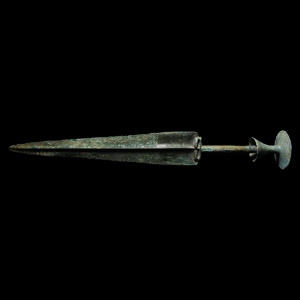
Luristan 'Cotton Reel' Pommel Sword
13th-6th century B.C.Sold for (Inc. bp): £889
A bronze sword with a broad double-edged blade with a central ridge on both sides, square bronze hilt with goblet-shaped pommel surmounted by a disc. 725 grams, 51 cm
Fine condition.
Acquired 1980-2015. Ex Abelita family collection.
Bimetallic swords (some examples are entirely cast in iron and others entirely cast in bronze) with disc pommel, slender cylindrical grip and tapering blades of this type are among the most common types of daggers / swords in Northern Iranian graveyards. This type has occasionally been referred to as the 'cotton reel' pommel, as below the flat circular pommel there is a second, a rather wide disc, and a plain or incised cylindrical grip in between. -
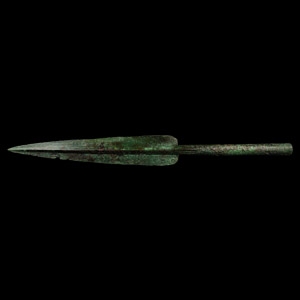
Marlik Decorated Spearhead
14th-10th century B.C.Sold for (Inc. bp): £330
A bronze spearhead with projecting midribs, long folded socket, decorated by concentric horizontal lines at the base and beneath the blade, horizontal triangles and vertical grooves along the shaft; triangular blade with round shoulders, ornamented by vertical lines running parallel to the midrib; pair of holes on the lower part of the shaft for attachment to a wooden haft. 562 grams, 55 cm
Fine condition.
Ex important Japanese collection, 1970s-2010.
The spearhead, cast in one piece, belongs to the type VIII, subtype B (triangular blade) of the Khorasani classification. Similar spearheads were excavated by Dr Negahban in the Marlik necropolis (tomb 1, trench III D) and are preserved in the National Museum of Iran, Teheran.
