
Loading, please wait...
LOT 0231
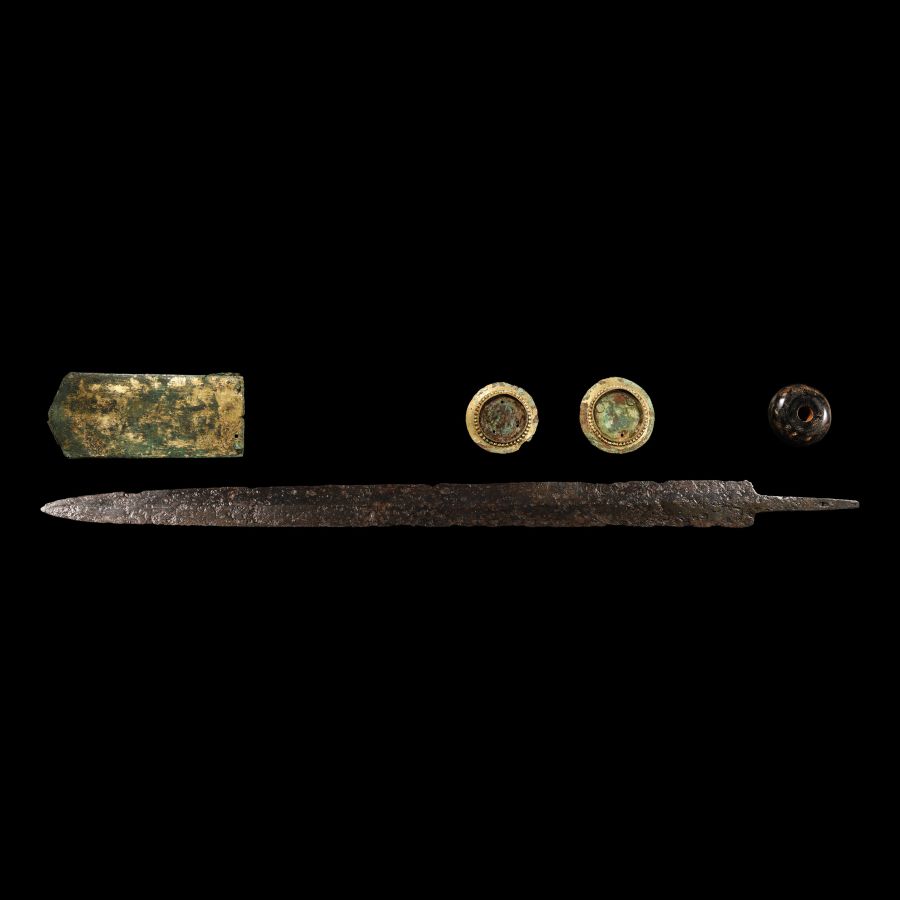
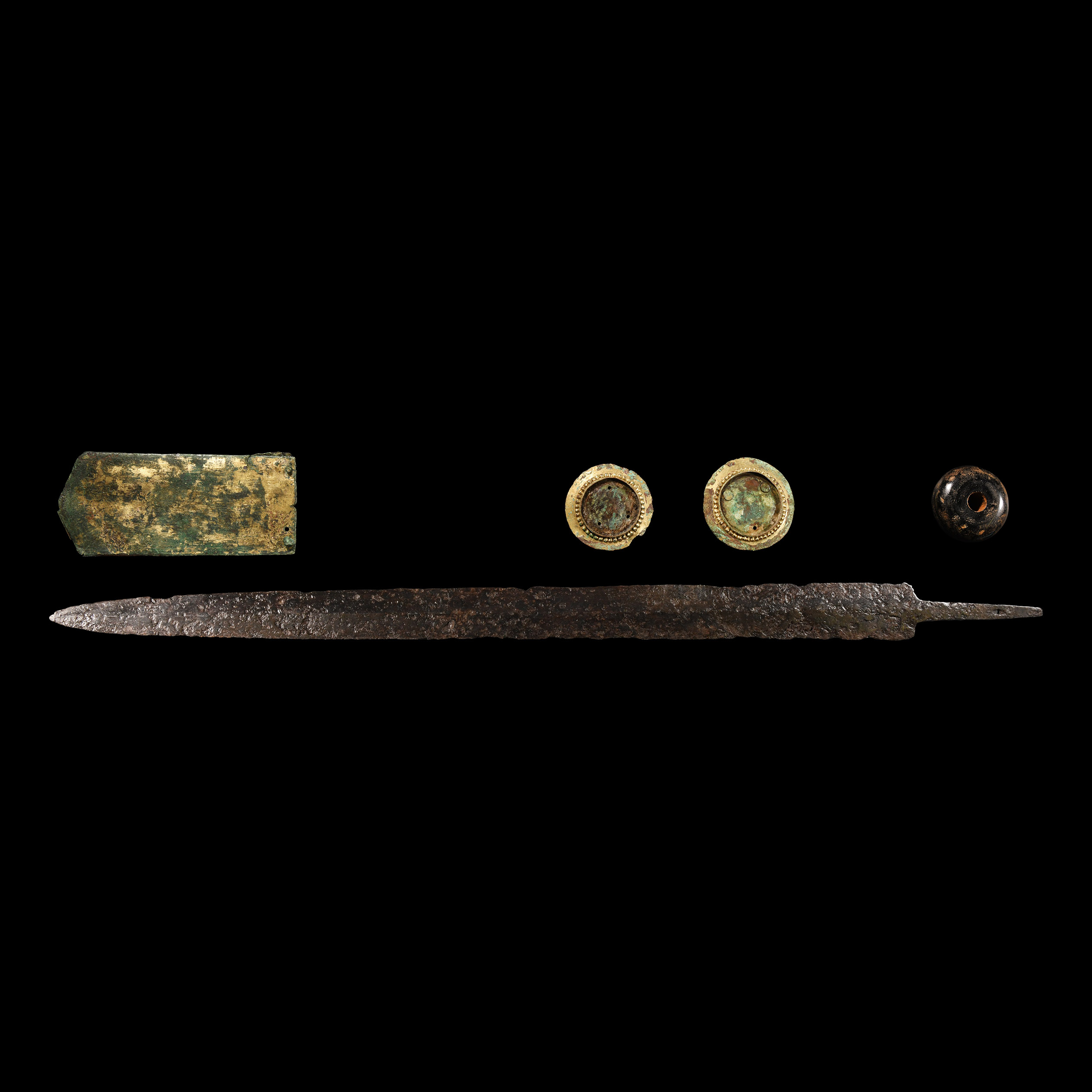
Migration Period Spatha Sword Blade with Fittings
CIRCA 4TH-5TH CENTURY A.D.
2 - 32 in. (937 grams total, 5-81.3 cm).
A military assemblage comprising: a double-edged spatha with a lentoid parallel-sided iron blade and pointed tip, battle nicks to both cutting edges; long tang with a bronze fastening rivet in situ; oblate chalcedony pommel; gilt copper-alloy chape scabbard fitting with fastening holes and a pair of round scabbard or baldric fittings. [4, No Reserve]
ProvenanceAcquired 1971-1972.
From the collection of the vendor's father.
Property of a London, UK, collector.
Accompanied by an academic report by Dr Raffaele D’Amato.
This lot has been checked against the Interpol Database of stolen works of art and is accompanied by a search certificate number no.11587-198852.
Cf. Lebedinski, I., Armes et guerriers Barbares au temps des grandes invasions IVème au Vième siècle après J.C., Paris, 2001, pp.117ff.; Kazanski, M.M., “Парадные” мечи эпохи Великого переселения народов на Боспоре Киммерийском’ ("Ceremonial" swords of the era of the Great Migration of People in the Cimmerian Bosporus, in Russian), in Bosporos Studies / Боспорские Исследования, 2022, 44, pp.177-201, figs.3, 7, no.1, for similar scabbard and fitting parts.
FootnotesPrestigious swords with richly trimmed sheaths, guards and hilts of the Great Migration Period on the Cimmerian Bosphorus are very few, although some specimens have been excavated from Kerch, Phanagoria, Hermonassa and Dzhurga-Oba. They were either custom-made or received as war booty. This sword belongs to a group of spathae of late Roman typology spread among the Germanic and Nomad foederati, and garrison troops of the Northern Black Sea and Bosphorus.
CONDITIONTimeLine Auctions follows a vetting process to ensure the authenticity and legality of all items, reinforcing our commitment to integrity and responsible trading. Each antiquity, antique, and coin lot undergoes thorough examination by a vetting committee of at least ten external specialists, professional trade association members, scientists, and archaeologists: Our Vetting Process
AUCTIONS:
TimeLine is a leading auction house specialising in antiquities, ancient art, collectables, natural history, coins, medals, and books. Our auctions offer museums, collectors, historians, and enthusiasts the opportunity to acquire unique and historically significant pieces.
-
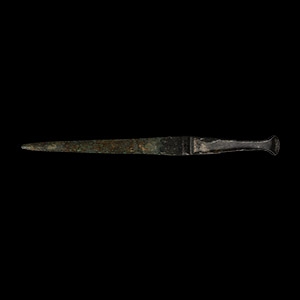
Luristan Dirk with Cuneiform Inscription
1125-1104 B.C.Estimate: £8,000 - 10,000 (+bp*)
Opening Bid: £4,000
A bronze dirk or dagger with raised flanges to the grip, possibly to accept organic inserts, cuneiform script over two lines inscribed to the blade below the grip on both faces; blade repaired. 188 grams, 40 cm
with a London, UK gallery 1971-early 2000s. Accompanied by an academic report by Dr Raffaele D'Amato. This lot has been checked against the Interpol Database of stolen works of art and is accompanied by search certificate number no.11591-199676.
This is a dagger with an inscription of King Nebuchadnezzar I of Babylon, 1125-1104 B.C. The inscription is identical to those on four other bronze daggers (reportedly from Luristan), three of which are in the Foroughi collection and one in the Iran Bastan museum (National Museum of Iran, inventory no.626/1626). The Type IIIa bronze dirk of the Medveskaya classification belongs to a series of weapons bearing the same engraved inscription in Babylonian cuneiform script which reads: 'It belongs to Nabu, the King of Kiohatti, the King of Babylon, King of Sumer and Akkad'. It was cast in one piece (hilt and blade) and probably formed an endowment to the royal guard. -
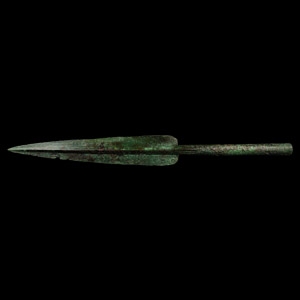
Marlik Decorated Spearhead
14th-10th century B.C.Sold for (Inc. bp): £330
A bronze spearhead with projecting midribs, long folded socket, decorated by concentric horizontal lines at the base and beneath the blade, horizontal triangles and vertical grooves along the shaft; triangular blade with round shoulders, ornamented by vertical lines running parallel to the midrib; pair of holes on the lower part of the shaft for attachment to a wooden haft. 562 grams, 55 cm
Fine condition.
Ex important Japanese collection, 1970s-2010.
The spearhead, cast in one piece, belongs to the type VIII, subtype B (triangular blade) of the Khorasani classification. Similar spearheads were excavated by Dr Negahban in the Marlik necropolis (tomb 1, trench III D) and are preserved in the National Museum of Iran, Teheran. -
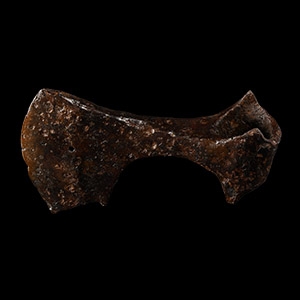
Viking Period Bearded Axehead
Circa 9th-11th century A.D.Sold for (Inc. bp): £169
A hand-forged iron axehead with triangular-section narrow blade widening to a broad bevelled edge with square chin, socket with lateral flanges and rectangular panel to the rear. 422 grams, 15.2 cm
Acquired 1971-1972. From the collection of the vendor's father. Property of a London, UK, collector.
The axe appears to belong to the typology of Viking side axes of Wheeler type B (Wheeler III / Rygh 559). Usually these bearded axeheads (skeggöks) had a longer edge, designed to split tree trunks into planks and beams, or heads during the battle. Some of the bearded axes were known as halfÞynna öx, the neck on such 'half thin axe' was thinly forged, to make it lighter.
