
Loading, please wait...


LOT 0334
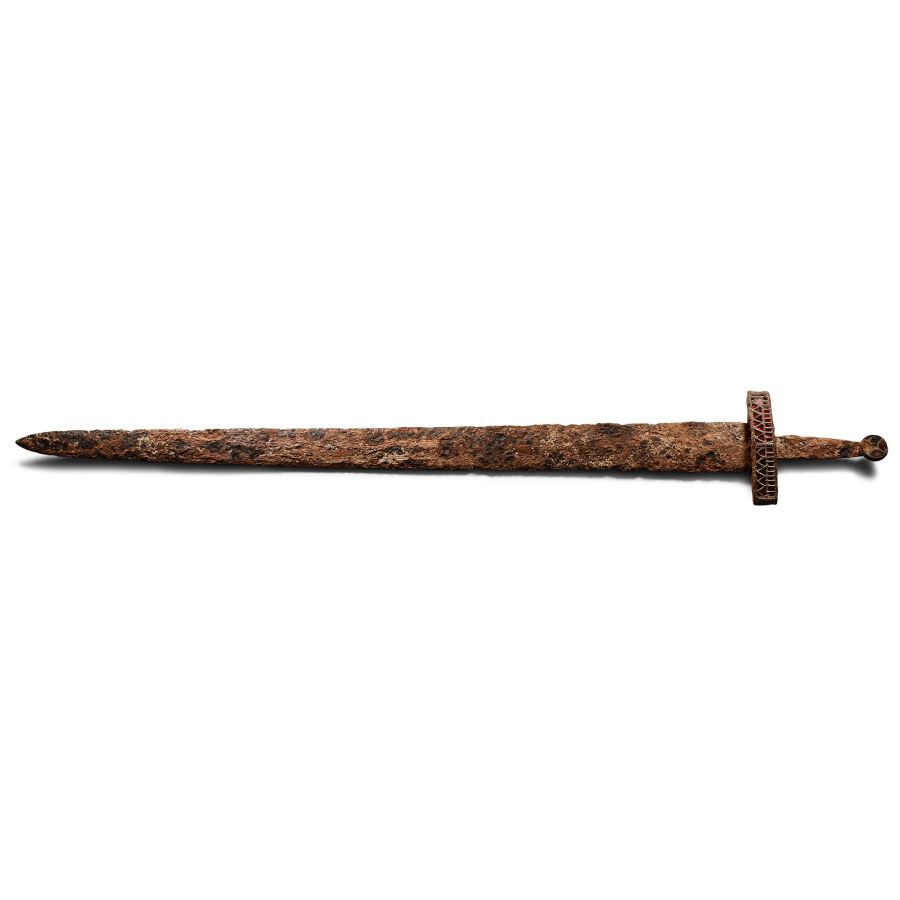
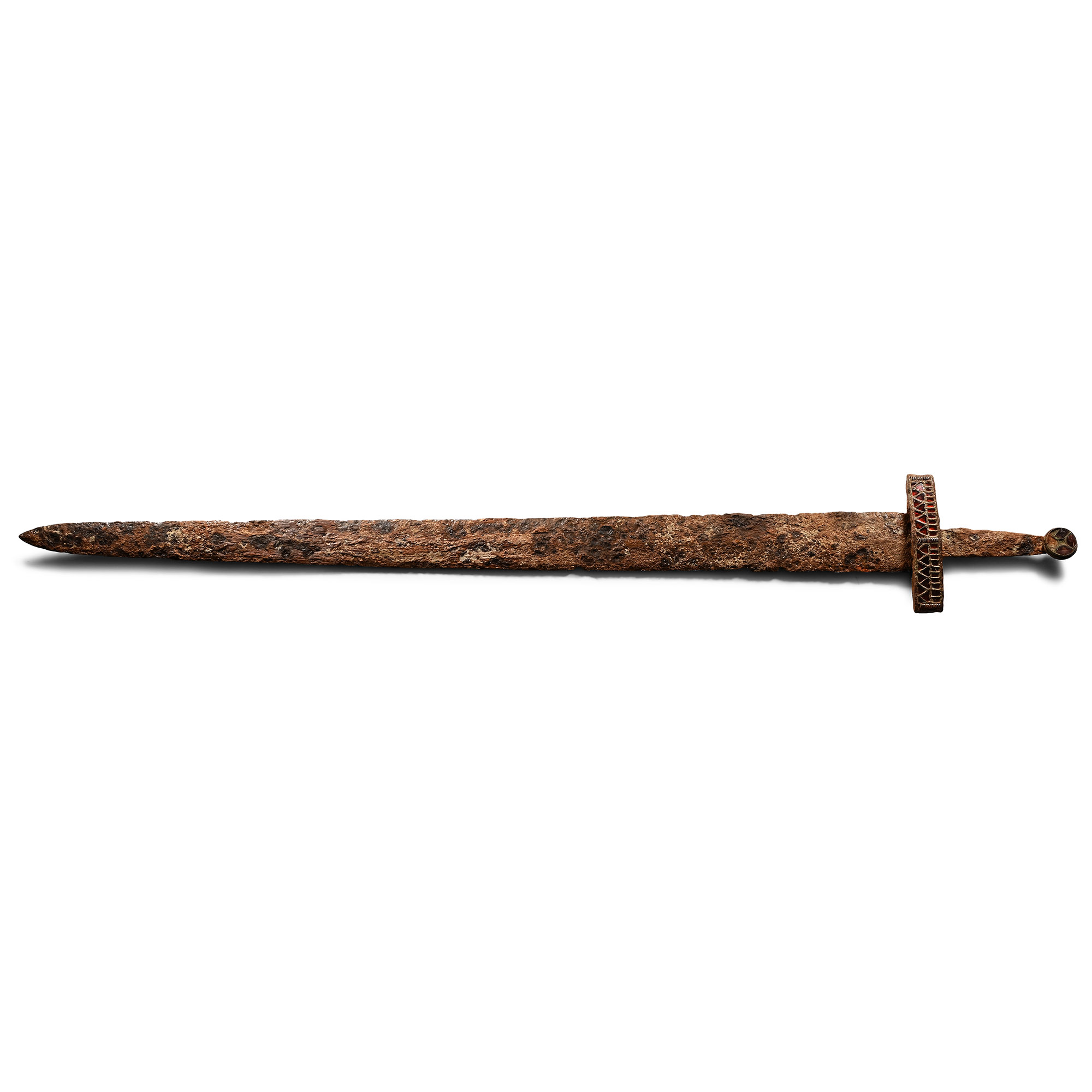
Migration Period Iron Sword with Jewelled Hilt
5TH-6TH CENTURY A.D.
33 in. (954 grams, 84.5 cm).
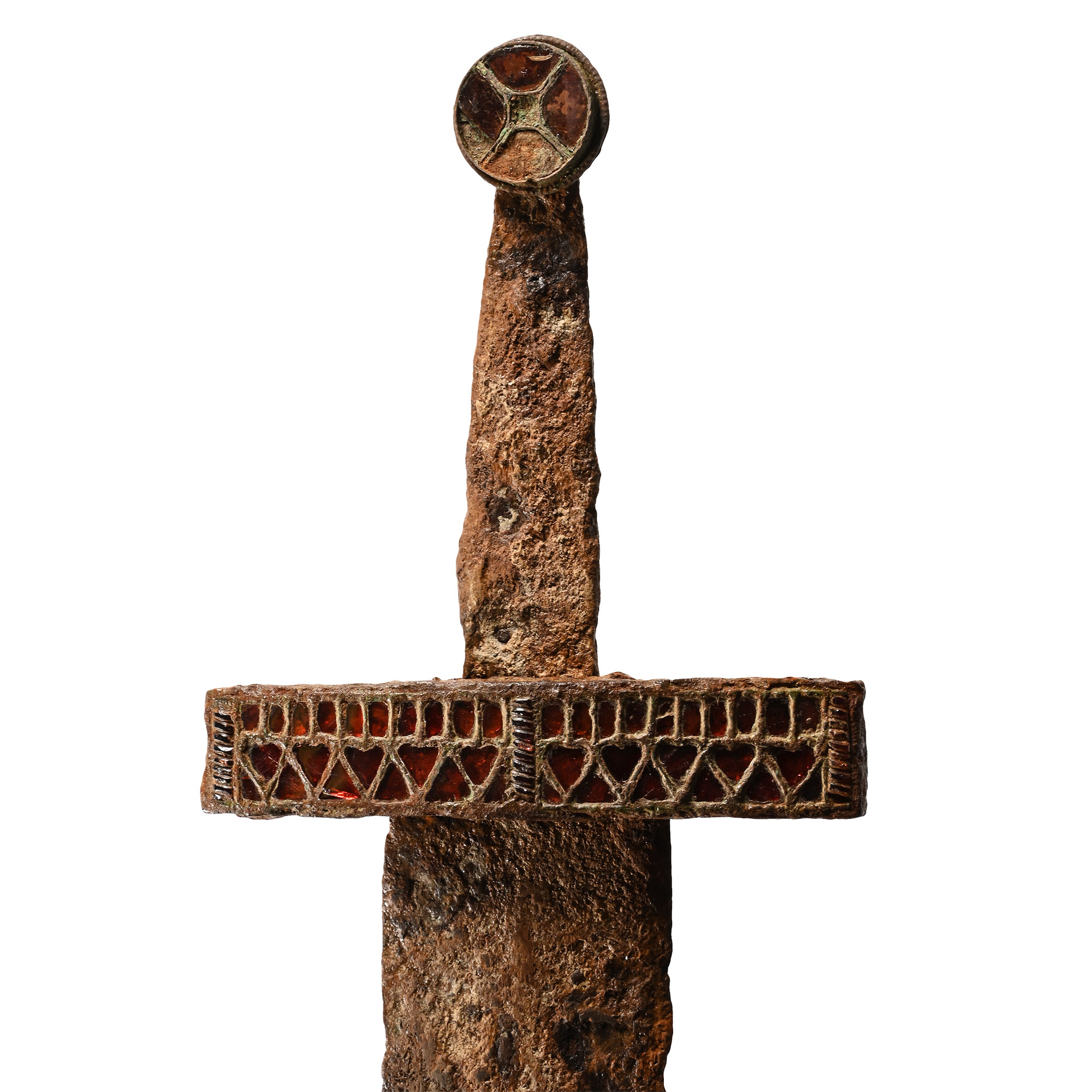
Comprising: a spatha-type two-edged tapering blade, lentoid in section with sloped shoulders and short tang pierced by an attachment rivet for the grip; traces to both faces of the blade of wooden fibre from the scabbard; edges lightly notched but substantially complete; the lower guard rectangular in plan and scaphoid in section with inset garnet cloisons, triangular along the lower row and heart-shaped above, rectangular at the top, with small rectangular slivers at each end; accompanied by the upper roundel of the pommel, set with four garnet cloisons.
ProvenanceFrom the private collection of a London gentleman, from his grandfather's collection formed before the early 1970s.
Accompanied by an academic report by Dr Raffaele D’Amato.
This lot has been checked against the Interpol Database of stolen works of art and is accompanied by search certificate no. 12357-225921.
Cf. Menghin, W., Das Schwert im Frühen Mittelalter, Stuttgart, 1983, p.335, for cloisonné on guard; Zasetskaïa, I.P., Kul’tura Kotchovnikov iujnorusskikh stepeï v gunnskuïu epokhu (Culture of the nomads of the southern Russian steppes in the Hun Era), Saint Petersburg, 1994; Lebedinski, I., Armes et guerriers Barbares au temps des grandes invasions IVème au Vième siècle après J.C., Paris, 2001, pp.117ff., swords from Loutchistoïé, Novohryhorivka, Bátaszék, Jakuszowice, Szirmabesényo, Ártánd, Horgos; Miks, C., Studien zur Römischen Schwertbewaffnung in der Kaiserzeit, I-II Banden, Rahden, 2007; Kazanski, M.M., Barbarians at the borders of the Eastern Roman Empire (in Russian), Simferopol, 2024, figs.7, 12, pp.20, 23, p.31, pl.36, for similar cross-guards.
FootnotesThese ‘ceremonial’ swords (in reality widely used in battle) with an inlaid guard are according to Kazanski Late Roman in origin. The cloisonné decoration was probably linked with the production of particularly ornamented swords in the ateliers of the Roman capital of Constantinople. This typology of weapon was not only produced as a gift for Barbarian chiefs allied to the empire, but it was also adopted by the Imperial army, and reserved for the Imperial officers, who were often of Germanic or Asiatic origin.
CONDITIONTimeLine Auctions follows a vetting process to ensure the authenticity and legality of all items, reinforcing our commitment to integrity and responsible trading. Each antiquity, antique, and coin lot undergoes thorough examination by a vetting committee of at least ten external specialists, professional trade association members, scientists, and archaeologists: Our Vetting Process
AUCTIONS:
TimeLine is a leading auction house specialising in antiquities, ancient art, collectables, natural history, coins, medals, and books. Our auctions offer museums, collectors, historians, and enthusiasts the opportunity to acquire unique and historically significant pieces.
LOT 0334
Migration Period Iron Sword with Jewelled Hilt
Estimate £8,000 - 10,000€9,280 - 11,600 (for guidance only)$10,800 - 13,500 (for guidance only)
-
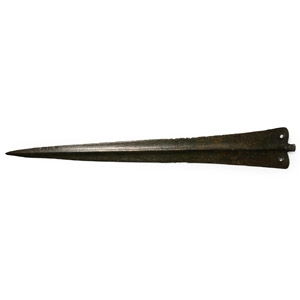
Luristan Bronze Blade
1200-1100 B.C.Estimate: £250 - 350 (+bp*)
Opening Bid: £130
With a long pointed triangular blade and a short tang, two rivet holes at the base of the blade. 193 grams, 36.5 cm
Acquired 1980-2015. Ex Abelita family collection.
The Luri people produced a quantity of fine metalwork, which according to Dr. Khorasani, could be due to a settled period which arose as a result of the defeat of the Elamites by the Babylonians, leaving the Luristani people in relative peace for a period of time after 1200 BC. According to Khorasani 'A culture of innovation and experimentation flourished, and the repertoire of the Luristan smiths expanded in the period between 1150–1050 BC.' -
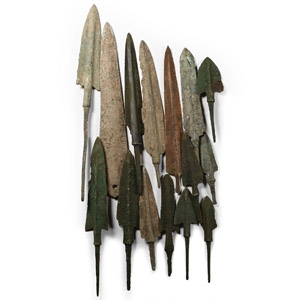
Luristan Bronze Arrow and Blade Group
13th-7th century B.C.Sold for (Inc. bp): £364
Including narrow two-edged dagger blade, barbed-and-tanged arrowhead and other types. 422 grams total, 7.5-20.5 cm
Ex London, UK, collection, 1990s. -
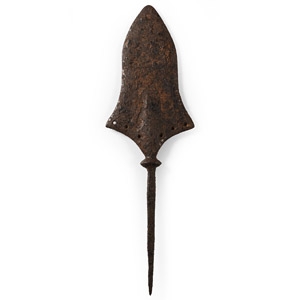
Medieval Pierced Incendiary Fire Arrowhead
Circa 12th-14th century A.D.Sold for (Inc. bp): £104
With bell-shaped profile and holes to the trailing edge, baluster to the neck, square-section tang. 81 grams, 18.1 cm
Private Buckingham, UK, collection, formed before 2000.
