
Loading, please wait...
LOT 0303
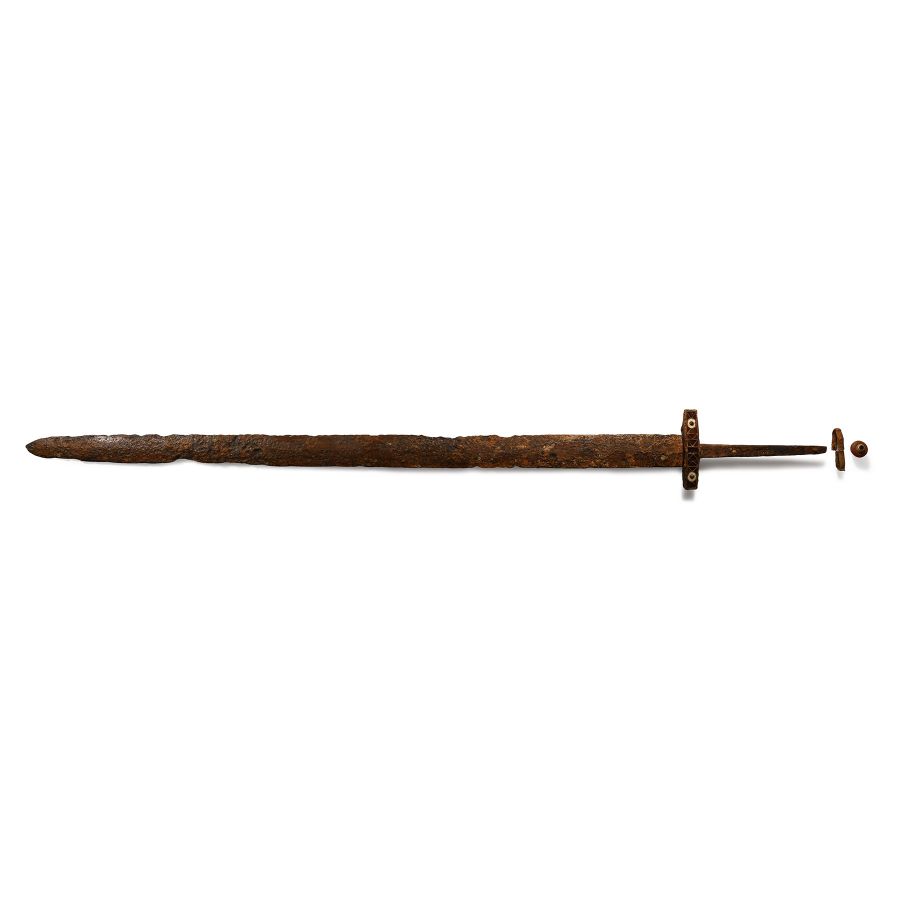
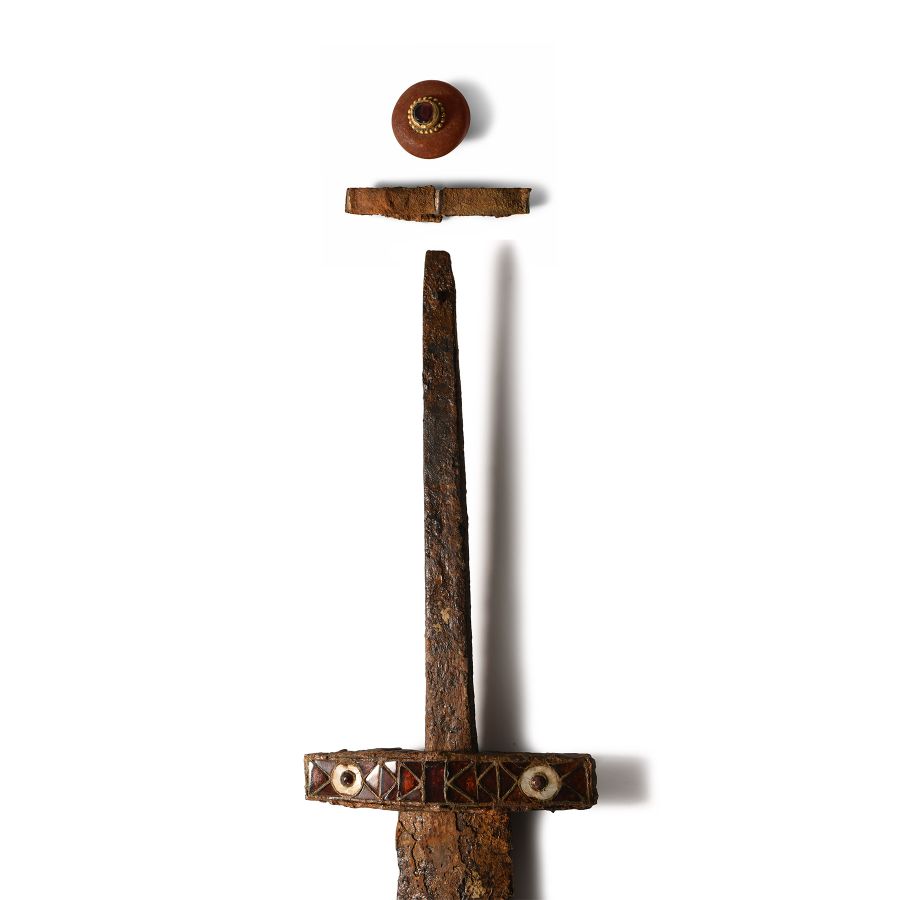
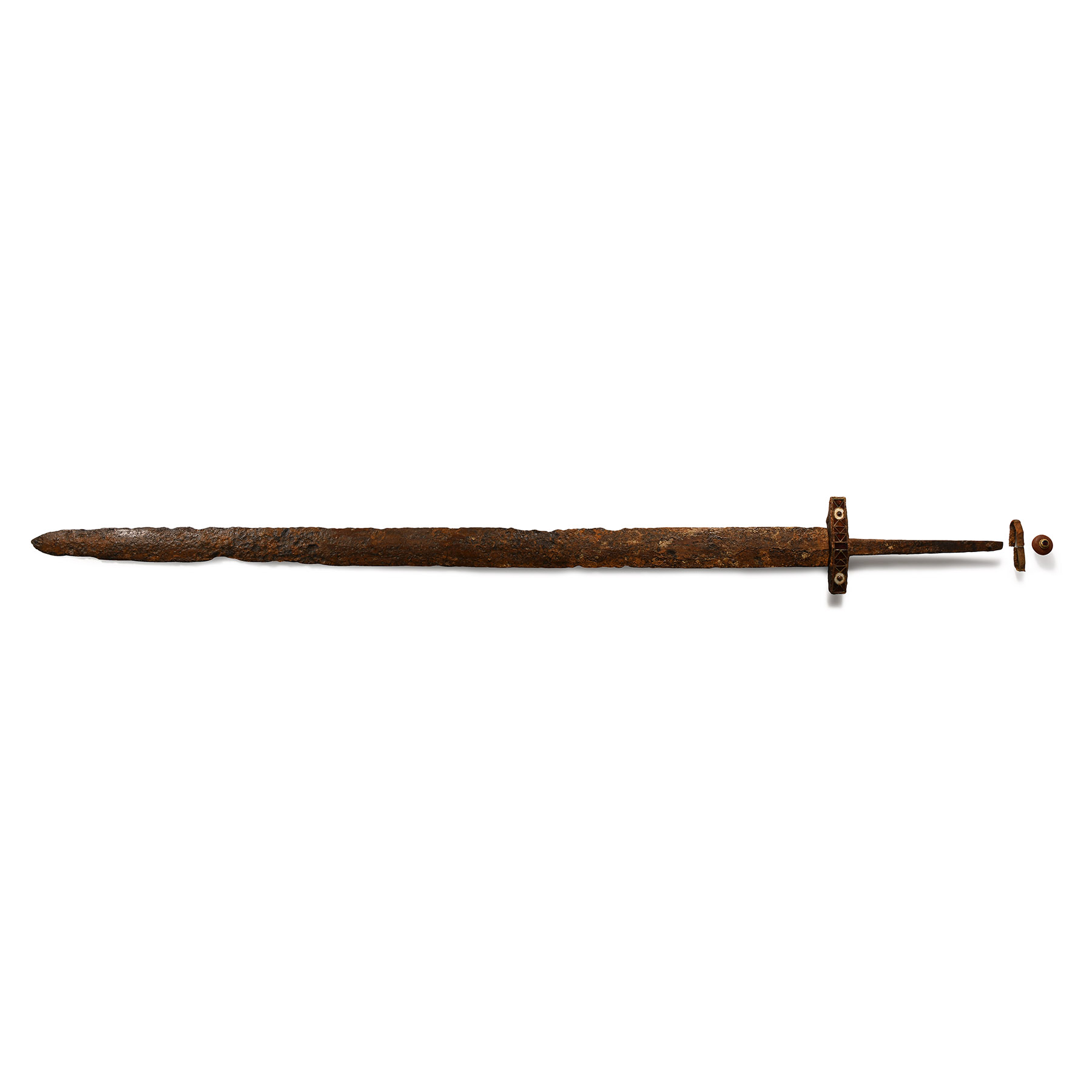
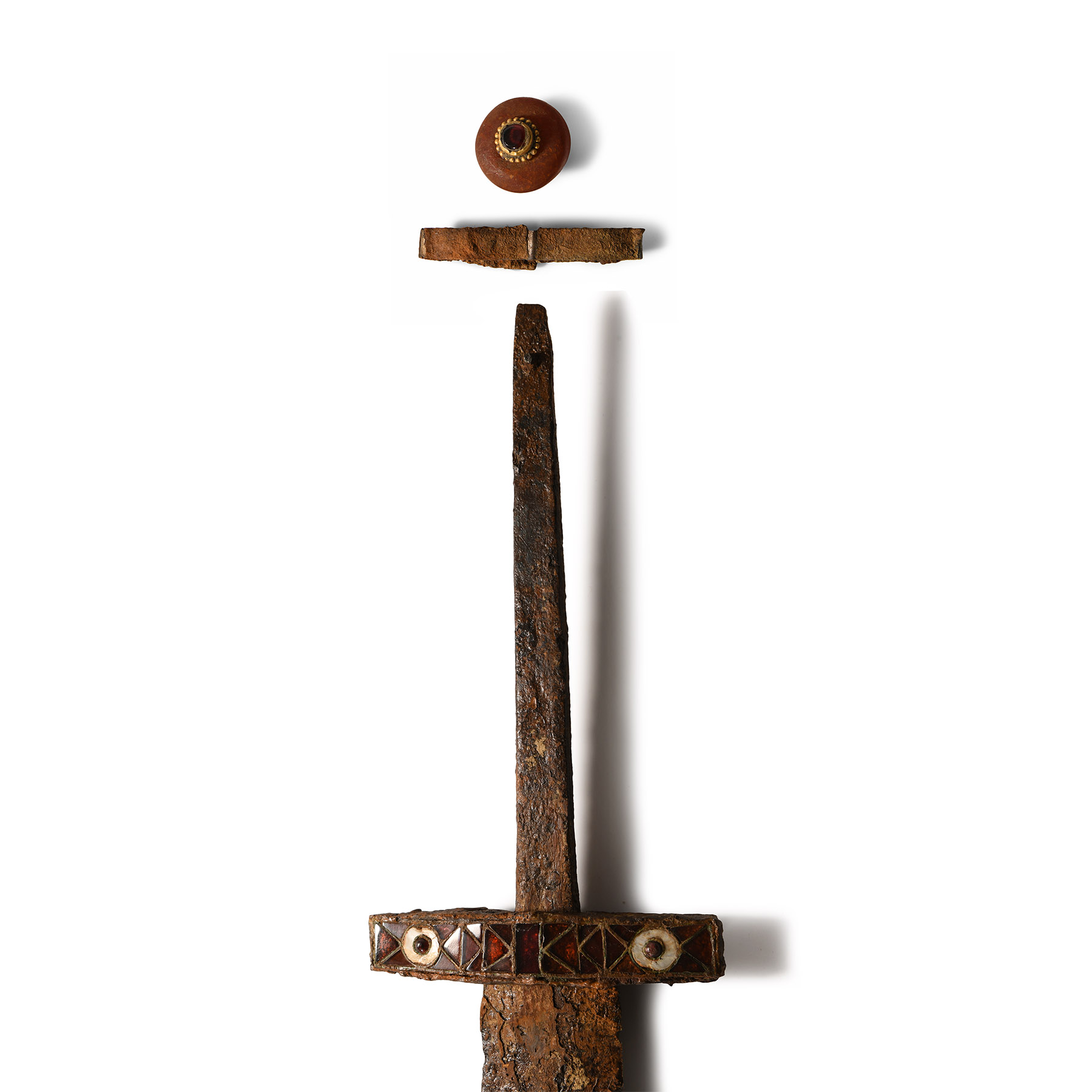
Migration Period Iron Sword with Garnet and Shell Cross Guard with Gold and Amber Sword Bead
5TH-6TH CENTURY A.D.
3/4 - 39 3/8 in. (970 grams total, 2-100 cm).
Eastern Roman or Germanic cavalry spatha with a parallel-sided blade and broad pointed tip, long tang; the trapezoidal lower guard with a gilt chip-carved plate divided in segments set with garnets to one side, each end with a shell disc set with a central garnet cabochon; accompanied by a strap from the scabbard and an amber sword bead with a beaded gold setting with a garnet cabochon. [4]
ProvenanceFrom the private collection of a London gentleman, from his grandfather's collection formed before the early 1970s.
Accompanied by an academic report by Dr Raffaele D’Amato.
This lot has been checked against the Interpol Database of stolen works of art and is accompanied by search certificate number no.12012-213600.
Cf. Behmer, E., Das zweischneidige Schwert der germanischen Völkerwanderungszeit, Stockholm, 1939; Lebedinsky, I., Armes et guerriers barbares au temps des grandes invasions, Paris, 2001; Périn P., Kazanski, M., ‘La tombe de Childéric, le Danube et la Méditerranée’ in Villes et campagnes en Neustrie, (Europe médiévale, 8) Montagnac, 2007, pp.29-38; Spier, J., Treasures of the Ferrell collection, Wiesbaden, 2010.
FootnotesThe western spatha of the 4th-6th centuries was developed in a context that one can qualify as Romano-Germanic. Certain characteristics of the future Merovingian sword were already present in late Roman swords. It is quite natural that Type IV swords have been found in the countries conquered or settled by the Goths in southern, central and western Europe.
CONDITIONTimeLine Auctions follows a vetting process to ensure the authenticity and legality of all items, reinforcing our commitment to integrity and responsible trading. Each antiquity, antique, and coin lot undergoes thorough examination by a vetting committee of at least ten external specialists, professional trade association members, scientists, and archaeologists: Our Vetting Process
AUCTIONS:
TimeLine is a leading auction house specialising in antiquities, ancient art, collectables, natural history, coins, medals, and books. Our auctions offer museums, collectors, historians, and enthusiasts the opportunity to acquire unique and historically significant pieces.
LOT 0303
Migration Period Iron Sword with Garnet and Shell Cross Guard with Gold and Amber Sword Bead
Sold for (Inc. bp): £6,240
-
Western Asiatic Spiked Bronze Macehead Group
2nd-1st millennium B.C.Estimate: £3,000 - 4,000 (‡+bp*)
Opening Bid: £1,500
Comprising: one with two unaligned rows, each with four horizontal spikes, topped by a tooth helping to secure the mace to a wooden shaft; the second with a long socket and a row of six spikes, three pointed and three rounded, double tipped edge for securing the shaft; the third with six horizontal spikes; all with solid heads and hollow tubular sockets; of North-West Iranian typology. 1.35 kg total, 10-15 cm
Acquired from Artemis Gallery, Munich in 1995. European private collection. Accompanied by an academic report by Dr Raffaele D’Amato. This lot has been checked against the Interpol Database of stolen works of art and is accompanied by search certificate number no.11997-211853.
A variety of similar bronze mace heads have been recovered in Hasanlu and Marlik, mainly of spiked variety. Excavations at 8th-7th century B.C. War Kabud and Chamzhi-Mumah in Luristan have produced related types, with smaller spikes or knobs and with an elongated socket, like one of our examples. These spiked maces are a specifically Iranian type. In general, they were used from the 9th century B.C. although some scholars support the thesis of their use in the late 2nd-early 1st millennium based on finds from Marlik. -
Large Marlik Type Bronze Socketted Spearhead with Blood Channels
14th-10th century B.C.Sold for (Inc. bp): £211
Comprising a triangular blade with prominent midrib, long split socket with two piercings for attachment and lower part decorated by horizontal circular grooves. 336 grams, 48 cm
Acquired 1980-2015. Ex Abelita family collection.
According to Khorasani, this spearhead belongs to the type VIII of his classification, characterised by a well-projecting midrib and long folded socket. The triangular blade is related to the subtype 2. Similar spearhead was excavated by Dr Negahban in the Royal Cemetery of Marlik (tomb 2, trench III D). -
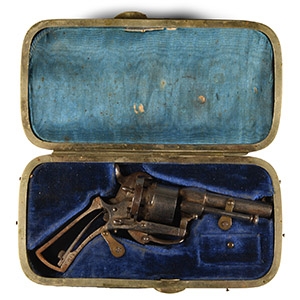
Belgian Lady's Purse Revolver
19th century A.D.Sold for (Inc. bp): £546
A Belgian-made six-shot, 5mm double action Lefaucheux type pinfire purse revolver with 52mm rifled barrel, loading gate and extractor rod to right of frame, nickel plated, folding trigger, grip scales absent; Liege proof marks to cylinder; contained in the original leather-covered twin hinged compartment purse case, one side velvet lined and moulded to receive revolver, the other with leather compartments to receive lady's accessories. 143 grams, 14cm long
Fine condition; some wear to plating and case loose. Scarce.
Acquired from J. C. Militaria. Ex property of a Kent collector.
Sold as an exempt item under Section 58 (2) of the Firearms Act, 1968, to be held as a curiosity or ornament. No license required but buyer must be over 18 years of age.
