
Loading, please wait...
LOT 0207
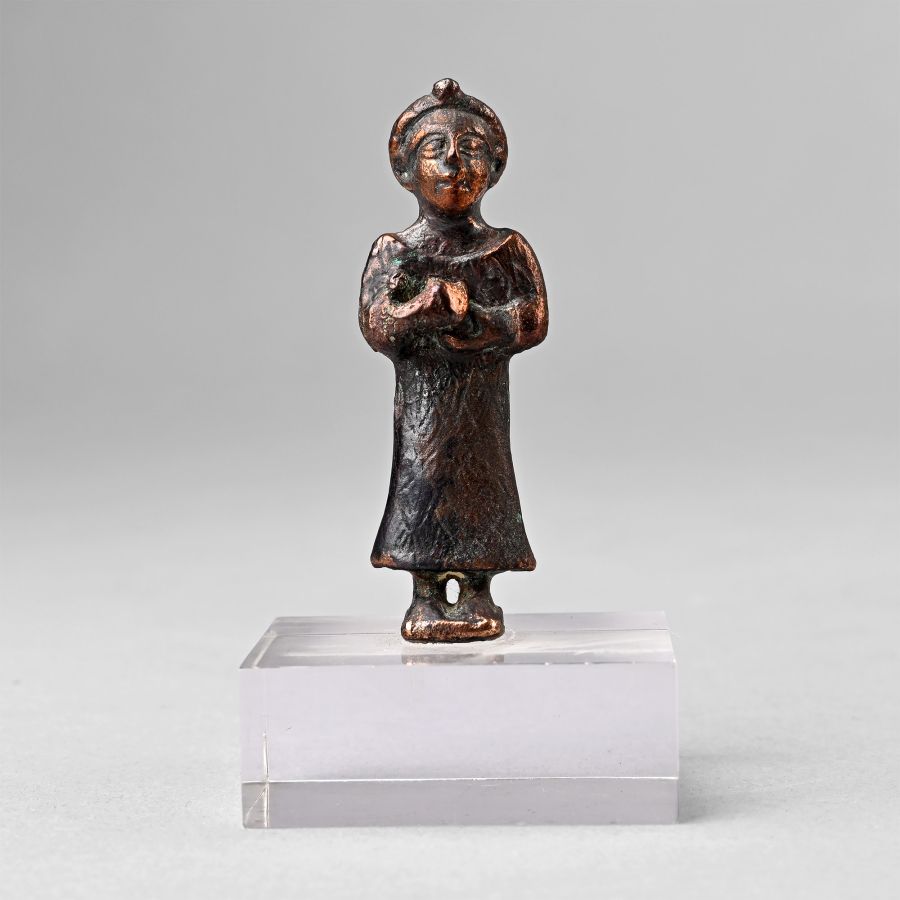
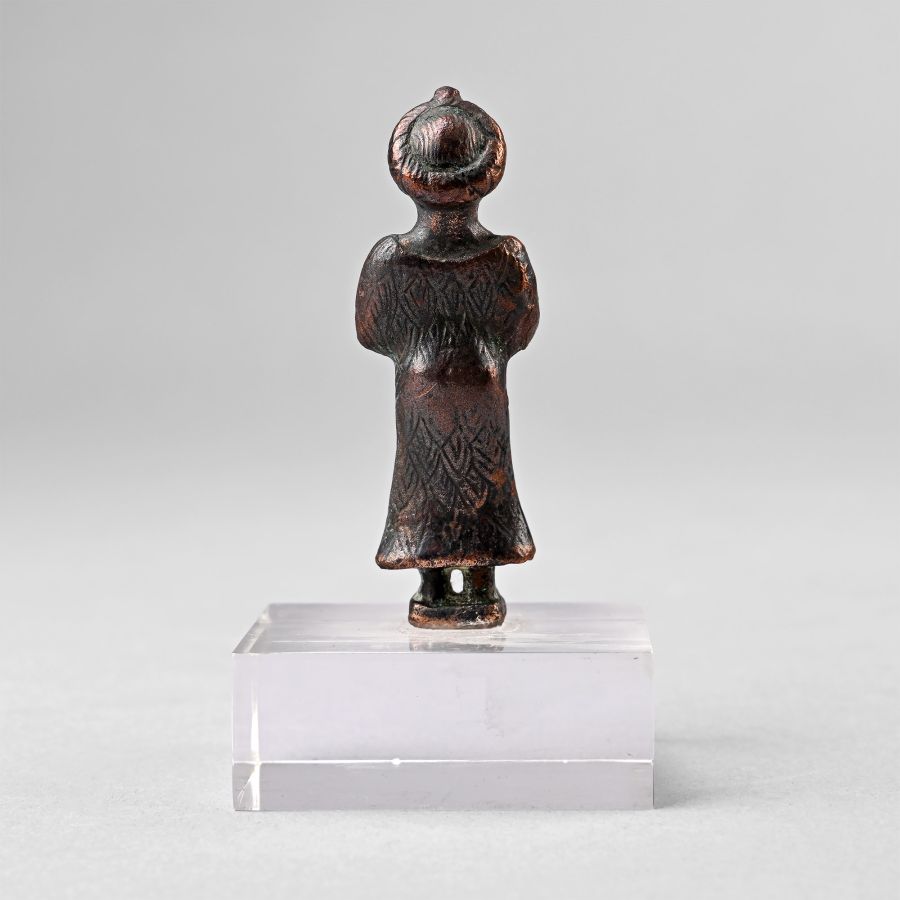
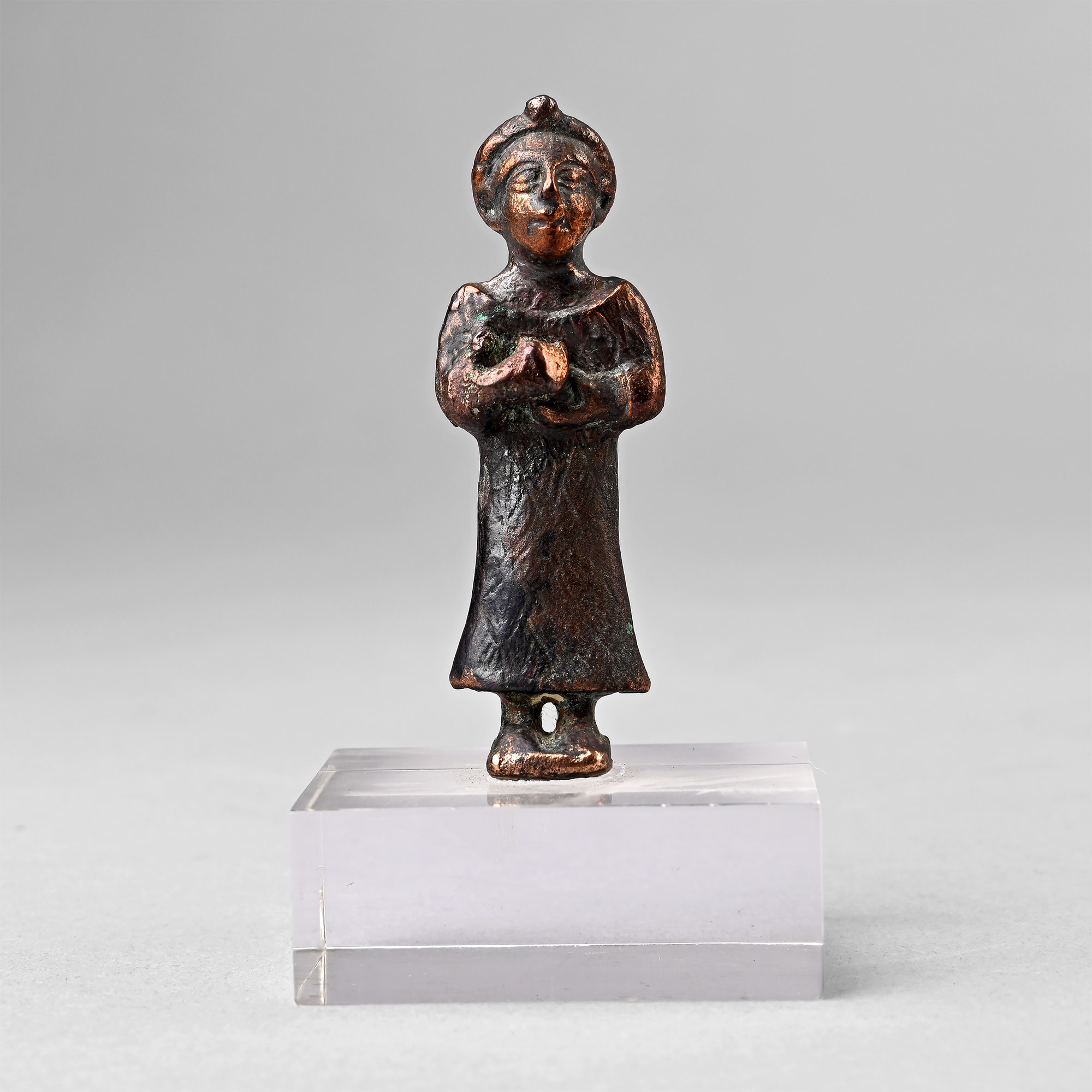
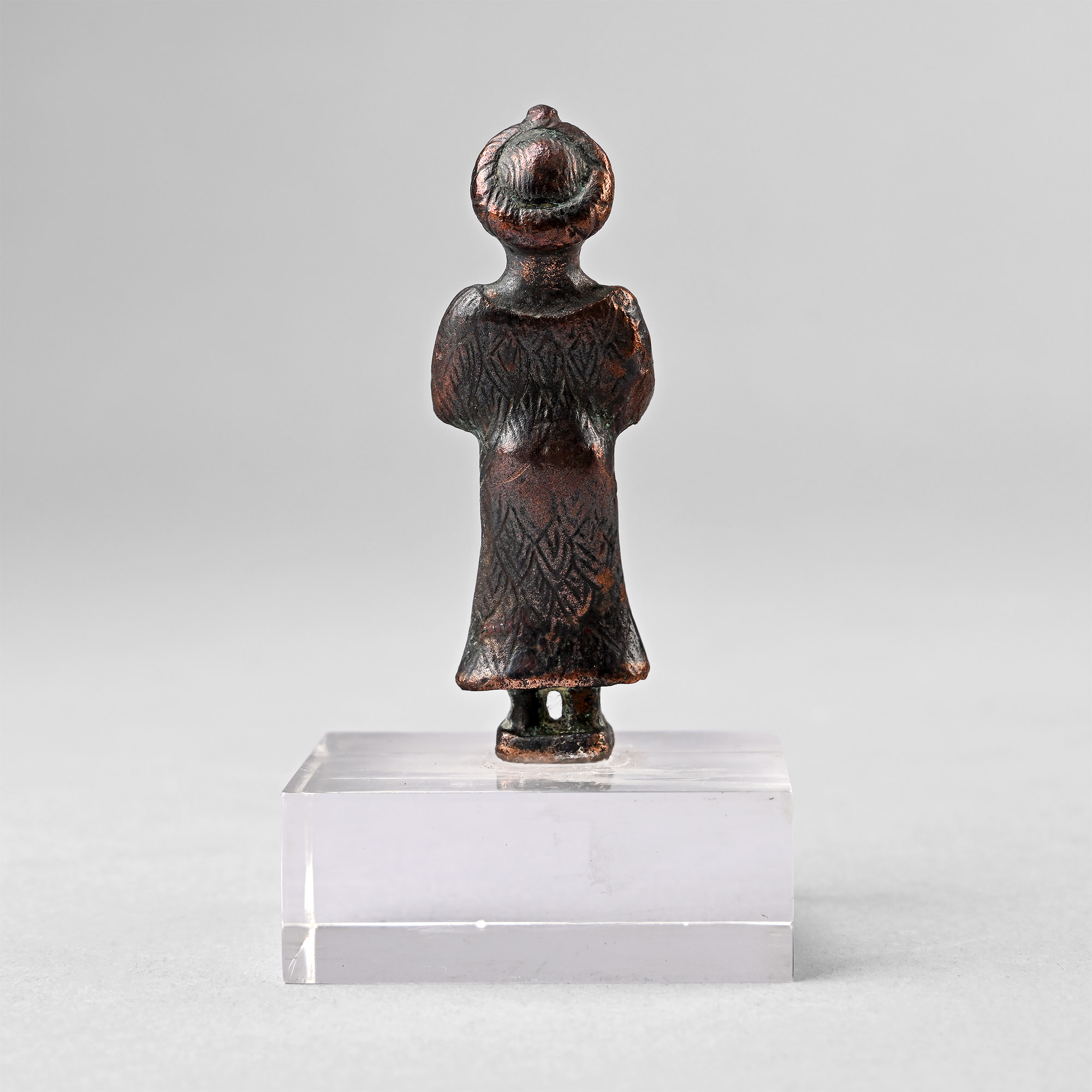
Middle Elamite Copper Figure of a Worshipper
CIRCA 1500–1100 B.C.
3 3/8 in. (106 grams total, 87 mm including stand).
Figure of a worshipper with the hands raised at the waist and standing barefoot on a rectangular plinth, wearing a dress without any visible seams, the embroidery and pattern of the fabric represented by a concentric chevron design; stylised facial features and large almond-shaped eyes, thick twisted roll of fabric holding the hair with a small knot at the top; set on a custom-made stand.
Provenancewith Mr Modjallal Iradj, France.
Acquired by a London, UK gallery, 18 March 1977.
Private collection, UK.
This lot has been checked against the Interpol Database of stolen works of art and is accompanied by search certificate number no.13370-257696.
Cf. The Metropolitan Museum of Art, New York, object no.51.159, for a similar female worshipper figure; see also the Louvre Museum, Paris, object no.Sb 2758, for a male worshipper figure in gold and copper, and no.Sb 2759, for a similar male worshipper in silver and copper in Harper, P., Aruz, J., Tallon, F., The Royal City of Susa. Ancient Near Eastern Treasures in the Louvre, New York, 1992, pp.146-148.
FootnotesThe Elamite culture was an important civilisation in the ancient Near East that lasted for many centuries, from the 3rd millennium to the 6th century BC. They developed their own style of art, metalwork, and seal designs, as well as their own form of cuneiform writing. Although the Elamites were eventually absorbed into later empires, many aspects of their culture continued to influence the ancient world around them. Objects of this type are understood to be ritual or votive gifts.
CONDITIONTimeLine Auctions follows a vetting process to ensure the authenticity and legality of all items, reinforcing our commitment to integrity and responsible trading. Each antiquity, antique, and coin lot undergoes thorough examination by a vetting committee of at least ten external specialists, professional trade association members, scientists, and archaeologists: Our Vetting Process
AUCTIONS:
TimeLine is a leading auction house specialising in antiquities, ancient art, collectables, natural history, coins, medals, and books. Our auctions offer museums, collectors, historians, and enthusiasts the opportunity to acquire unique and historically significant pieces.
LOT 0207
Middle Elamite Copper Figure of a Worshipper
Estimate £4,000 - 6,000€4,640 - 6,960 (for guidance only)$5,400 - 8,100 (for guidance only)
-
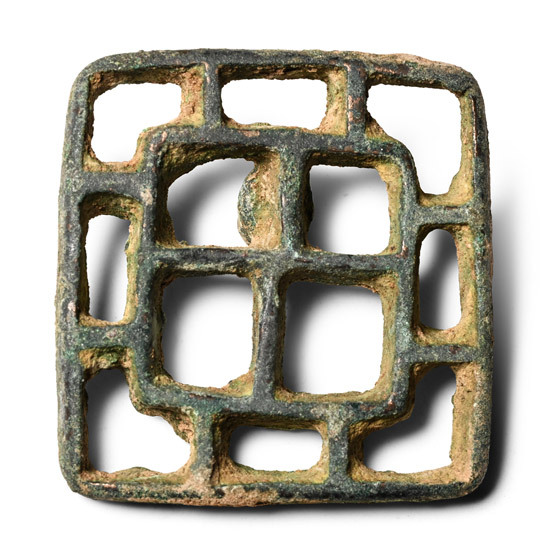
Large West Central Asian Bronze Cross of Squares Seal Matrix
Circa 2300-2000 B.C.Sold for (Inc. bp): £156
An openwork seal, accompanied by an old scholarly note, typed and signed by W.G. Lambert, late Professor of Assyriology, University of Birmingham, 1970-1993, which states: 'Stamp Seal of Bronze, 35 x 34 x 10 mm. This is square, with flat face and flat back, on which was mounted a suspension loop, of which only one end now remains. The design is open-work and consists of a central square divided by a simple cross into four smaller squares, and the spaces between this inner and an outer square are divided into L-shapes at each corner and oblongs between them. This comes from west central Asia and dates to c. 2300-2000 B.C.It is in good condition save for the mostly lost handle.' 18.5 grams, 35 mm
Acquired in the late 1980s-early 1990s. Ex property of a West London businessman. Academically researched and catalogued by the late Professor Lambert in the early 1990s. Accompanied by a copy of a scholarly report, numbered U-391, typed and signed by Professor Wilfrid George Lambert. -
.jpg)
Persian Iron Dragon-Shaped Flint Striker
17th-18th century A.D.Sold for (Inc. bp): £520
With a thick looped body and striking face to the outer edge; handle formed in openwork with stylised serpent-head, open mouth with recurved teeth, trident tail with similar pellet clusters; engraved and drilled detailing. 297 grams, 11.5 cm
Acquired Christie's, The Longridge Collection, London, UK, 2010 (£1,276.00). Personal collection of a Suffolk lady, UK.
Among the objects reflecting the continuation of traditional figural compositions in Indo-Iranian art, there are zoomorphic flint strikers, decorated with serpents, ducks or geese and hawks attacking birds, indicating the persistence of imperial and solar symbols. -
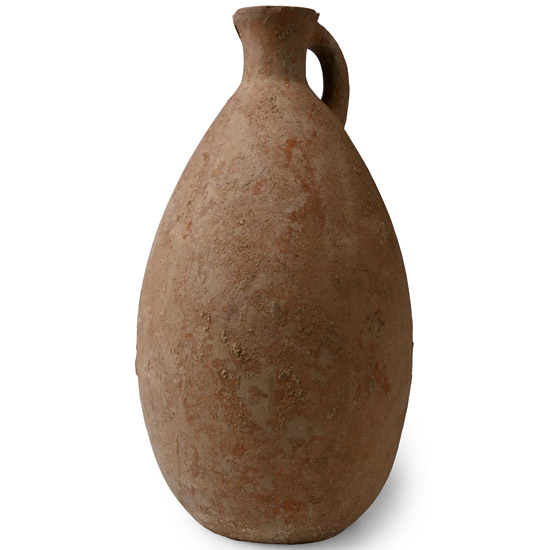
Large Western Asiatic Tall Terracotta Jug
1st millennium B.C.Sold for (Inc. bp): £260
Piriform body with a narrow trumpet-shaped neck and a small strap handle to the rear. 1.61 kg, 32.7 cm
Ex Abelita collection, 1990s.
