
Loading, please wait...
_900x900.jpg "Mesopotamian Cylinder Seal with Walking Women")
_200x200.jpg "Mesopotamian Cylinder Seal with Walking Women")
.jpg "Mesopotamian Cylinder Seal with Walking Women")
LOT 0903
Mesopotamian Cylinder Seal with Walking Women
4TH-3RD MILLENNIUM B.C.
3/4 in. (13.7 grams, 18 mm).
A drum-shaped stone cylinder seal with figural frieze; accompanied by an old scholarly note, typed and signed by W.G. Lambert, late Professor of Assyriology, University of Birmingham, 1970-1993, which states: 'Cylinder seal of red stone, 18 x 20 mm. Frieze of four walking women holding standards. Mesopotamia, c.3000 B.C. Condition fine.'
ProvenanceFrom an important family collection.
Examined by Professor Wilfrid George Lambert FBA (1926-2011), historian, archaeologist, and specialist in Assyriology and Near Eastern archaeology, in the late 1980s and early 1990s.
Accompanied by an old scholarly note, typed and signed by W.G. Lambert, late Professor of Assyriology, University of Birmingham, 1970-1993.
Cf. The Metropolitan Museum, New York, accession number 62.70.74, for similar.
CONDITIONTimeLine Auctions follows a vetting process to ensure the authenticity and legality of all items, reinforcing our commitment to integrity and responsible trading. Each antiquity, antique, and coin lot undergoes thorough examination by a vetting committee of at least ten external specialists, professional trade association members, scientists, and archaeologists: Our Vetting Process
AUCTIONS:
TimeLine is a leading auction house specialising in antiquities, ancient art, collectables, natural history, coins, medals, and books. Our auctions offer museums, collectors, historians, and enthusiasts the opportunity to acquire unique and historically significant pieces.
-
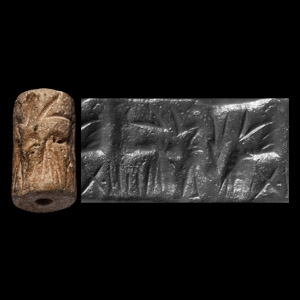
Sumerian Cylinder Seal with Banqueting Scene
26th-24th century B.C.Sold for (Inc. bp): £191
A chalk cylinder seal with frieze; accompanied by an old scholarly note, handwritten and signed by W.G. Lambert, late Professor of Assyriology, University of Birmingham, 1970-1993, which states: 'Cylinder seal of white stone, 28x17 mm. Two facing seated drinkers, wearing long robes and holding up cups. Standing servant in short clothes between them. Vessel with pointed base and two straws in it. Mesopotamian, c.2600-2400 B.C.. Top of seal damaged, but design deep and clear.' In a different hand beneath 'Sumerian seal; early Dynastic Period III. Banquet scene. Manuscript of Prof. W.G. Lambert' and further notation to the reverse; accompanied by a museum-quality impression. 7.2 grams, 28 mm
Fine condition.
From the private collection of Emilio Bacarani, Valbonne, France, 1950-1988. Acquired in 1988. From the collection of G.M.R.H., London, UK. Accompanied by an original handwritten unsigned scholarly note by Professor Wilfrid George Lambert FBA. -
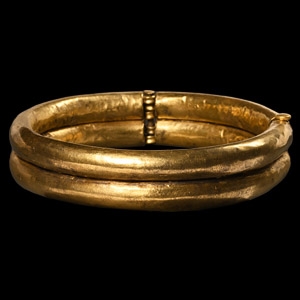
Sarmatian Gold Hinged Bracelet
2nd century B.C.Sold for (Inc. bp): £3,640
A substantial gold bangle with hinged clasp, composed of two conjoined oval-section hoops, gusseted loops to each terminal and closure pin. 65 grams, 85 mm wide
Acquired 1990s. London Mayfair gallery, UK. Ex Dutch collection, 2000s. This lot has been checked against the Interpol Database of stolen works of art and is accompanied by search certificate no.11645-199207. -
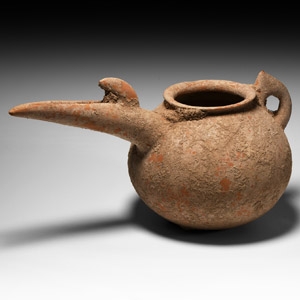
Luristan Zoomorphic Spouted Vessel
2nd-1st millennium B.C.Sold for (Inc. bp): £169
A zoomorphic ceramic pouring vessel, possibly in the form of a wading bird; formed with a bulbous body, everted rim, tapering spout with U-section channel and hooked projection, loop handle with conical apex to rear; two knop 'feet' to base. 548 grams, 39 cm
Acquired 1980-2015. Ex Abelita family collection.
