
Loading, please wait...
_900x900.jpg "Mesopotamian Cylinder Seal with Seated Deity")
_200x200.jpg "Mesopotamian Cylinder Seal with Seated Deity")
.jpg "Mesopotamian Cylinder Seal with Seated Deity")
LOT 1139
Mesopotamian Cylinder Seal with Seated Deity
THIRD DYNASTY OF UR, 2100-2000 B.C.
1/4 - 7/8 in. (5.65 grams total, 8.1-23.5 mm).
With cord and bead handles; accompanied by a copy of an old scholarly note, typed and signed by W.G. Lambert, late Professor of Assyriology, University of Birmingham, 1970-1993, which states: 'Cylinder Seal of lapis Lazuli, 23.5 x 9 mm. The design shows a seated deity to the right, raising one hand, while from the left an introducing goddess leads in a worshipper. The cutting is simple, but is identifiable as from the period of the Third Dynasty of Ur, c. 2100-2000 B.C., coming from southern Mesopotamia or a neighbouring area. The design is worn, but clearly visible. Lapis is a rare stone for this period.'; accompanied by a museum-quality impression. [No Reserve]
ProvenanceUK private collection, acquired 1980-1983.
Accompanied by a copy of a scholarly note, typed and signed by Professor Wilfrid George Lambert in July 1991.
This lot has been cleared against the Art Loss Register database, and is accompanied by an illustrated lot declaration signed by the Head of the Antiquities Department, Dr Raffaele D'Amato.
TimeLine Auctions follows a vetting process to ensure the authenticity and legality of all items, reinforcing our commitment to integrity and responsible trading. Each antiquity, antique, and coin lot undergoes thorough examination by a vetting committee of at least ten external specialists, professional trade association members, scientists, and archaeologists: Our Vetting Process
AUCTIONS:
TimeLine is a leading auction house specialising in antiquities, ancient art, collectables, natural history, coins, medals, and books. Our auctions offer museums, collectors, historians, and enthusiasts the opportunity to acquire unique and historically significant pieces.
-
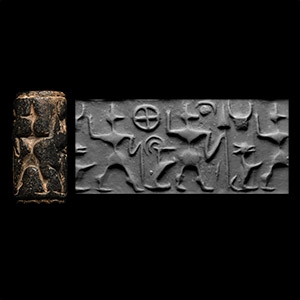
North-Syrian Black Stone Cylinder Seal with Storm God
Circa 2000-1800 B.C.Sold for (Inc. bp): £910
Cylinder with standing figures and animals, restrung pair of red stone beads, old handwritten label '1659'; accompanied by a copy of an old scholarly note, typed and signed by W.G. Lambert, late Professor of Assyriology, University of Birmingham, 1970-1993, which states: 'Cylinder Seal of Black Stone, 40.5 x 19.5 mm. The deeply engraved design shows two warrior gods, standing, wearing short kilts with one hand raised the other holding an object the one holding a spear, the other an unidentified item represented by a vertical line. Before each standing warrior god is a sideways horned animal in one case and a sideways donkey in the other. There is a row of symbols along the top of the area: a circle with cross inside, an inverted crescent and dot, and a bull's head. There are horizontal rulings above and below the scene. This is a North Syrian or Anatolian seal c. 2000-1800 B.C. This is a rare type, and a nice example. The points on the top of the heads of the gods are no doubt spiked helmets, and the short kilt also fits the Anatolian storm god, which was worshipped in a variety of different forms. The style of engraving is deep but uncluttered and has a considerable charm.'; accompanied by a museum-quality impression. 30.8 grams, 40 mm
Armand Trampitsch, Glyptique Archéologie, Paris, Hôtel Drouot, 13-14 May 1992, no.23 [Part]. Accompanied by a copy of a scholarly note, typed and signed by Professor Wilfrid George Lambert in 1992. This lot has been cleared against the Art Loss Register database, and is accompanied by an illustrated lot declaration signed by the Head of the Antiquities Department, Dr Raffaele D'Amato. -
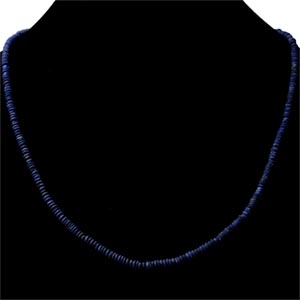
Western Asiatic Lapis Lazuli Bead Necklace String
20th century A.D.Sold for (Inc. bp): £91
Composed of small biconvex beads; restrung. 15.82 grams, 46 cm
From the London, UK, art market in the 1990s. This lot has been cleared against the Art Loss Register database, and is accompanied by an illustrated lot declaration signed by the Head of the Antiquities Department, Dr Raffaele D'Amato. -
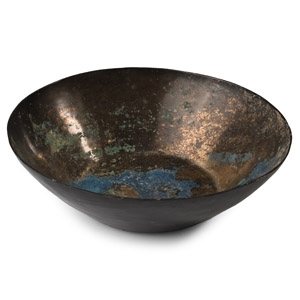
Graeco-Persian Bronze Vessel
2nd century B.C.-1st century A.D.Sold for (Inc. bp): £182
With an almost flat base and slightly rounded, steep walls. 345 grams, 20.5 cm
Ex London, UK, collections, 1990s-2000s. This lot has been cleared against the Art Loss Register database, and is accompanied by an illustrated lot declaration signed by the Head of the Antiquities Department, Dr Raffaele D'Amato.
