
Loading, please wait...
_900x900.jpg "Mesopotamian Copper Double Rein Guide for a Chariot")
_200x200.jpg "Mesopotamian Copper Double Rein Guide for a Chariot")
.jpg "Mesopotamian Copper Double Rein Guide for a Chariot")
LOT 0333
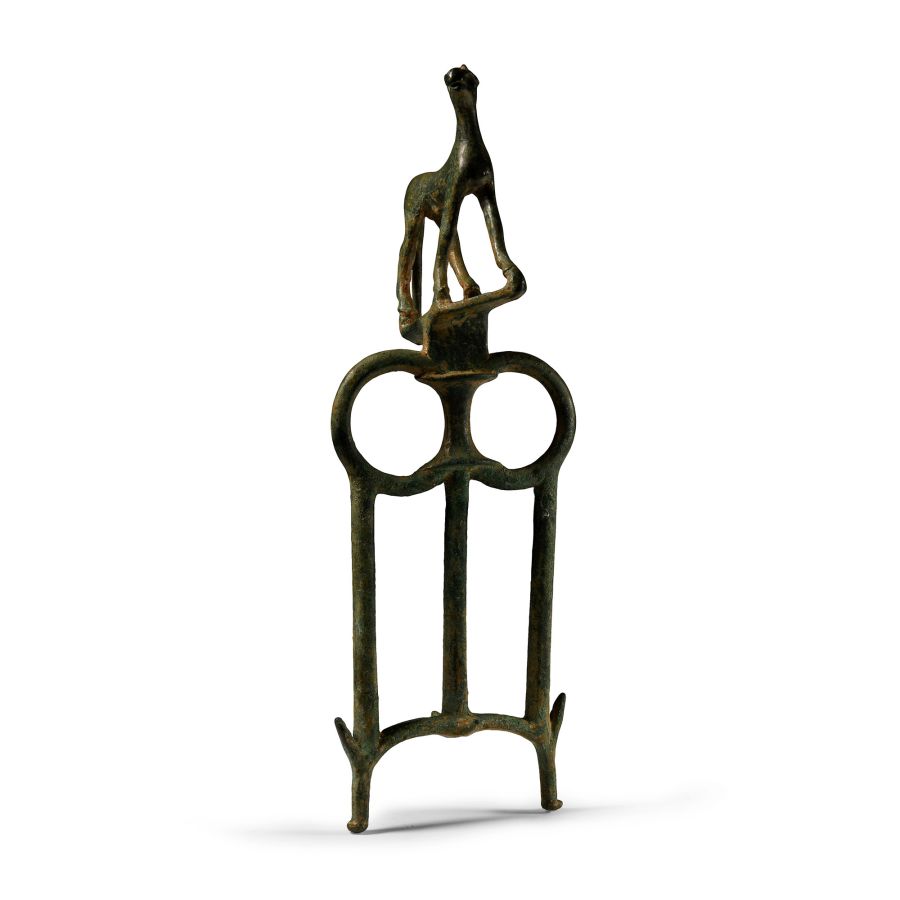
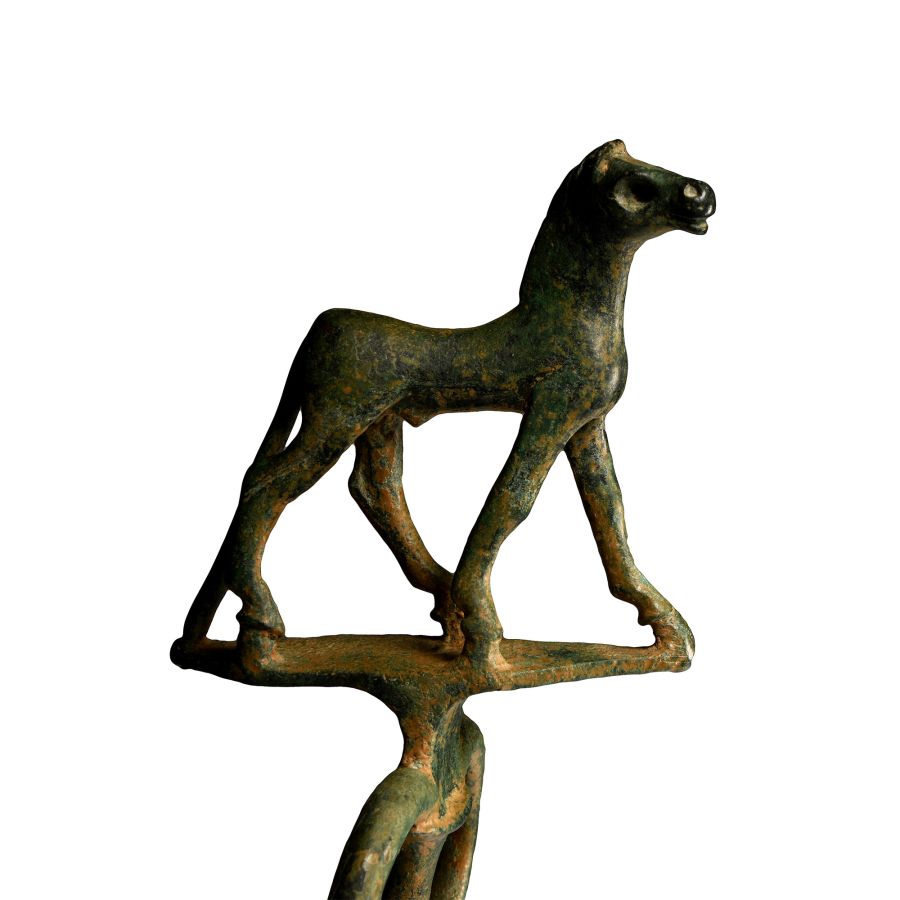
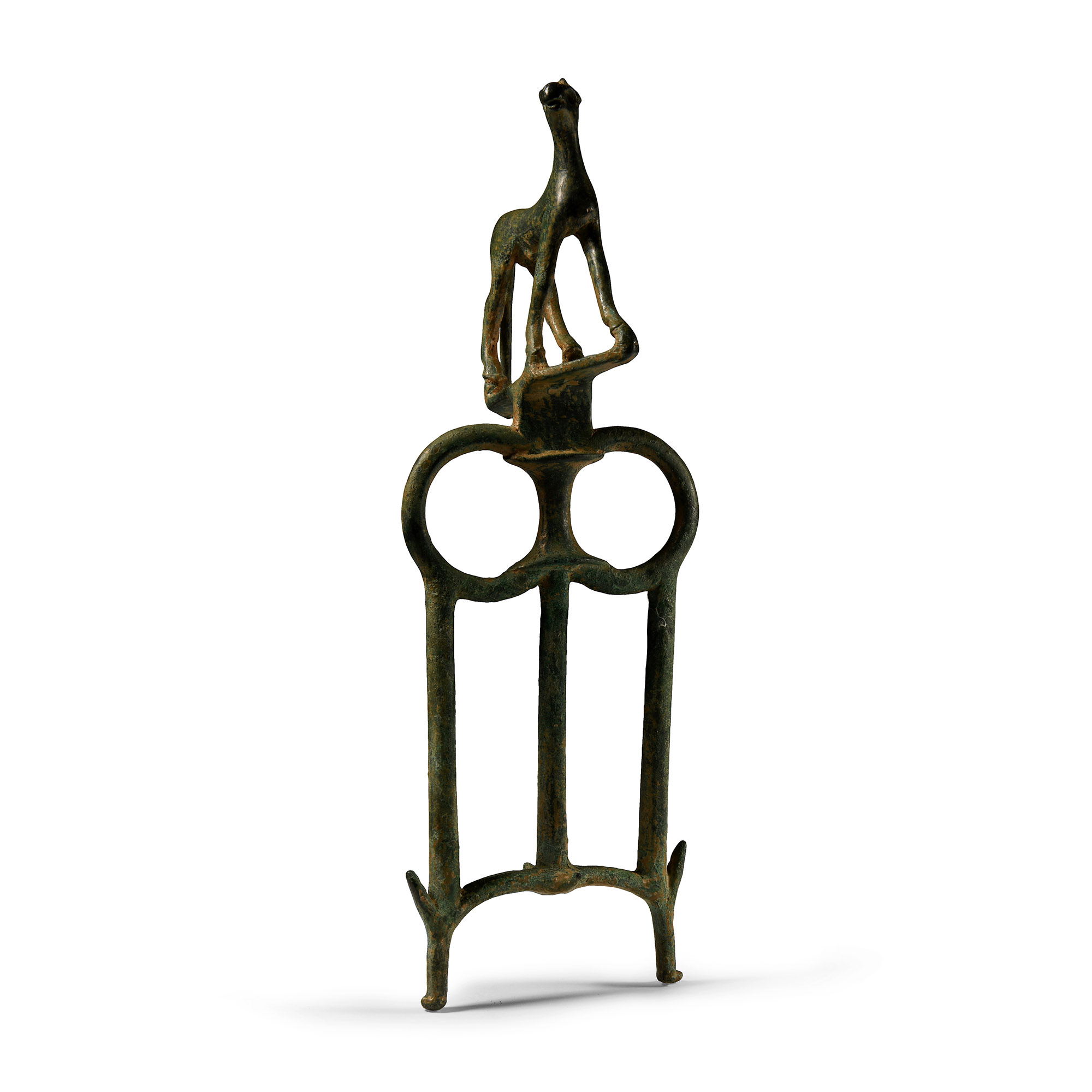
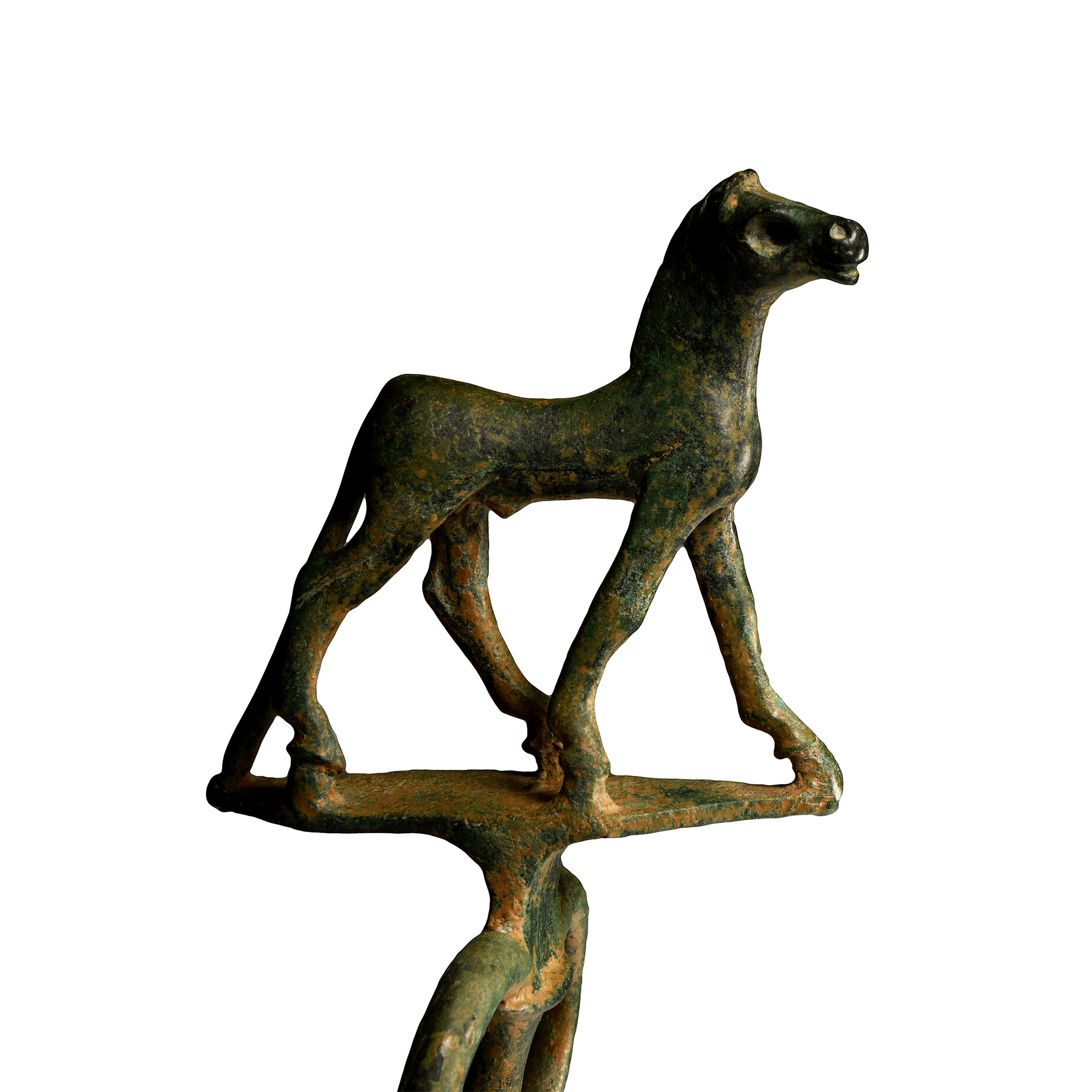
Mesopotamian Copper Double Rein Guide for a Chariot
CIRCA MID 3RD MILLENNIUM B.C.
11 1/4 in. (603 grams, 28.5 cm).
In the form of an advancing stallion on a plinth, holding its head high and gazing to the right; short standing mane with incised detailing, and a long tail extending to the plinth; recessed eyes, likely once inlaid, drilled nostrils and open mouth; the plinth joined at a right angle to two connected rings atop three parallel rods, the rods joined at the bottom to an arching bar with side lugs.
ProvenanceAcquired from Toufic Arakji, Hamburg, Germany, 14 January 1997.
with Mahboubian Gallery, London, UK.
Property of a London gentleman.
Accompanied by an academic academic report by Dr Raffaele D’Amato.
This lot has been checked against the Interpol Database of stolen works of art and is accompanied by a search certificate number no.12160-218627.
See a similar terret ring in Muscarella, O.W.,Bronze and Iron, ancient Near Eastern Artifacts in the Metropolitan Museum of Art, New York, 1988, no.466; Basmachi, F., Treasures of Iraq Museum, Baghdad, 1976, pl.90; for a similar terret in silver and electrum at the British Museum, from Ur, see Crouwel, J.H., ’Wheeled Vehicles and their Draught Animals in the Ancient Near East – an Update’ in Raulwing, P., Linduff, K.M., Crouwel, J.H., Equids and Wheeled Vehicles in the Ancient World, Oxford, 2019, pp.29-48, fig.6; for the mounting on chariots and carts see Stillmann, N., Tallis, N., Armies of the Ancient Near East, 3000 BC to 539 BC, Worthing, 1984, pp.119-121, figs.56-58.
FootnotesThis magnificent chariot fitting was cast in one piece, probably made in arsenical copper in Mesopotamia in the Early Dynastic Period (ED). The reins were connected to the head harness and then passed through the rein ring, that was connected to a yoke pole. The purpose of the rein ring was to prevent the multiple reins snarling and also added an element of control for the driver. The lower concave bar was tied onto the pole by rope or leather, while the hooks served to secure the ends. These rein rings were not only practical instruments, but also ornamental elements of royal vehicles. A well-known example of this type is a terret crowned by an equid figure that was associated with Pu-abi’s sledge in the Royal Cemetery at Ur, today at the British Museum, inv.121438.
CONDITIONTimeLine Auctions follows a vetting process to ensure the authenticity and legality of all items, reinforcing our commitment to integrity and responsible trading. Each antiquity, antique, and coin lot undergoes thorough examination by a vetting committee of at least ten external specialists, professional trade association members, scientists, and archaeologists: Our Vetting Process
AUCTIONS:
TimeLine is a leading auction house specialising in antiquities, ancient art, collectables, natural history, coins, medals, and books. Our auctions offer museums, collectors, historians, and enthusiasts the opportunity to acquire unique and historically significant pieces.
LOT 0333
Mesopotamian Copper Double Rein Guide for a Chariot
Estimate £6,000 - 8,000€6,960 - 9,280 (for guidance only)$8,100 - 10,800 (for guidance only)
-
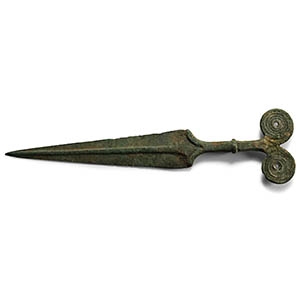
Western Asiatic Bronze Dagger
3rd-2nd millennium B.C.Sold for (Inc. bp): £650
With triangular blade and a square sectioned mid-rib ‘antenna’ guard with tubular grip and spiral ‘ears’. 240 grams, 34 cm
Acquired 1980-2015. Ex Abelita family collection. -
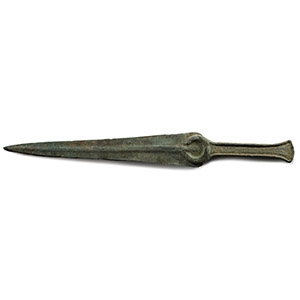
Luristan Bronze Dagger
14th-10th century B.C.Estimate: £300 - 400 (+bp*)
Opening Bid: £150
A short dagger with slender triangular blade, low round shallow midrib with flat upper face, annular guard and round shoulders, columnar grip with open sides to receive organic hilt, crescent pommel. 154 grams, 34 cm
Acquired 1980-2015. Ex Abelita family collection.
Moorey, Gordon and Khorasani created a classification of bladed weapons, according to which daggers are edged weapons no greater than 36cm in length, dirks (short swords) are between 36cm and 50cm in length, and swords are edged weapons greater than 50cm in length. -
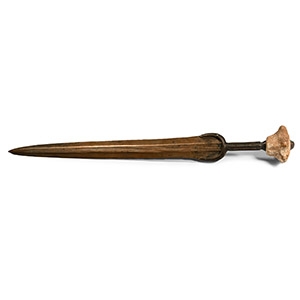
Luristan Bronze Sword with Decorated Stone Pommel
13th-7th century B.C.Sold for (Inc. bp): £715
With solid cast hilt with penannular guard and a horizontally ribbed grip; a massive star-shaped pommel and a multi-fullered blade tapering to a sharp tip; handle restored. 1.03 kg, 63.5 cm
Acquired 1980-2015. Ex Abelita family collection.
According to Moorey, such category of swords were distributed in the Northern Iran area, as proved by the Amarlu finds. Based on the example from the Ashmolean Museum, he dated them to the end of the 2nd millennium B.C., more precisely to a period between 1400-1200 B.C. The type was in use until the 7th century B.C.
