
Loading, please wait...
LOT 1537
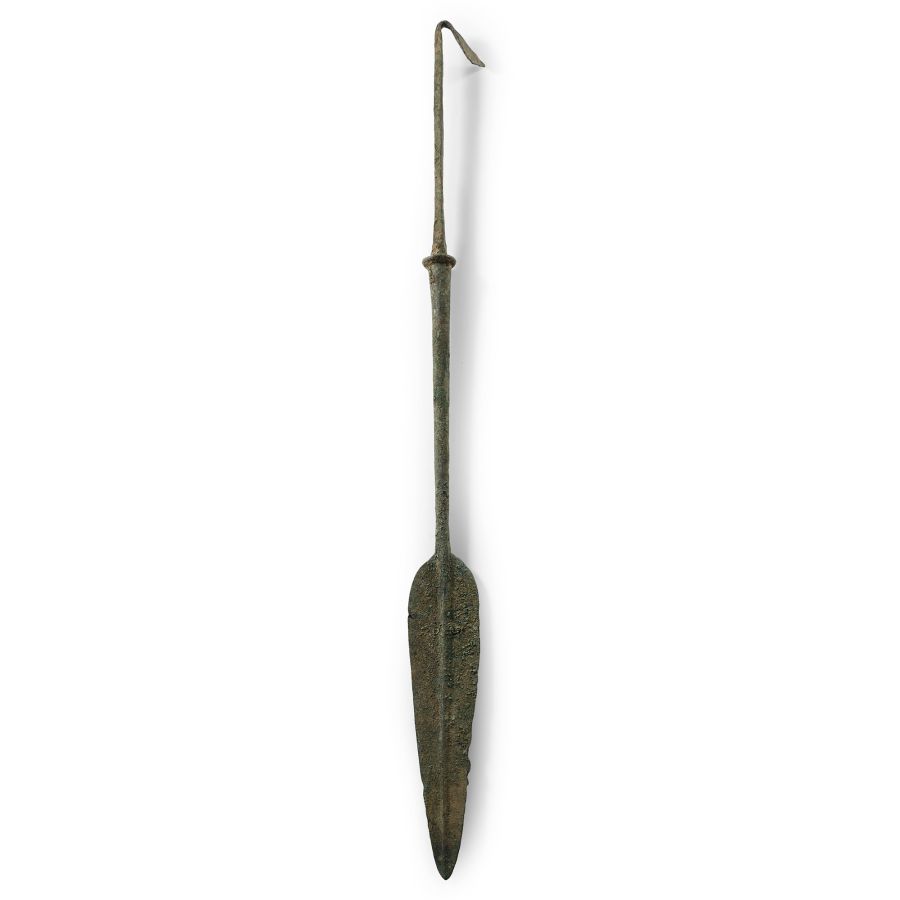
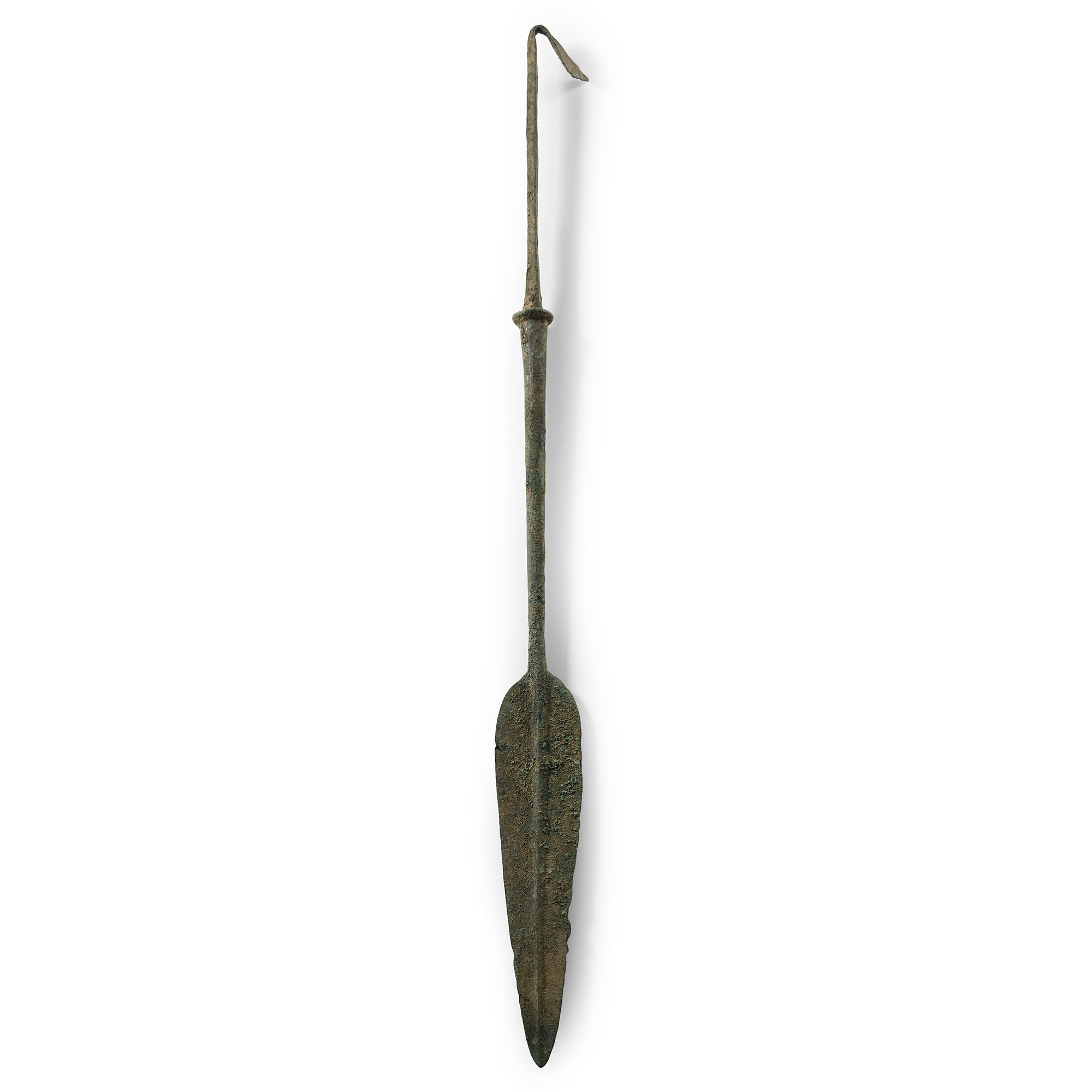
Mesopotamian Bronze Javelin Head
3RD-2ND MILLENNIUM B.C.
18 3/8 in. (184 grams, 46.7 cm).
With foliate blade, raised mid-rib, medium length stem widening at its base and forming a small stop, rectangular-section tang with bent terminal.
ProvenanceAcquired 1980-2015.
Ex Abelita family collection.
This lot is accompanied by an illustrated lot declaration signed by the Head of the Antiquities Department, Dr Raffaele D’Amato.
Cf. Gorelik, M., Weapons of Ancient East, IV millennium BC-IV century BC, Saint Petersburg, 2003, in Russian, see pl.XXXIII, no.82, from Tepe Hissar; Gernez, G., L’armament en métal au Proche et Moyen-Orient: des origines a 1750 av. J.C., Paris, 2007, p.301, fig.2.88, subtype L2.B.b.
FootnotesThe specimen belongs to the category of tripartite spears with long pointed biconvex blade and single bevelled tang. They seem to be a Mesopotamian and Susian (Elamite) variant, and this type also includes decorated blades, like the spear from Tello with the inscription 'King of Kish'.
CONDITIONTimeLine Auctions follows a vetting process to ensure the authenticity and legality of all items, reinforcing our commitment to integrity and responsible trading. Each antiquity, antique, and coin lot undergoes thorough examination by a vetting committee of at least ten external specialists, professional trade association members, scientists, and archaeologists: Our Vetting Process
AUCTIONS:
TimeLine is a leading auction house specialising in antiquities, ancient art, collectables, natural history, coins, medals, and books. Our auctions offer museums, collectors, historians, and enthusiasts the opportunity to acquire unique and historically significant pieces.
-
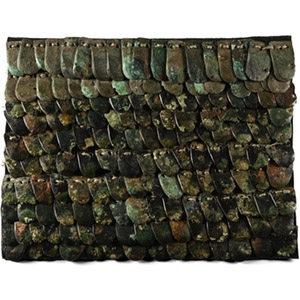
Scythian Bronze Scale Armour Section
6th-5th century B.C.Sold for (Inc. bp): £1,040
A section of scale armour coat composed of 162 overlapping tongue-shaped scales mounted onto a cloth panel, each with three holes to the top and some with one or two holes to the right for fastening onto the original leather backing. 165 grams, 16 x 12 cm
From the private collection of a London gentleman, from his grandfather's collection formed before the early 1970s. Accompanied by an academic report by Dr Raffaele D’Amato. This lot has been checked against the Interpol Database of stolen works of art and is accompanied by search certificate number no.12469-231236. This lot is accompanied by an illustrated lot declaration signed by the Head of the Antiquities Department, Dr Raffaele D’Amato.
The favourite armour of the Scythian noblemen was composed of scales, usually protecting the torso, sometimes the entire body (kataphraktoi). The Scythians found that the most efficient method was to arrange the overlapping ‘fish-scales’ as a corselet made of a number of bronze and iron plates, which then protected the wearer against sword and spear thrusts. Our scales correspond well to bronze scales found in May 1961 in an accidentally destroyed burial in a barrow, near the village of Nadezhda Sovetsky district. They were discovered together with iron scales, a Greek Corinthian helmet, fragments of an amphora, five arrowheads and fragments of an iron sword. Most of these bronze scales were oblong in shape, with a sub-rectangular upper end and a rounded lower end, but slightly bigger than our scales. -
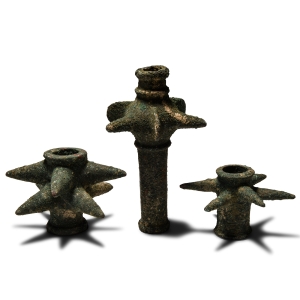
Western Asiatic Bronze Spiked Macehead Group
2nd-1st millennium B.C.Estimate: £2,000 - 3,000 (‡+bp*)
Opening Bid: £1,111
Comprising: one with two unaligned rows, each with four horizontal spikes, topped by a tooth helping to secure the mace to a wooden shaft; the second with a long socket and a row of six spikes, three pointed and three rounded, double tipped edge for securing the shaft; the third with six horizontal spikes; all with solid heads and hollow tubular sockets; of North-West Iranian typology. 1.35 kg total, 10-15 cm
Acquired from Artemis Gallery, Munich in 1995. European private collection. Accompanied by an academic report by Dr Raffaele D’Amato. This lot has been checked against the Interpol Database of stolen works of art and is accompanied by search certificate number no.11997-211853. This lot has been cleared against the Art Loss Register database, and is accompanied by an illustrated lot declaration signed by the Head of the Antiquities Department, Dr Raffaele D’Amato.
A variety of similar bronze mace heads have been recovered in Hasanlu and Marlik, mainly of spiked variety. Excavations at 8th-7th century B.C. War Kabud and Chamzhi-Mumah in Luristan have produced related types, with smaller spikes or knobs and with an elongated socket, like one of our examples. These spiked maces are a specifically Iranian type. In general, they were used from the 9th century B.C. although some scholars support the thesis of their use in the late 2nd-early 1st millennium based on finds from Marlik. -
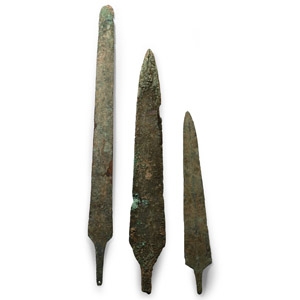
Western Asiatic Bronze Dagger Group
2nd millennium B.C.Sold for (Inc. bp): £124
With a narrow pointed blade and wide shallow raised flange to the centre, straight sides, well marked shoulders with narrow tang, one rivet hole still preserved in one specimen. 358 grams total, 20.7-33.5 cm
Acquired 1980-2015. Ex Abelita family collection. This lot is accompanied by an illustrated lot declaration signed by the Head of the Antiquities Department, Dr Raffaele D’Amato.
The type was technically more advanced than previous types of blades in the Near East, owing to the shape of the weapon, with its slightly convex sides widening out near the point, which combined the advantages of the leaf-shaped and straight-sided forms. This kind of dagger was used in the early second millennium in Mesopotamia and in Syria, and as late as the mid-first millennium in Luristan.
