
Loading, please wait...
_900x900.jpg "Merovingian Silver Ring with Twisted Bezel")
_200x200.jpg "Merovingian Silver Ring with Twisted Bezel")
.jpg "Merovingian Silver Ring with Twisted Bezel")
LOT 1207
Merovingian Silver Ring with Twisted Bezel
CIRCA 6TH-7TH CENTURY A.D.
1 in. (2.50 grams, 24.79 mm overall, 19.84 mm internal diameter (approximate size British T 1/2, USA 9 3/4, Europe 21.89, Japan 21)).
A silver finger ring formed as a single rod tapering at both ends, formed into a flat coil and wound around the shank.
ProvenanceAcquired in the late 1990s-2000.
Property of an East London gentleman.
Cf. Hadjadj, R., Bagues Merovingiennes - Gaul du Nord, Paris, 2007, item 15 (Molain), for type.
CONDITIONTimeLine Auctions follows a vetting process to ensure the authenticity and legality of all items, reinforcing our commitment to integrity and responsible trading. Each antiquity, antique, and coin lot undergoes thorough examination by a vetting committee of at least ten external specialists, professional trade association members, scientists, and archaeologists: Our Vetting Process
AUCTIONS:
TimeLine is a leading auction house specialising in antiquities, ancient art, collectables, natural history, coins, medals, and books. Our auctions offer museums, collectors, historians, and enthusiasts the opportunity to acquire unique and historically significant pieces.
-
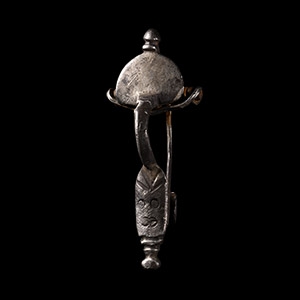
Eastern Germanic Silver Bow Brooch
Early 6th century A.D.Sold for (Inc. bp): £98
A silver bow brooch with semi-circular headplate, decorative knop to apex, slender arched bow, sub-rectangular footplate with knop finial and punched annulets; spring, pin and catchplate to reverse. 8.58 grams, 51 mm
Acquired before 2000. From the collection of a European gentleman living in the UK.
The triple-bossed fibula developed from the fibulae of the southern east-European Germanic tribes, during the migration in the 5th century. This type can be found in modern territories from Hungary to France and occasionally even in England, but in general it remains rare. The type usually carries button-shaped decorations at the end of the semi-circular bow plate. -
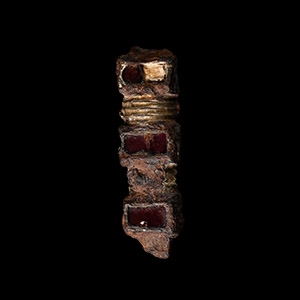
Frankish Gilt Chip-Carved Scabbard Mount with Garnets
Circa 6th century A.D.Sold for (Inc. bp): £85
A gilt copper-alloy mount or scabbard-slider (Menghin's Typ IIIa Basel-Gotterbarmweg-Entringen) comprising three horizontal rectangular cells to the upper, middle and lower third of the body, each with gilt frame and set with a polished garnet cloison; the interstitial bridges with gilt ribbing; iron remains to verso. 11.8 grams, 44 mm
Found UK. Acquired in the 1990s. From a North Yorkshire private collection, UK. -
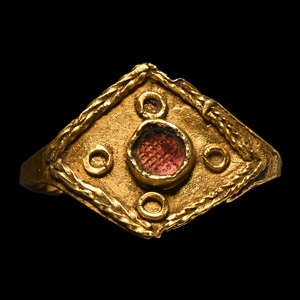
Merovingian Gold Ring with Garnet in Lozenge Bezel
6th-7th century A.D.Sold for (Inc. bp): £3,276
A gold finger ring comprising a lozengiform bezel and twisted hoop; applied filigree bilinear frame to the bezel enclosing four applied filigree hoops and central cell with inset garnet cloison over a waffle-pattern gold-foil reflector. 3.16 grams, 22.79 mm overall, 20.52 mm internal diameter (approximate size British K, USA 5 1/4, Europe 9.95, Japan 9)
Acquired 1960s-1990s. Late Alison Barker collection, a retired London barrister. This lot has been checked against the Interpol Database of stolen works of art and is accompanied by search certificate no.11651-199135.
