
Loading, please wait...
_900x900.jpg "Merovingian Gold Cloisonne Pendant")
_200x200.jpg "Merovingian Gold Cloisonne Pendant")
.jpg "Merovingian Gold Cloisonne Pendant")
LOT 1270
Merovingian Gold Cloisonne Pendant
LATE 7TH CENTURY A.D.
5/8 in. (0.68 grams, 15 mm).
In the shape of a beetle(?) with a flat surface on one side, and divided on the other side by five spaces intended for cloisonne insertions; small loop for suspension in the upper part.
ProvenanceFrom a late Japanese specialist collector, 1970-2000s.
LiteratureCf. a pendant of similar dimensions and typology in Various, Die Franken, Wegbereiter Europas, Mainz, 1996, p.1023, no.6.c.
FootnotesThe cloisonne decoration, probably of Constantinopolitan origin, became an object of local production in the Merovingian kingdom since the 6th century A.D. Decorative objects of this type are common in female and male tombs, intended for the ornamentation of belts and household objects, arms and clothing.
CONDITIONTimeLine Auctions follows a vetting process to ensure the authenticity and legality of all items, reinforcing our commitment to integrity and responsible trading. Each antiquity, antique, and coin lot undergoes thorough examination by a vetting committee of at least ten external specialists, professional trade association members, scientists, and archaeologists: Our Vetting Process
AUCTIONS:
TimeLine is a leading auction house specialising in antiquities, ancient art, collectables, natural history, coins, medals, and books. Our auctions offer museums, collectors, historians, and enthusiasts the opportunity to acquire unique and historically significant pieces.
-
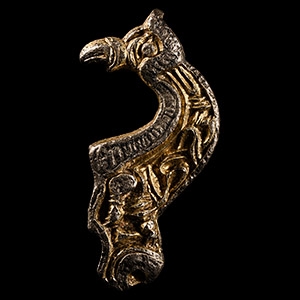
Pre-Viking Silver-Gilt Mythical Beast Helmet Mount
Circa 5th-6th century A.D.Estimate: £1,500 - 2,000 (+bp*)
Opening Bid: £700
In the form of an equine creature modelled in the round with long beak and arched neck; panels of gilded Style I ornament to each lateral face, stepped band with punched detailing extending from the ears to the chest; rounded rump with pointillé detailing; hollow mounting socket to the underside. 13.6 grams, 42 mm
Acquired early 1990s. From an East Anglian private collection. This lot has been checked against the Interpol Database of stolen works of art and is accompanied by search certificate no.11895-204402.
The socket on the underside suggests that the mount was placed prominently, perhaps on the crest of a helmet. Zoomorphic helmet mounts are known e.g. the boars on the Benty Grange and Wollaston examples, though these are not so detailed as the present example. The item is too small to be seen from afar but is ornate enough to attract attention at close quarters. Stylistically, the piece might have been made in southern Scandinavia or in an Anglian area of England in the later 5th or 6th century A.D. -
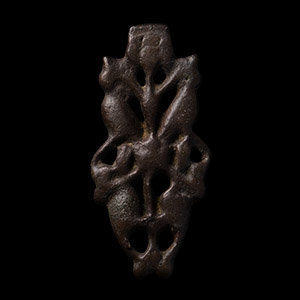
Viking Age Bronze Zoomorphic Mount
10th-11th century A.D.Estimate: £100 - 140 (‡+bp*)
Opening Bid: £50
Displaying a symmetrical openwork design of birds within a vinescroll; attachment pin to the reverse. 12.4 grams, 44 mm
Found Winteringham, Humberside, UK, in 1986. -
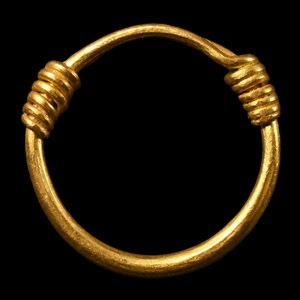
Viking Age Viking Age Gold Coiled Wire Ring
8th-10th century A.D. or earlierSold for (Inc. bp): £780
The single wire formed into a loop with the ends wound about the shank. 2.35 grams, 19.03 mm overall, 15.90 mm internal diameter (approximate size British H, USA 3 3/4, Europe 6.18, Japan 6)
Acquired 1980-2015. Ex Abelita family collection.
