
Loading, please wait...
LOT 1746
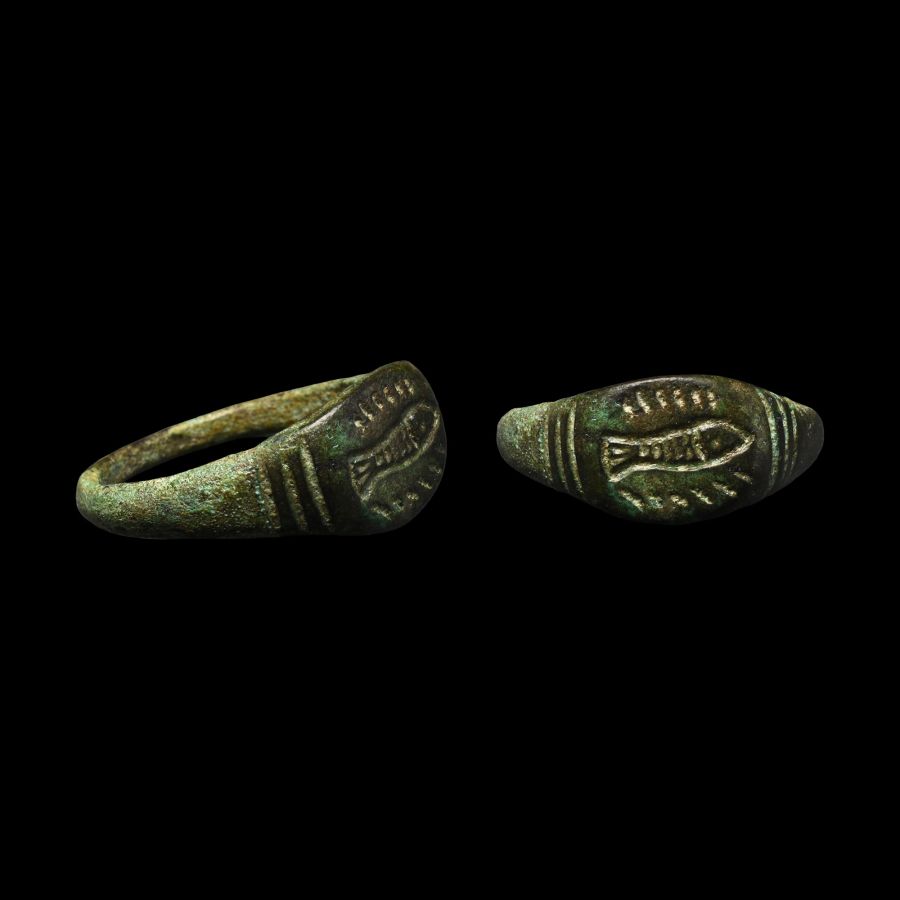
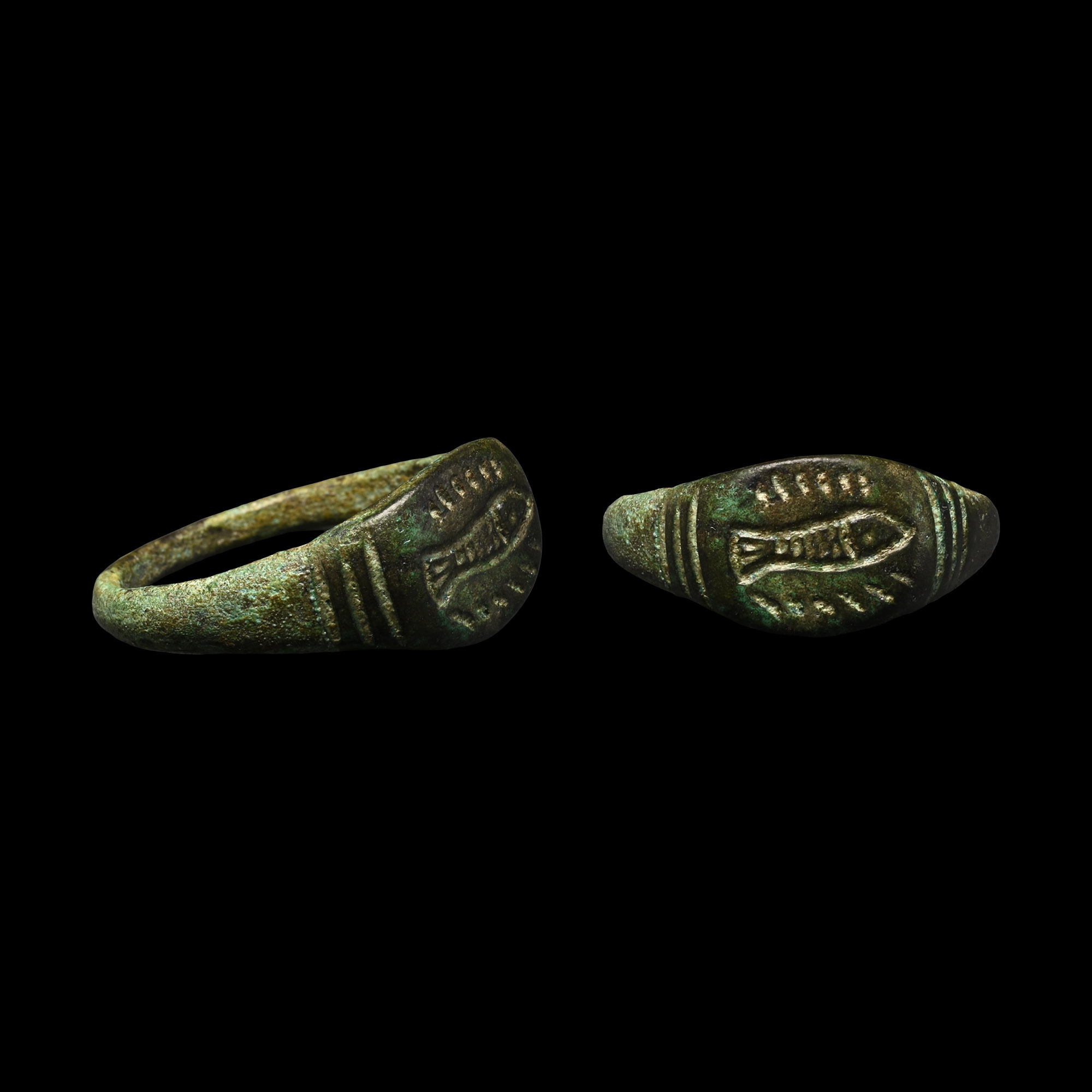
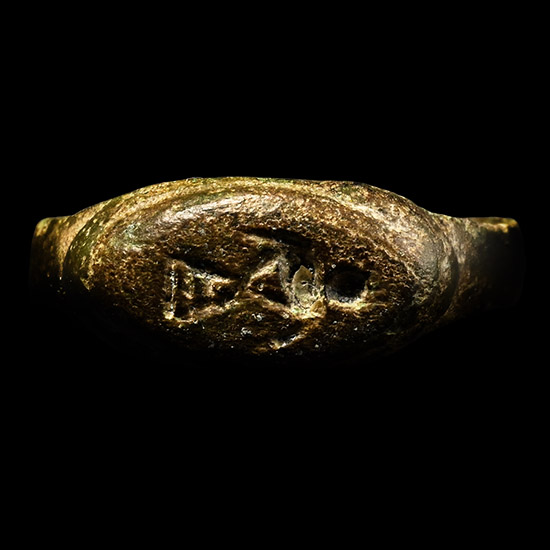
Merovingian Bronze Ring with Early Christian Fish Symbol
6TH CENTURY A.D.
1 in. (5.72 grams, 25.40 mm overall, 19.14 mm internal diameter (approximate size British S, USA 9, Europe 20, Japan 19)).
Comprising a D-section hoop expanding at the shoulders, an oval bezel with a stylised fish flanked by linear motifs. [No Reserve]
ProvenanceAcquired on the UK and EU art market before 2000.
From the private collection of a Surrey, UK, gentleman.
See Bequest, F., Catalogue of the finger rings Early Christian, Byzantine, Teutonic, Mediaeval and later, London, 1912, no.146, for the typology.
FootnotesThe German tribes who settled inside the Roman Empire were great wearers of rings; archaeological discoveries show that these ornaments were worn by adults and children of both sexes. The number of graves excavated in Gaul and Germany is large, and the material for comparative study is extensive. A considerable proportion of rings are signets, with portraits, names or monograms, and emblems such as the cross, the fish, the dove, i.e. early Christian symbols; most of these have the designs cut in a metal bezel.
CONDITIONTimeLine Auctions follows a vetting process to ensure the authenticity and legality of all items, reinforcing our commitment to integrity and responsible trading. Each antiquity, antique, and coin lot undergoes thorough examination by a vetting committee of at least ten external specialists, professional trade association members, scientists, and archaeologists: Our Vetting Process
AUCTIONS:
TimeLine is a leading auction house specialising in antiquities, ancient art, collectables, natural history, coins, medals, and books. Our auctions offer museums, collectors, historians, and enthusiasts the opportunity to acquire unique and historically significant pieces.
LOT 1746
Merovingian Bronze Ring with Early Christian Fish Symbol
Sold for (Inc. bp): £195
-
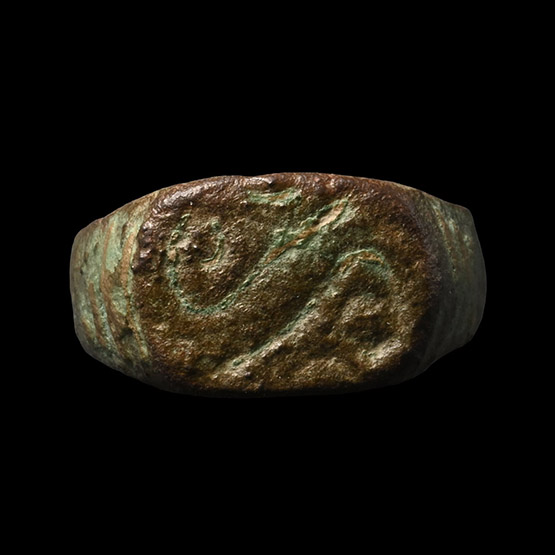
Merovingian Bronze Ring with Scrolls
6th-7th century A.D.Sold for (Inc. bp): £85
Wide hoop with a raised boss at the base of the hoop, wide bezel with incuse scrolls. 6.36 grams, 23.31 mm overall, 17.40 mm internal diameter (approximate size British O, USA 7, Europe 14.98, Japan 14)
Found Oxfordshire, UK. Acquired on the UK and EU art market before 2000. From the private collection of a Surrey, UK, gentleman.
The ring belongs to the Type 1d of Hadjadj classification, with wide shoulders and a ribbon-like bend to form a bezel engraved with a simple monogram with a pattern borrowed from the Celtic and Germanic iconography. The lateral decoration with vertical lines was arranged in symmetrical parts. -
Merovingian Bronze Ring with Female Figure
6th-7th century A.D.Sold for (Inc. bp): £52
D-section hoop and a raised lentoid bezel with an incuse image of a facing woman dressed in a long skirt. 4.98 grams, 25.85 mm overall, 19.73 mm internal diameter (approximate size British U, USA 10, Europe 22.52, Japan 21)
Acquired on the UK and EU art market before 2000. From the private collection of a Surrey, UK, gentleman.
The ring belongs to the Type 4a of Hadjadj classification, i.e. rings with a sinuous and continuous profile. The image on the bezel is reminiscent of motifs linked to the Romano-Celtic mythology, and that of the mother goddess. -
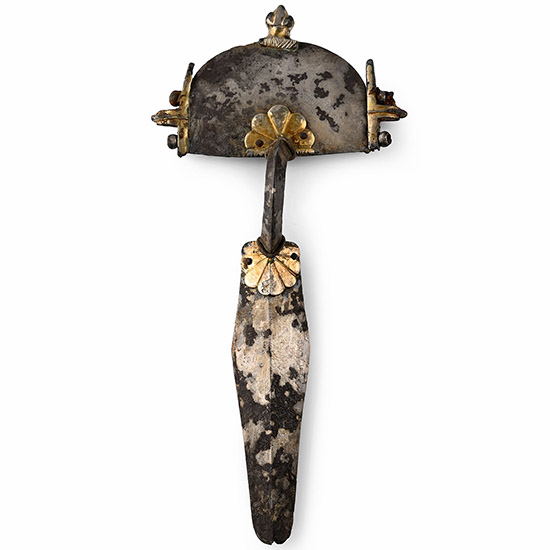
Large Gothic Silver-Gilt Fibula
Bosphorean Culture, 5th century A.D.Estimate: £3,500 - 4,500 (‡+bp*)
Opening Bid: £1,750
Comprising: a semi-circular headplate with a ram-head knop at the apex and applied gilt projections at the sides forming part of the spring mechanism; deep keeled bow with a petalled finials; keeled subrectangular footplate with a rounded finial and a tapering catchplate below. 67 grams, 20.7 cm
L. De Clercq collection, Belgium, 1980s. Ex private European collection. Accompanied by an academic report by Dr Raffaele D’Amato. This lot has been checked against the Interpol Database of stolen works of art and is accompanied by search certificate number no. 13013-246783.
These types of fibulae were mainly found in female burials and were placed on the right side of the chest and on the left shoulder. It was from this period that the custom of wearing wide belts with buckles and a pair of brooches on the shoulders spread along the south-western Black Sea coast, having originated among the Germanic tribes of the western Roman provinces.
