
Loading, please wait...



LOT 1952
Melody Maker Magazine Original Advertising Poster
1950S A.D.
30 x 20 in. (22 grams, 76.2 x 50.6 cm).
Off-white ground with dark blue masthead 'Meldoy Maker / World's Largest Net Sale ' red blocked text and dark blue footer 'Every Friday - 6d'; footnote 'Printed and issued by Odhams Press, Long Acre, London WC2'. [No Reserve]
ProvenanceAcquired on the UK art market.
Property of a Harwich, UK, collector.
'Melody Maker' was an important music-industry weekly magazine which was founded in 1926 by the publisher Lawrence Wright, aimed at dance band musicians under the title 'The Melody Maker and British Metronome'. The footnote reference is to the Odhams publishing venture which folded in 1968.
CONDITIONTimeLine Auctions follows a vetting process to ensure the authenticity and legality of all items, reinforcing our commitment to integrity and responsible trading. Each antiquity, antique, and coin lot undergoes thorough examination by a vetting committee of at least ten external specialists, professional trade association members, scientists, and archaeologists: Our Vetting Process
AUCTIONS:
TimeLine is a leading auction house specialising in antiquities, ancient art, collectables, natural history, coins, medals, and books. Our auctions offer museums, collectors, historians, and enthusiasts the opportunity to acquire unique and historically significant pieces.
LOT 1952
Melody Maker Magazine Original Advertising Poster
Estimate £80 - 100€93 - 116 (for guidance only)$108 - 135 (for guidance only)
-
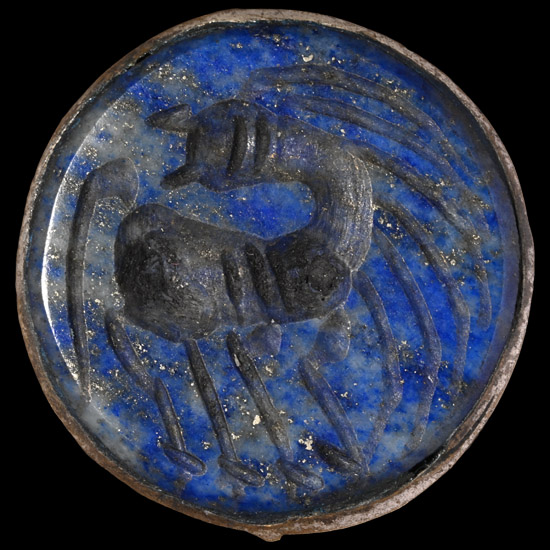
Bedouin Silver-Coloured Metal Ring with Gemstone
20th century A.D.Sold for (Inc. bp): £26
D-section hoop with scroll design, large bezel with tendril decoration underneath, set with a lapis lazuli intaglio with a fantastical beast motif. 8.80 grams, 30.14 mm overall, 18.20 x 17.69 mm internal diameter (approximate size British P, USA 7 1/2, Europe 16.23, Japan 15)
London, UK, collection, 1980s-1990s. -
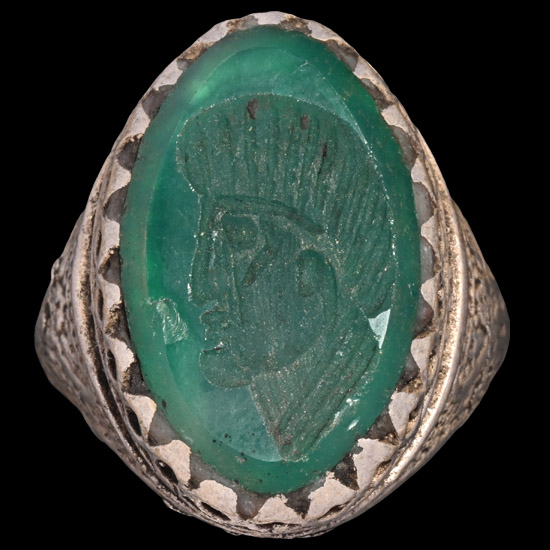
Bedouin Silver-Coloured Metal Ring with Gemstone
20th century A.D.Sold for (Inc. bp): £20
Keeled hoop with decorative panels on the shoulders, oval bezel set with a green glass cabochon with a profile bust. 12.24 grams, 32.81 mm overall, 19.86 mm internal diameter (approximate size British T 1/2, USA 9 3/4, Europe 21.89, Japan 21)
London, UK, collection, 1980s-1990s. -
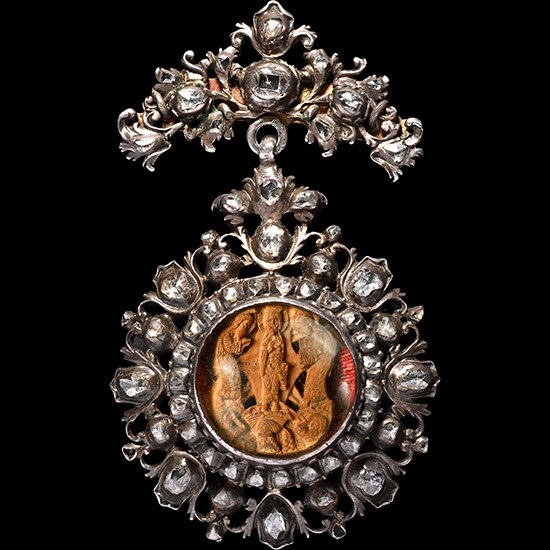
Silver and Diamond Pendant with the Transfiguration
Spain, circa 1700 A.D.Sold for (Inc. bp): £2,340
The elaborate openwork pendant set with old-cut diamonds, the hanger centred with a table-cut diamond; at the centre a circular glazed compartment containing a Greek Orthodox, micro-sandalwood carving of the Metamorphosis, featuring the three elaborately carved nimbate figures of Christ, Heliah and Moises, and the three apostles Peter, John and James at their feet; the reverse of the pendant with a flowering tulip; a brooch pin added in the 19th century to the reverse. 31.97 grams, 66 mm
Acquired on the European art market. This lot has been checked against the Interpol Database of stolen works of art and is accompanied by search certificate no.13450-257984.
The central scene represents the Transfiguration of Christ, as it is described in the Gospels of Matthew, Luke and Mark. Having led his companions up the holy Mount Tabor to pray, the men are awoken the following day by the startling sight of Christ floating above the mountain at Galilee. He is flanked by the prophets Elijah and Moses, who stand serenely talking to him from two rocky outcrops. Christ hovers within an aureole, which represents divine uncreated light, and makes a sign of blessing. As the disciples, still ‘heavy with sleep’, stare with amazement to see him in his deified humanity, a voice speaks out from a cloud: ‘This is my Beloved Son, in whom I am well pleased; hear ye him’ (Matthew 17:5). In confusion they scramble and fall. John loses a sandal. James stumbles and shields his eyes.
