
Loading, please wait...
_900x900.jpg "Medieval Wooden Bench Finial in the Form of an Elephant and Castle")
_200x200.jpg "Medieval Wooden Bench Finial in the Form of an Elephant and Castle")
_900x900.jpg "Medieval Wooden Bench Finial in the Form of an Elephant and Castle")
_200x200.jpg "Medieval Wooden Bench Finial in the Form of an Elephant and Castle")
.jpg "Medieval Wooden Bench Finial in the Form of an Elephant and Castle")
.jpg "Medieval Wooden Bench Finial in the Form of an Elephant and Castle")
LOT 0300
Medieval Wooden Bench Finial in the Form of an Elephant and Castle
ENGLAND, 15TH CENTURY A.D.
13 1/2 in. (1.31 kg total, 34.2 cm including stand).
Carved stylised elephant with elongated ears supporting a palanquin in the form of a castle with a carved cross, foliage motif to the reverse; mounted on a velvet-covered stand.
ProvenancePrivate collection, Europe.
Acquired on the English art market.
This lot has been checked against the Interpol Database of stolen works of art and is accompanied by search certificate number no.13088-248391.
Cf. Sotheby’s, Haute Epoque, London, 29 October 2008, lot 336.
FootnotesThe image of an elephant carrying warriors in a howdah originated from Alexander the Great's battle against King Porus's war elephants at the Battle of Hydaspes in 326 BC. This motif became widely known in European art through the spread of Bestiaries which were medieval texts combining natural history with moralising Christian stories. One of the most well known was Matthew Paris’s imagined depictions of elephants, most notable in this case is his war elephant illustrated in Chronica maiora II, circa 1240-1255 (Cambridge, Corpus Christi College, MS 016II). Another well known manuscript - The Rochester Bestiary, circa 1230-1240 (British Library, London, Royal MS 12 F.xiii) contains a miniature with a war elephant in the midst of battle, above another image of elephants supposedly in their natural habitat. Since very few live elephants were seen in Europe during the medieval period, their representations were often more imaginative than realistic. Other Medieval bench end carvings of elephants in English churches are known, amongst them are: St Peter and St Paul, Tuttington, Norfolk; St Andrew, South Lopham, Norfolk; St Edmund, South Burlingham, Norfolk; St Andrew, Holme Hale, Norfolk. Elephants can also be found on misericords, some examples can be found at: Cathedral Church of Saint Peter, Exeter; Cathedral Church of St Peter, Gloucester; and St Mary's Church, Beverley.
CONDITIONTimeLine Auctions follows a vetting process to ensure the authenticity and legality of all items, reinforcing our commitment to integrity and responsible trading. Each antiquity, antique, and coin lot undergoes thorough examination by a vetting committee of at least ten external specialists, professional trade association members, scientists, and archaeologists: Our Vetting Process
AUCTIONS:
TimeLine is a leading auction house specialising in antiquities, ancient art, collectables, natural history, coins, medals, and books. Our auctions offer museums, collectors, historians, and enthusiasts the opportunity to acquire unique and historically significant pieces.
LOT 0300
Medieval Wooden Bench Finial in the Form of an Elephant and Castle
Estimate £3,000 - 4,000€3,480 - 4,640 (for guidance only)$4,050 - 5,400 (for guidance only)
-
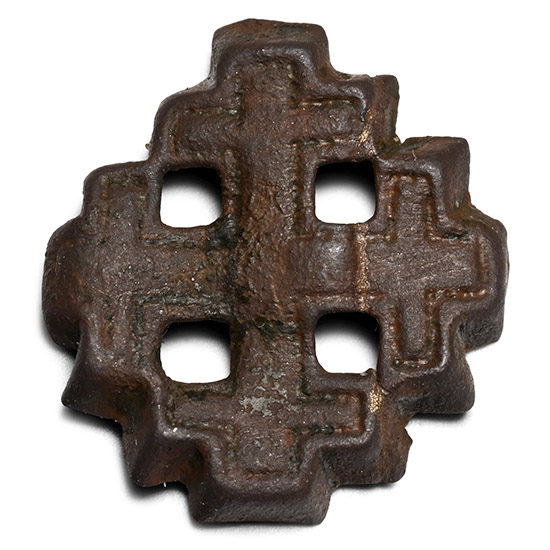
Medieval Bronze Knight's Holy Sepulchre Badge
Circa 13th-14th century A.D.Sold for (Inc. bp): £65
Formed as a cross-crosslet, the symbol of the Knights of the Holy Sepulchre, with a punched-point border. 0.66 grams, 19 mm
Found Suffolk, UK. Property of a Suffolk, UK, gentleman.
The 'Equestrian Order of the Holy Sepulchre of Jerusalem' was an order of knighthood under the protection of the Pope, formed around 1099 AD by Duke Godfrey of Bouillon, the leader of the First Crusade. It was established for the protection of pilgrims travelling to the Holy Land and was recognised by a Papal Bull in about 1113 AD. -
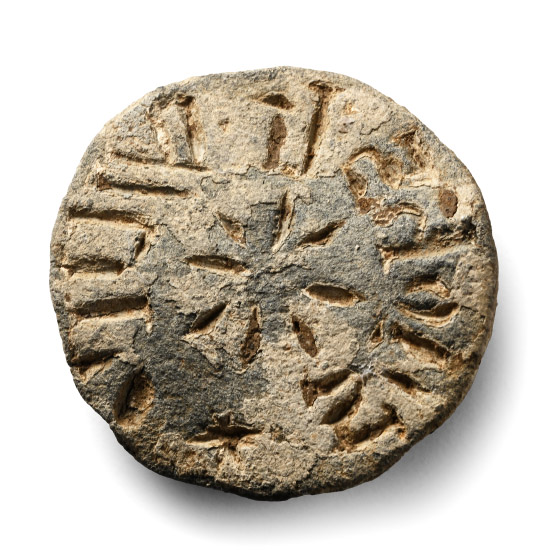
Medieval Lead Personal Seal Matrix for John
England, 1100-1300 A.D.Sold for (Inc. bp): £20
Discoid type with central intaglio eight-pointed star; Latin inscription to border '* S' IOH'S W[...]'; possibly '* S' IOH'S F WILL' for 'Sigillum Iohannis filii Willelmi' (Seal of John, son of William). 13.1 grams, 27 mm
Found Harrold, Bedfordshire, UK. Recorded with UKDFD no.44886. -
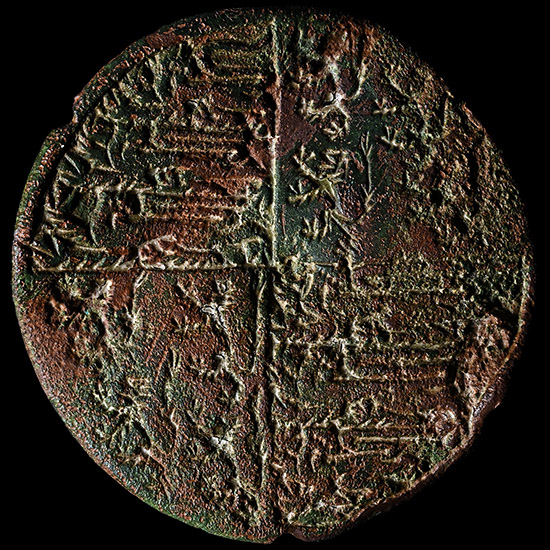
Royal Medieval Bronze Carriage Plate of Edward III and his Wife Queen Philippa of Hainault
England, 1327-1377 A.D.Sold for (Inc. bp): £546
Discoid appliqué, flat in section and slightly distorted; incuse heraldic detailing to obverse blazoned 'Quarterly 1st and 4th Gules three lions passant guardant [Or] 2nd and 3rd [Or] four lions rampant [in a quadrangle] the 1st and 4th Sable the 2nd and 3rd [Gules]'. 37.2 grams, 59 mm
Found Lowick, East Northamptonshire, UK. Accompanied by a copy of the British Museum's Portable Antiquities Scheme (PAS) report no.BH-7A9E2F.
The Royal College of Arms has identified these arms as belonging to King Edward III and his wife, Philippa of Hainault (r. 1327 - 1369). The terminus post quem for this piece is therefore 1327, the date of the marriage, and the likely terminus ante quem is Edward's death in 1377. A circular mount with the same fixing method, which bore the arms of the Bishopric of Ely, was found in Norfolk and is illustrated and described by Steven Ashley (2002: Fig. 20, p. 45, no. 196). The presence of the royal arms on this piece is likely to be a public display of allegiance to the throne rather than an indication of ownership on the part of the crown.
