
Loading, please wait...
_900x900.jpg "Medieval Wooden Bench Finial in the Form of an Elephant and Castle")
_200x200.jpg "Medieval Wooden Bench Finial in the Form of an Elephant and Castle")
_900x900.jpg "Medieval Wooden Bench Finial in the Form of an Elephant and Castle")
_200x200.jpg "Medieval Wooden Bench Finial in the Form of an Elephant and Castle")
.jpg "Medieval Wooden Bench Finial in the Form of an Elephant and Castle")
.jpg "Medieval Wooden Bench Finial in the Form of an Elephant and Castle")
LOT 0365
Medieval Wooden Bench Finial in the Form of an Elephant and Castle
ENGLAND, 15TH CENTURY A.D.
13 1/2 in. (1.31 kg total, 34.2 cm including stand).
Carved stylised elephant with elongated ears supporting a palanquin in the form of a caste with a carved cross, foliage motif to the reverse; mounted on a velvet-covered stand.
ProvenancePrivate collection, Europe.
Acquired on the English art market.
This lot has been checked against the Interpol Database of stolen works of art and is accompanied by search certificate number no.13088-248391.
Cf. Sotheby’s, Haute Epoque, London, 29 October 2008, lot 336.
FootnotesThe image of an elephant carrying warriors in a howdah originated from Alexander the Great's battle against King Porus's war elephants at the Battle of Hydaspes in 326 BC. This motif became widely known in European art through the spread of Bestiaries which were medieval texts combining natural history with moralising Christian stories. One of the most well known was Matthew Paris’s imagined depictions of elephants, most notable in this case is his war elephant illustrated in Chronica maiora II, circa 1240-1255 (Cambridge, Corpus Christi College, MS 016II). Another well known manuscript - The Rochester Bestiary, circa 1230-1240 (British Library, London, Royal MS 12 F.xiii) contains a miniature with a war elephant in the midst of battle, above another image of elephants supposedly in their natural habitat. Since very few live elephants were seen in Europe during the medieval period, their representations were often more imaginative than realistic. Other Medieval bench end carvings of elephants in English churches are known, amongst them are: St Peter and St Paul, Tuttington, Norfolk; St Andrew, South Lopham, Norfolk; St Edmund, South Burlingham, Norfolk; St Andrew, Holme Hale, Norfolk. Elephants can also be found on misericords, some examples can be found at: Cathedral Church of Saint Peter, Exeter; Cathedral Church of St Peter, Gloucester; and St Mary's Church, Beverley.
CONDITIONTimeLine Auctions follows a vetting process to ensure the authenticity and legality of all items, reinforcing our commitment to integrity and responsible trading. Each antiquity, antique, and coin lot undergoes thorough examination by a vetting committee of at least ten external specialists, professional trade association members, scientists, and archaeologists: Our Vetting Process
AUCTIONS:
TimeLine is a leading auction house specialising in antiquities, ancient art, collectables, natural history, coins, medals, and books. Our auctions offer museums, collectors, historians, and enthusiasts the opportunity to acquire unique and historically significant pieces.
LOT 0365
Medieval Wooden Bench Finial in the Form of an Elephant and Castle
Estimate £3,500 - 4,500€4,060 - 5,220 (for guidance only)$4,730 - 6,080 (for guidance only)
-
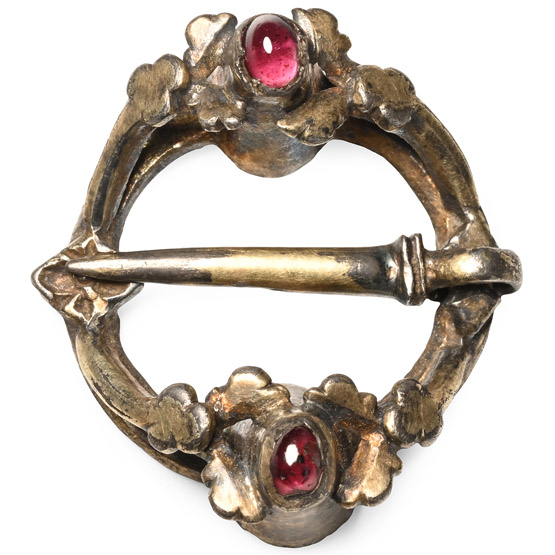
Medieval Silver-Gilt Ring Brooch with Garnet Cabochons
European, 13th-14th century A.D.Estimate: £350 - 450 (+bp*)
Opening Bid: £175
Annular in form with tapering cells to each end, with inset garnet cabochons, and leaf detailing, quatrefoil opposite the sword-shaped pin. 5.42 grams, 26 mm
Private collection, London, UK. -
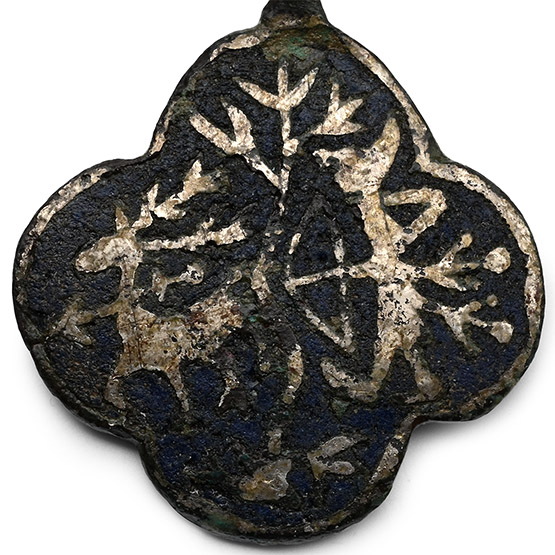
Medieval Knight's Heraldic Horse Harness Pendant with Royal Hunting Scene
13th century A.D.Sold for (Inc. bp): £2,340
Quatrefoil-type with integral loop and broad lobes; niello surface with reserved image of a bowman (right) with arrow nocked and one arm bent, advancing towards a stag (left) with tined antlers, an arrow having pierced it through the neck; scene divided by a median vertical tree with three radiating boughs. 11.36 grams, 38 mm
Found by Robert Wiseman in Longdon, Worcestershire, UK, circa 2015, next to a trackway leading to St John the Baptist church that was built by the military order of the Knights Hospitaller in the 12th century. Recorded with Mark Lodwick of the National Museum of Wales, Cardiff, UK.
Described by Phil Parkes, the conservator at the National Museum of Wales, as the best of its type that he had ever seen or worked on to clean and preserve, in 30 years. -
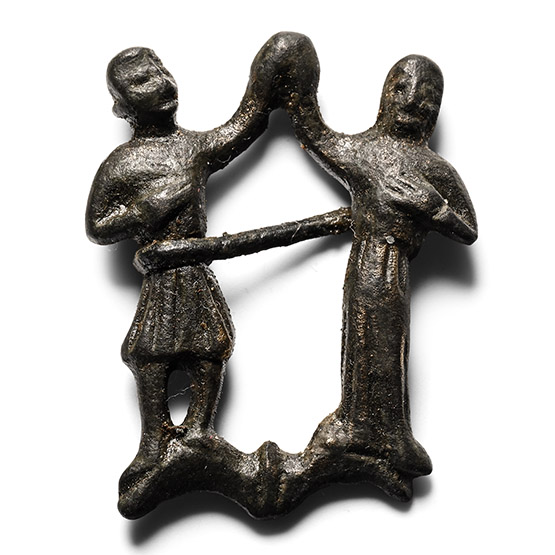
Medieval Bronze Marriage Couple Annular Brooch
Circa 14th century A.D.Sold for (Inc. bp): £390
The frame formed as a couple with joined hands raised to head-height and the other hand placed on the chest, dancing on a curved baseline; tongue coiled about the waist of the male. 8.82 grams, 34 mm
Ex Norwich, UK, dealer, early 1980s. From a London, UK, private collection since the 1980s.
