
Loading, please wait...
_900x900.jpg "Medieval 'Thames' Silver-Gilt Lozenge-Shaped Brooch")
_200x200.jpg "Medieval 'Thames' Silver-Gilt Lozenge-Shaped Brooch")
.jpg "Medieval 'Thames' Silver-Gilt Lozenge-Shaped Brooch")
LOT 1841
Medieval 'Thames' Silver-Gilt Lozenge-Shaped Brooch
13TH-14TH CENTURY A.D.
5/8 in. (0.48 grams, 15.7 mm).
With a narrow frame, pin mounted at the apex. [No Reserve]
ProvenanceFound Billingsgate spoil from the Thames foreshore, London, UK, circa 1984.
Ex property of an Essex collector.
See Egan, G. & Pritchard, F., Dress Accessories 1150-1450, London, 2002.
CONDITIONTimeLine Auctions follows a vetting process to ensure the authenticity and legality of all items, reinforcing our commitment to integrity and responsible trading. Each antiquity, antique, and coin lot undergoes thorough examination by a vetting committee of at least ten external specialists, professional trade association members, scientists, and archaeologists: Our Vetting Process
AUCTIONS:
TimeLine is a leading auction house specialising in antiquities, ancient art, collectables, natural history, coins, medals, and books. Our auctions offer museums, collectors, historians, and enthusiasts the opportunity to acquire unique and historically significant pieces.
-
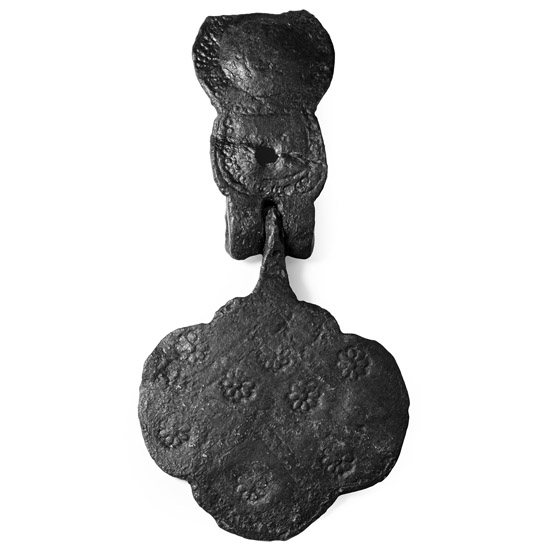
Medieval Knight's Heraldic Horse Harness Pendant with Hanger
13th-15th century A.D.Sold for (Inc. bp): £26
Comprising: suspension strap formed as two roundels with stamped pellet clusters and returned end holding the bar of a hinge securing the pendant, a quatrefoil type with its surface divided by bilinear bars into triangular zones, with a stamped rosette in each angle. 16.4 grams, 87 mm
From a UK collection formed in the 1980s. Property of an Essex, UK, gentleman. -
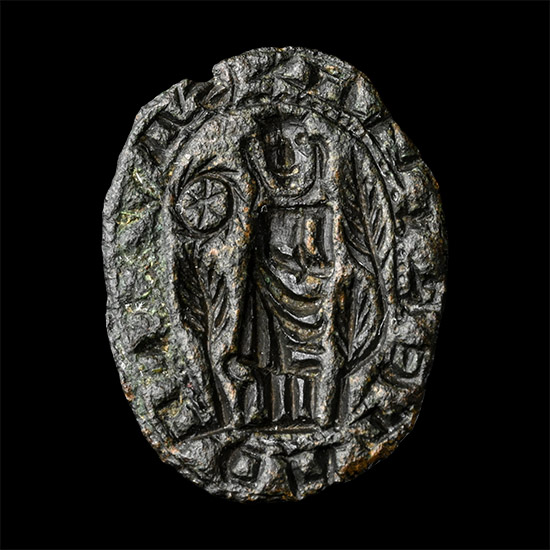
Medieval Ecclesiastical Oval Chess-Piece Type Seal Matrix
Circa 15th century A.D.Sold for (Inc. bp): £91
Oval seal with a tapering hexagonal-section handle surmounted by a suspension loop, underside with a standing nimbate Saint Catherine, a wheel to her side and an inscription 'SAVNC[T]A CATRINA' surrounding. 11.1 grams, 26 mm
Found Suffolk, UK. Property of a Suffolk, UK, gentleman. -
.jpg)
Large Medieval Stone Church Gargoyles
England, 15th century A.D.Sold for (Inc. bp): £4,940
Matched pair of carved stone corbels, each a mythical beast with a rounded body, bat-like wings folded behind the back, long arched neck and reptilian head with gaping mouth; mounted on an integral square-section base with stepped rear face; socket to forward face with bronze insert; some surface accretions. 400 kg total, 118 -121.5 cm
Private collection, UK. This lot has been checked against the Interpol Database of stolen works of art and is accompanied by search certificate number no.13385-259013.
From the Romanesque era onwards, images of demons, often carved on the external sides of cathedrals and churches, were strongly linked to the fantastical and monstrous creatures of ancient myth and legend. For theologians, supernatural creatures which could not otherwise be explained were not of God and therefore had to be demonic: their incorporation in the ecclesiastic structures showed that their malevolent powers could be kept under control only through the protection of the church. This origin of Christian demons is likely to have influenced the visual representation in medieval culture as hybrid and monstrous, especially given the increased interest in Greek works from the twelfth century onwards in the West.
