
Loading, please wait...
LOT 1283
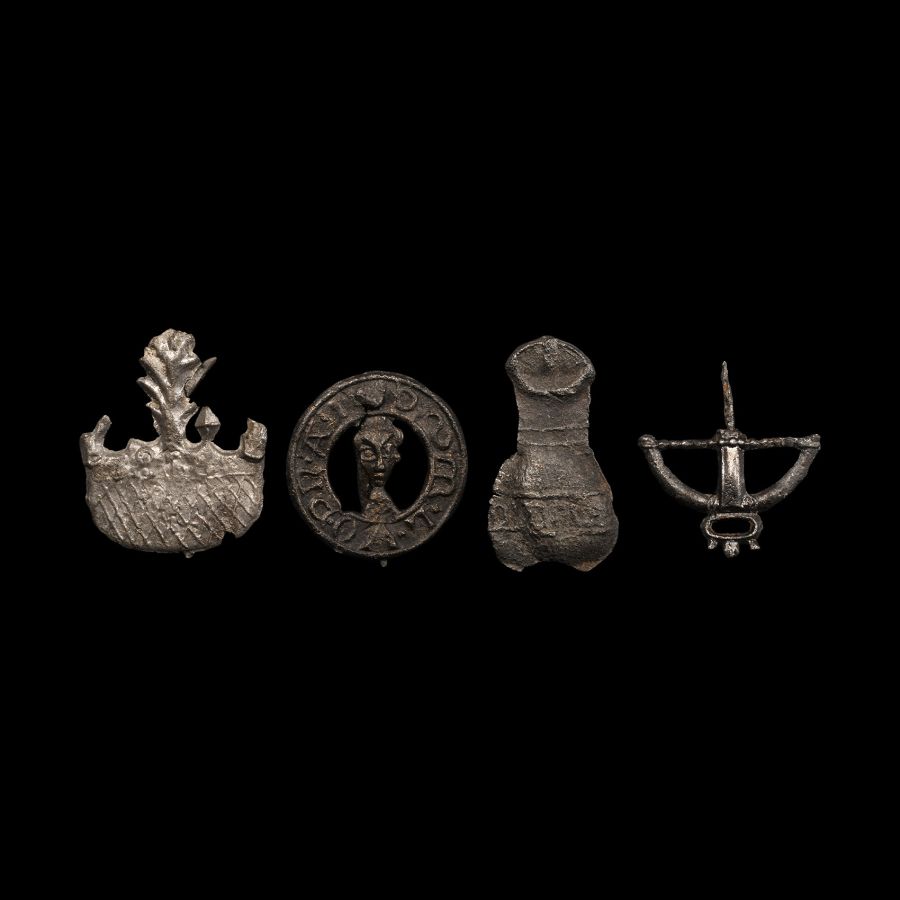
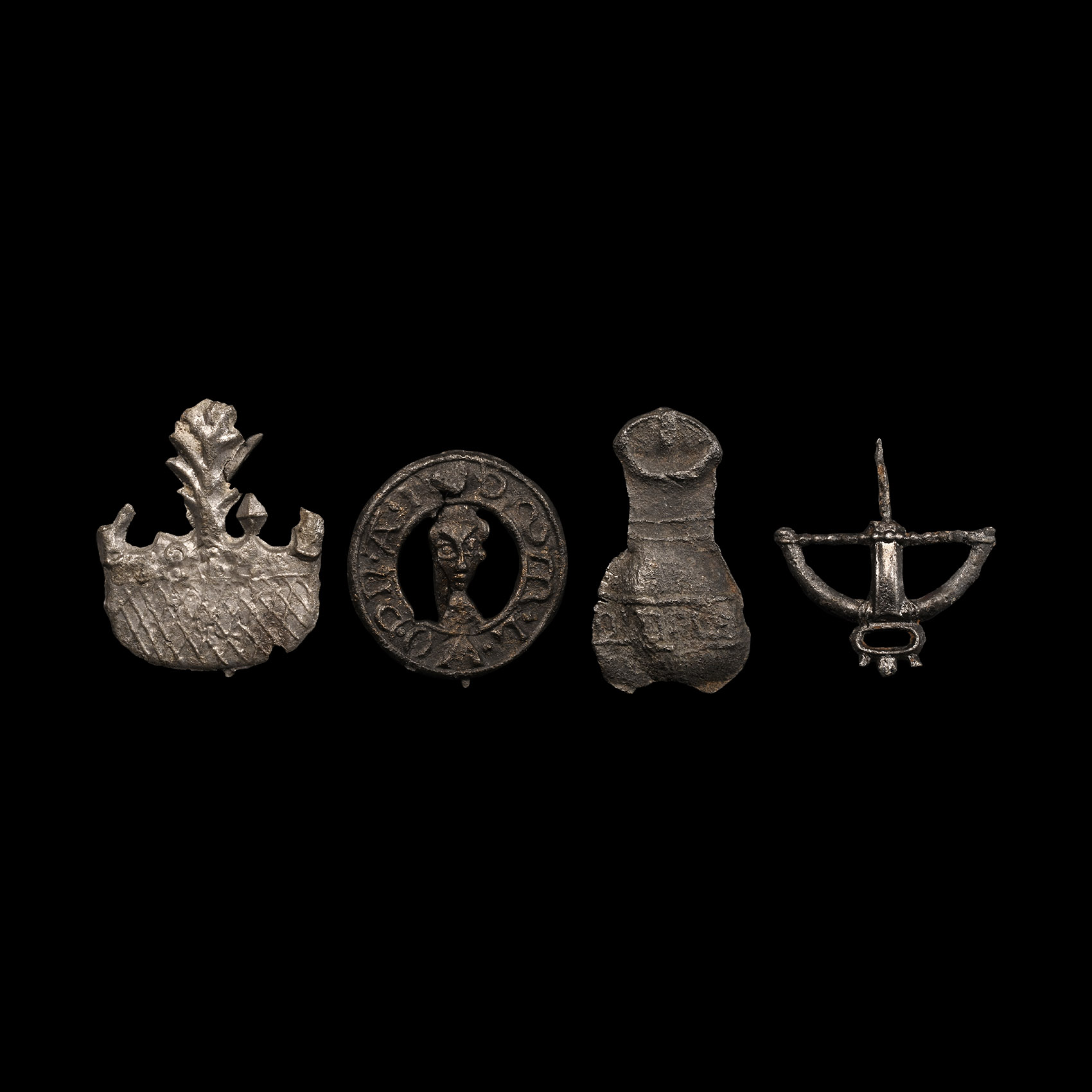
Medieval 'Thames' Secular Badge Collection
CIRCA 14TH-15TH CENTURY A.D.
3/4 - 1 in. (6.6 grams total, 20-24 mm).
A mixed group of lead-alloy badges and fragments comprising; a ring with facing mask to the centre, enigmatic legend 'DSMLAOCNA'; a hatched panel with frond emerging from the upper edge; a phallus; a crossbow with stirrup. [4, No Reserve]
ProvenanceFound on the Thames foreshore, London, UK.
Acquired on the UK antiques market between 1974-1985.
Albert Ward collection, Essex, UK.
TimeLine Auctions follows a vetting process to ensure the authenticity and legality of all items, reinforcing our commitment to integrity and responsible trading. Each antiquity, antique, and coin lot undergoes thorough examination by a vetting committee of at least ten external specialists, professional trade association members, scientists, and archaeologists: Our Vetting Process
AUCTIONS:
TimeLine is a leading auction house specialising in antiquities, ancient art, collectables, natural history, coins, medals, and books. Our auctions offer museums, collectors, historians, and enthusiasts the opportunity to acquire unique and historically significant pieces.
-
Medieval Handled Jug
14th-16th century A.D.Sold for (Inc. bp): £78
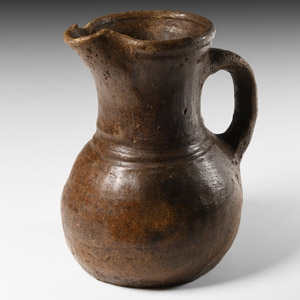
A ceramic jug with burnished surface, squat body, moulded gusset to the shoulder, rolled rim to the mouth with broad spout, thick strap handle to the rear. 918 grams, 17 cm high
Rim chipped.
Acquired 1971-1972. From the collection of the vendor's father. Property of a London, UK, collector. -
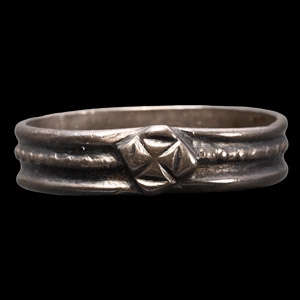
'The Lonsdale' Medieval Silver Ring with Cross Pattee
Circa 12th-13th century A.D.Sold for (Inc. bp): £117
A heavily patinated silver annular band, roughly rectangular in section decorated with a raised medial beaded band, plain raised bands above and below, and mounted lozengiform plaque displaying a central cross pattee; accompanied by a hinged ring box. 3.06 grams, 22.41 mm overall, 19.95 mm internal diameter (approximate size British T 1/2, USA 9 3/4, Europe 21.89, Japan 21)
Found whilst searching with a metal detector in Longsdale, Cumbia, UK, on Monday 1st January 1996, disclaimed and returned to the finder. Accompanied by a copy of the British Museum’s Portable Antiquities Scheme (PAS) report no.LANCUM-8541C5. -
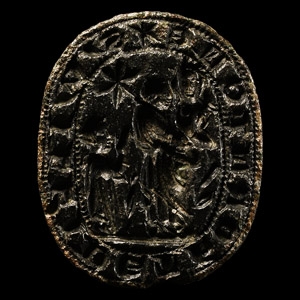
English Medieval Oval-Shaped Seal Matrix for William of Thornton
Early 14th century A.D.Sold for (Inc. bp): £312
A bronze ellipsoid seal matrix with pierced quatrefoil finial; incuse motif of Mary seated with infant Jesus on her lap, star above her shoulder, kneeling robed and tonsured figure beside her with hand raised in prayer; Lombardic script legend to the border with beaded bands '* S' WILL'I DE ThORNTONE' (seal of William of Thornton). 12.8 grams, 25 mm
The Matrix Collection, formed by David Morris since the late 1980s. Matrix Collection catalogue no.909. Many of the seals within the collection were published in a book titled 'The Matrix Collection', by David Morris in 2012. Accompanied by a copy of the illustrated collection notes.
Thornton is a village in West Yorkshire, close to the city of Bradford and mentioned in Domesday Book; it was where the Brontë sisters spent their early lives before moving to Haworth.
