
Loading, please wait...
_900x900.jpg "Medieval 'Thames' Pewter Bifacial Wine Tavern Token")
_200x200.jpg "Medieval 'Thames' Pewter Bifacial Wine Tavern Token")
.jpg "Medieval 'Thames' Pewter Bifacial Wine Tavern Token")
LOT 1626
Medieval 'Thames' Pewter Bifacial Wine Tavern Token
CIRCA 14TH-15TH CENTURY A.D.
3/4 in. (1.11 grams, 18 mm).
With a hatched double-headed eagle to one face and barred capital letter 'A' to the other; pierced in two places, perhaps for use as a button [No Reserve]
ProvenanceFound Billingsgate spoil from the Thames foreshore, London, UK.
CONDITIONTimeLine Auctions follows a vetting process to ensure the authenticity and legality of all items, reinforcing our commitment to integrity and responsible trading. Each antiquity, antique, and coin lot undergoes thorough examination by a vetting committee of at least ten external specialists, professional trade association members, scientists, and archaeologists: Our Vetting Process
AUCTIONS:
TimeLine is a leading auction house specialising in antiquities, ancient art, collectables, natural history, coins, medals, and books. Our auctions offer museums, collectors, historians, and enthusiasts the opportunity to acquire unique and historically significant pieces.
-
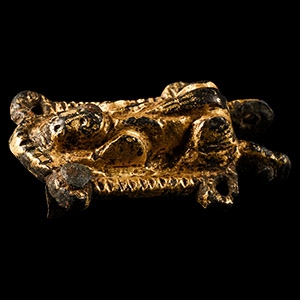
Medieval Gilt Bronze Knight's Horse Harness Hanger with Lion
12th-14th century A.D.Estimate: £200 - 300 (+bp*)
Opening Bid: £80
The lion in high-relief, lying along the pendant with its head resting on its front paws, lug to each corner with rivet hole, two pierced lugs to top edge for suspension bar, decoratively notched edges, extensive remains of gilding. 30 grams, 30 mm
Acquired early 1990s. From an East Anglian private collection. -

Medieval and Later Pottery Fragment Group
Circa 15th-18th century A.D.Sold for (Inc. bp): £26
Comprising glazed, unglazed, decorated and polychrome fragments mainly from tiles and vessels, together with a vessel fragment featuring a lion modelled in relief. 11 kg total, 4-22 cm
Acquired 1990s-early 2000s. East Anglian private collection. -
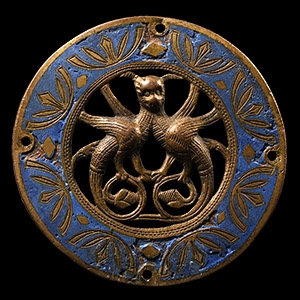
Medieval Limoges Bronze and Champleve Enamel Roundel with Fantastical Creature
Circa 13th century A.D.Sold for (Inc. bp): £23,400
Openwork winged beast to the centre, its tails curling beneath the body creating the foliate tendrils on which it perches, broad outer roundel decorated with geometric plants alternating with lozenges, extensive remains of blue champlevé enamelling; engraved and chiselled; four attachment holes. 61 grams, 89 mm wide
with Sotheby's, London, 9 December 1993, lot 22. Private collection, Europe. This lot has been checked against the Interpol Database of stolen works of art and is accompanied by search certificate no.11903-206496.
Likely used to adorn a coffret. Likely before 1227 A.D.
