
Loading, please wait...
LOT 1147
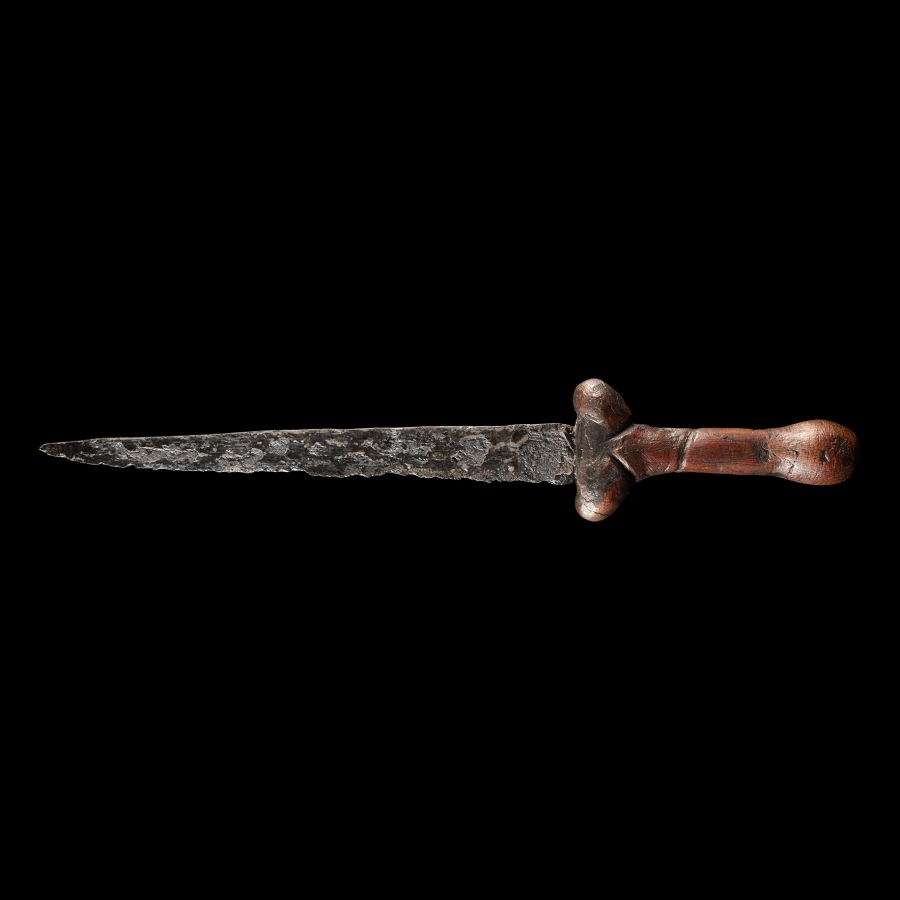
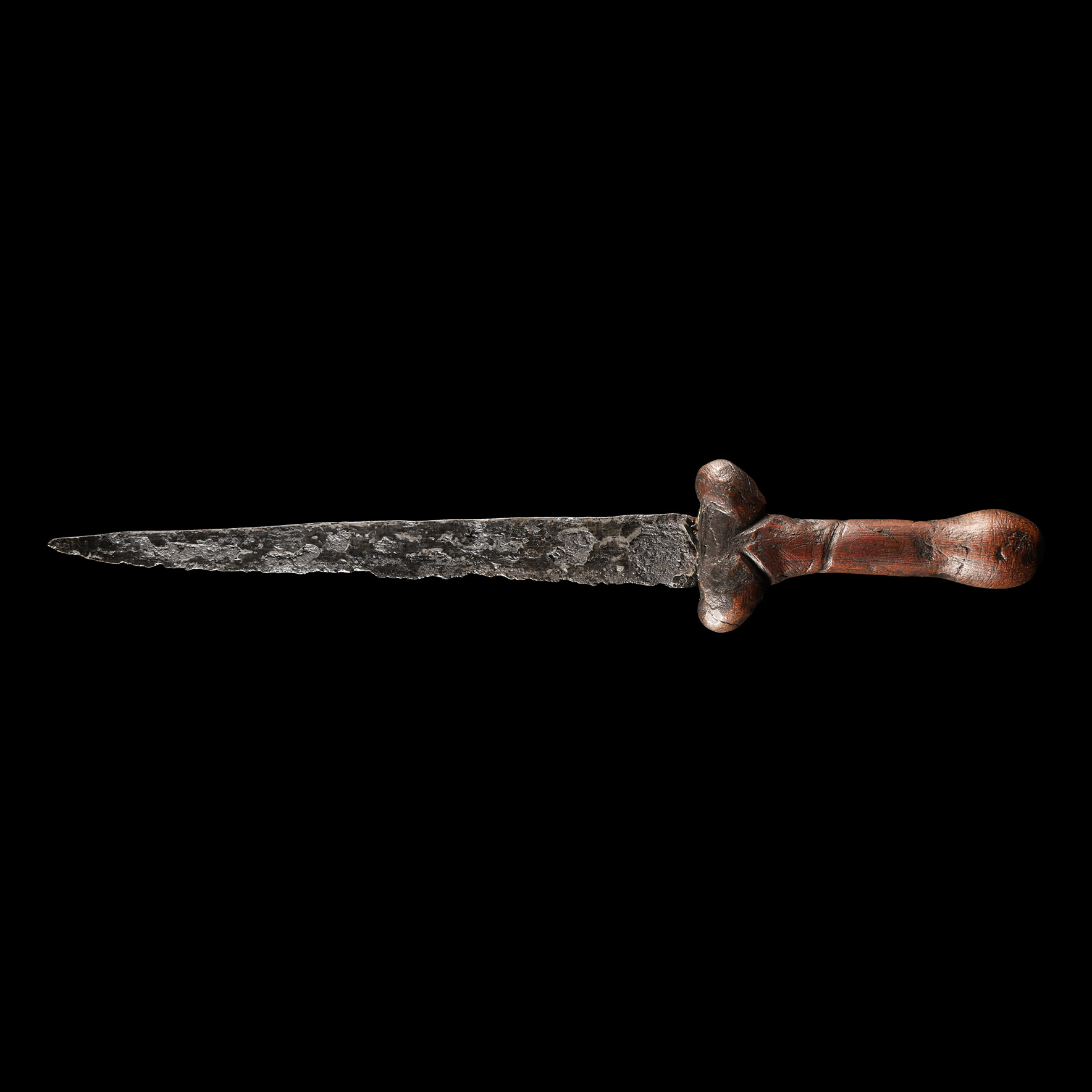
Medieval 'Thames' Iron Kidney Dagger
14TH-15TH CENTURY A.D.
11 1/2 in. (94 grams, 29.2 cm).
The tapering blade with a single cutting edge; replica wooden handle with bulbous guard and pommel. [No Reserve]
ProvenanceFound on the Thames foreshore at Vintry, Southwark, London, UK.
CONDITIONTimeLine Auctions follows a vetting process to ensure the authenticity and legality of all items, reinforcing our commitment to integrity and responsible trading. Each antiquity, antique, and coin lot undergoes thorough examination by a vetting committee of at least ten external specialists, professional trade association members, scientists, and archaeologists: Our Vetting Process
AUCTIONS:
TimeLine is a leading auction house specialising in antiquities, ancient art, collectables, natural history, coins, medals, and books. Our auctions offer museums, collectors, historians, and enthusiasts the opportunity to acquire unique and historically significant pieces.
-
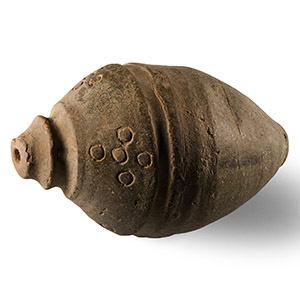
Byzantine 'Greek Fire' Ceramic Fire Bomb or Hand Grenade
Circa 11th-14th century A.D.Sold for (Inc. bp): £286
With a piriform body and domed mouth, stepped rings to the foot, engraved decoration on the shoulders with crosses and grapes; intended to be filled with explosive liquid and wick, used as a hand grenade. 573 grams, 15 cm
Acquired 1990s. From the H.N. collection, Milton Keynes, Bedfordshire, UK. Accompanied by an academic paper by military specialist Dr Raffaele D'Amato, dated 15 July 2019 and titled 'Eastern Roman Empire - Greek Fire Bomb or Hand Grenade (μεσαίον kακάβιον) 9th-11th century AD'.
Apart from the use of siphons or manual flame-throwers called cheirosiphona, special Roman soldiers employed terracotta grenades, in the form of small jars, abundantly evidenced in archaeological excavations. Such were the γανωτα, vessels (sometimes also in bronze) used for Greek fire. They were called μεσαία kακαβιά or κυτροκακάβια where the former had a bulbous shape and the latter a more cylindrical form. -
.jpg)
Archaic Greek Modified Bronze Corinthian Helmet
Late 7th-early 6th century B.C.Estimate: £4,000 - 6,000 (+bp*)
Opening Bid: £2,222
Consisting of two sections joined with bronze rivets; above a domed section with row of rivets; below, a folded band with rolled rim, with rivets to the rear holding two halves; line of holes to the base for securing an inner lining. 2.2 kg total, 31.5 cm high including stand
Acquired in the 1970s. Ex private Austrian collection. The Kusmirek Collection, UK. Accompanied by an academic report by Dr Raffaele D'Amato. Accompanied by a metal analysis and appraisal by Dr Brian Gilmour. This lot has been checked against the Interpol Database of stolen works of art and is accompanied by search certificate number no.11764-203980.
The upper part of the helmet was probably modified in antiquity, the lower part of the eye holes and the cheek pieces have been cut away, and replacement cheek pieces, now lacking, were once crudely rivetted to the sides. -
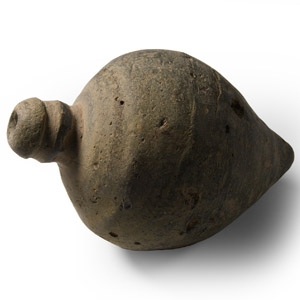
Byzantine 'Greek Fire' Ceramic Fire Bomb or Hand Grenade
9th-11th century A.D.Sold for (Inc. bp): £156
Piriform body with domed filler-hole, raised vertical flanges to the shoulder; intended to be filled with explosive liquid and wick, used as a hand grenade. 500 grams, 12 cm
Acquired 1980-2015. Ex Abelita family collection. Accompanied by an academic paper by military specialist Dr Raffaele D'Amato, dated 15 July 2019 and titled 'Eastern Roman Empire - Greek Fire Bomb or Hand Grenade (μεσαίον kακάβιον) 9th-11th century AD'.
Apart from the use of siphons or manual flame-throwers called cheirosiphona, special corps of Roman soldiers employed terracotta grenades, in the form of small jars, abundantly evidenced in archaeological excavations. Such were the γανωτα, vessels (sometimes also of bronze) used for Greek fire. They were called μεσαία kακαβιά or κυτροκακάβια where the former had a bulbous shape and the latter a more cylindrical form.
