
Loading, please wait...

LOT 1275
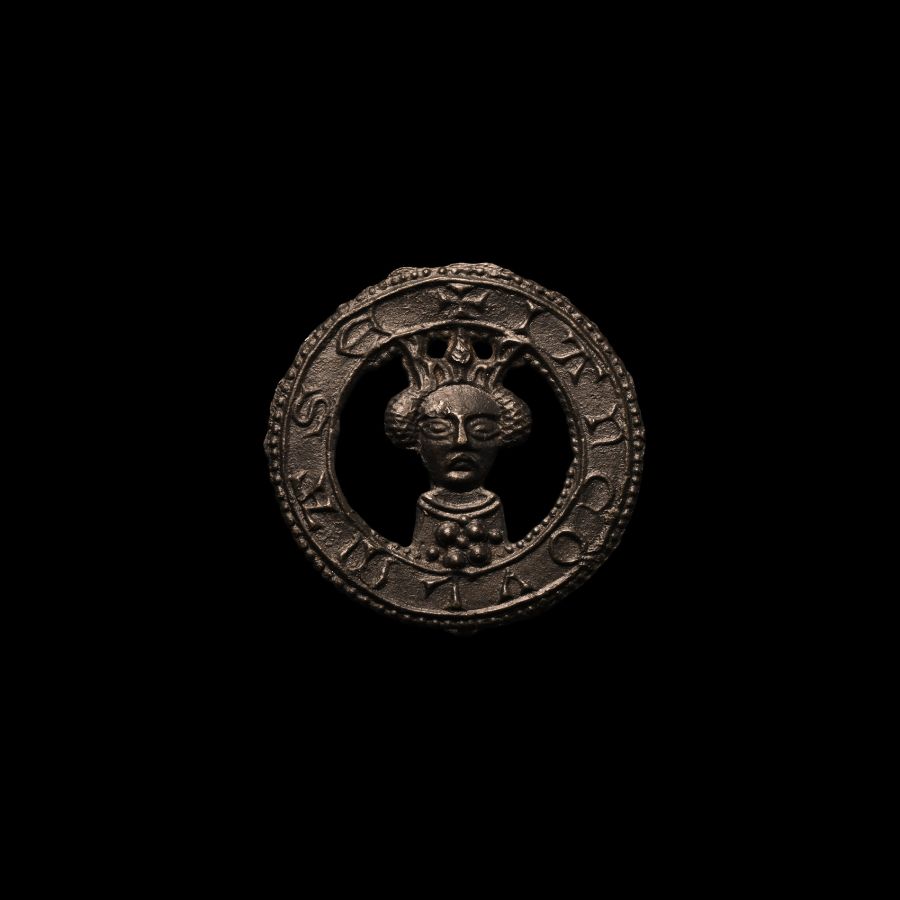
Medieval 'Thames' Crowned Bust Pilgrim's Badge
CIRCA 14TH-15TH CENTURY A.D.
7/8 in. (1.78 grams, 22 mm).
An openwork lead badge composed of a crowned facing male bust within a roundel bearing the inscription '+ IANCOVLMASE'; complete with pin. [No Reserve]
ProvenanceFound on the Thames foreshore, London, UK.
Acquired on the UK antiques market between 1974-1985.
Albert Ward collection, Essex, UK.
Spencer, B., Pilgrim Souvenirs and Secular Badges, Medieval Finds from Excavations in London, London, 2010, p.324, item 323f.
FootnotesThis enigmatic inscription has been found on other similar badges, but is yet to be satisfactorily understood. It is possibly associated with the cult of Edward the Confessor or representing the head of John the Baptist.
CONDITIONTimeLine Auctions follows a vetting process to ensure the authenticity and legality of all items, reinforcing our commitment to integrity and responsible trading. Each antiquity, antique, and coin lot undergoes thorough examination by a vetting committee of at least ten external specialists, professional trade association members, scientists, and archaeologists: Our Vetting Process
AUCTIONS:
TimeLine is a leading auction house specialising in antiquities, ancient art, collectables, natural history, coins, medals, and books. Our auctions offer museums, collectors, historians, and enthusiasts the opportunity to acquire unique and historically significant pieces.
-
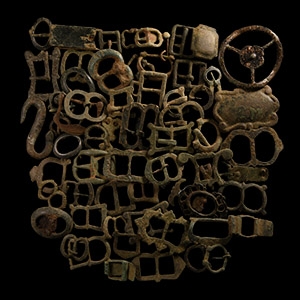
Late Medieval to Stuart Buckle Group
15th-17th century A.D.Sold for (Inc. bp): £22
A mixed group of bronze buckles and buckle-frames, plaques and other fittings. 327 grams total, 16-54 mm
Found Suffolk. -
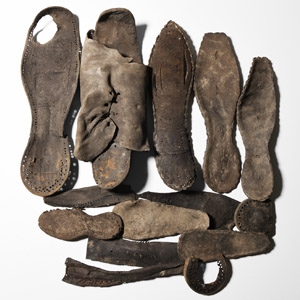
Medieval 'Thames' Leather Shoe Fragment Collection
Circa 14th-16th century A.D.Sold for (Inc. bp): £26
A group of leather shoe soles and fragments of various shapes, including examples displaying the original perforations for the attachment of additional shoe elements. 233 grams total, 5-25 cm
Found on the Thames foreshore, London, UK. Acquired on the UK antiques market between 1974-1985. Albert Ward collection, Essex, UK. -
.jpg)
Medieval Gilt Pendant with Saint
12th-13th century A.D.Sold for (Inc. bp): £98
A hollow-formed gilt-bronze triangular sleeve with open edge and attachment loops, repoussé image of a nimbate facing saint with a cross in one hand. 7.12 grams, 39 mm
Fine condition.
Acquired from Dick Meyer in 2005. Ex central London gallery.
