
Loading, please wait...
LOT 0337
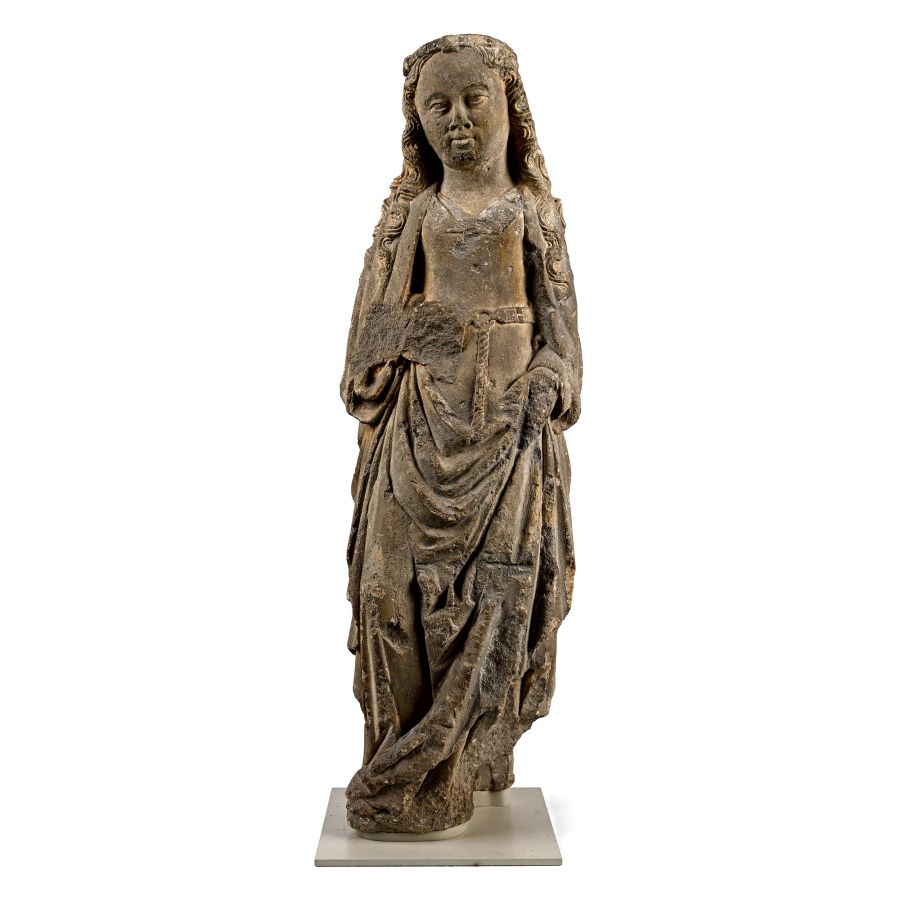
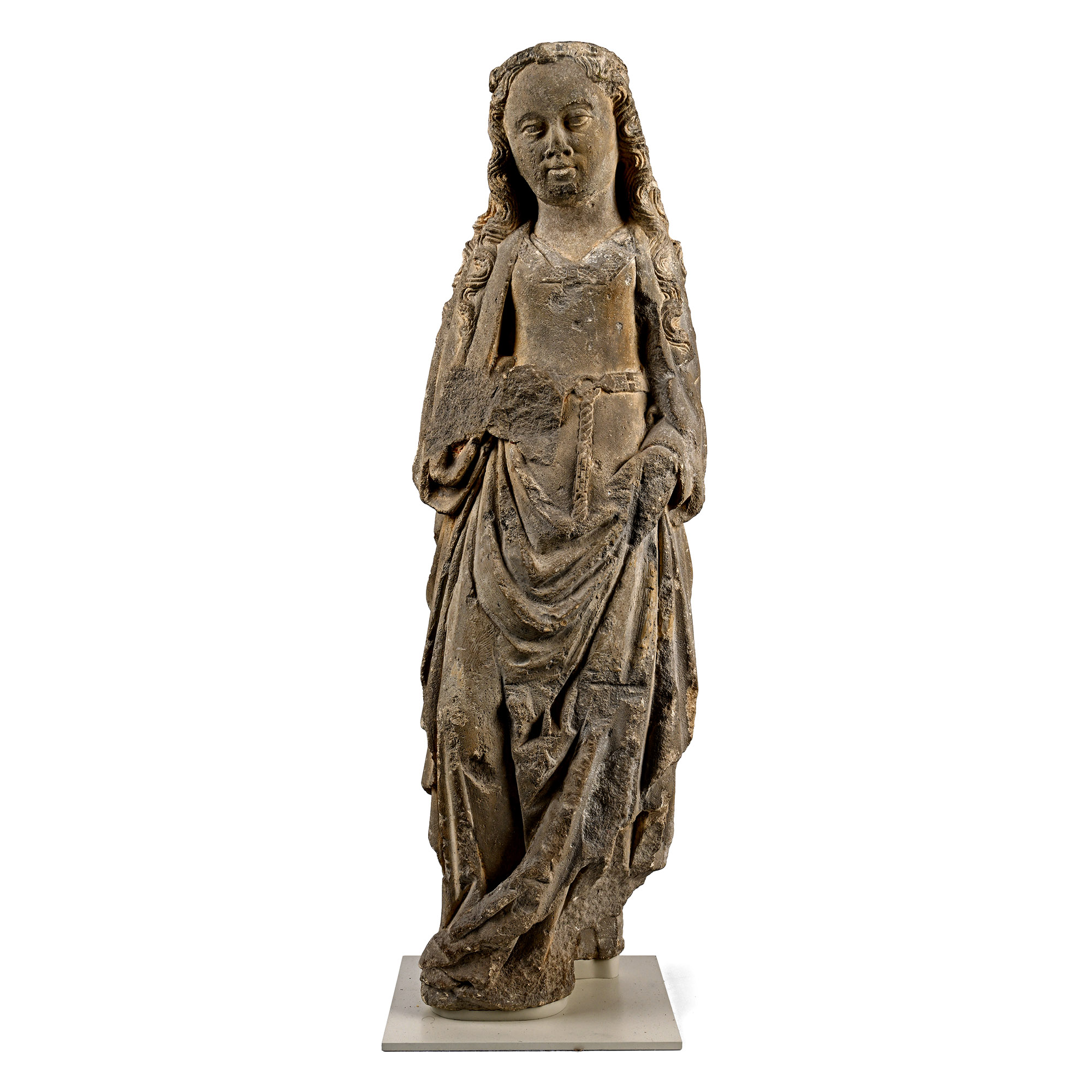
Medieval Stone Sculpture of St Mary Magdalene
FRANCE, EARLY 15TH CENTURY A.D.
27 1/2 in. (21.5 kg total, 70 cm high including stand).
Modelled in high relief with dorsal pillar; maiden in advancing pose with fillet to the brow and curly tresses falling to the shoulders, girdle with loop and chain to the waist, copious folds of the robe lifted by the left hand, right hand at waist-height; mounted on a custom-made stand. [No Reserve]
ProvenanceFrench-Swiss private collection.
The items were acquired in the 2010s to be displayed on the property in Ain, France. Following the move, they disposed of some of the items.
This lot has been checked against the Interpol Database of stolen works of art and is accompanied by search certificate no.13514-262848.
Cf. a French sculpture of Mary Magdalene in the Metropolitan Museum of Art, New York, accession no. 40.147.1.
FootnotesBy the early 13th century, bodies in Gothic sculpture acquired more three-dimensional mass, more flexibility, more natural poses and drapery, and individual faces. Later 13th-century sculpture gave up this monumental power for more specific anatomy, actions, and emotions. Late 14th -century and 15th-century work continued in the direction of greater mass and more detailed faces.
CONDITIONTimeLine Auctions follows a vetting process to ensure the authenticity and legality of all items, reinforcing our commitment to integrity and responsible trading. Each antiquity, antique, and coin lot undergoes thorough examination by a vetting committee of at least ten external specialists, professional trade association members, scientists, and archaeologists: Our Vetting Process
AUCTIONS:
TimeLine is a leading auction house specialising in antiquities, ancient art, collectables, natural history, coins, medals, and books. Our auctions offer museums, collectors, historians, and enthusiasts the opportunity to acquire unique and historically significant pieces.
LOT 0337
Medieval Stone Sculpture of St Mary Magdalene
Estimate £3,000 - 4,000€3,480 - 4,640 (for guidance only)$4,050 - 5,400 (for guidance only)
-
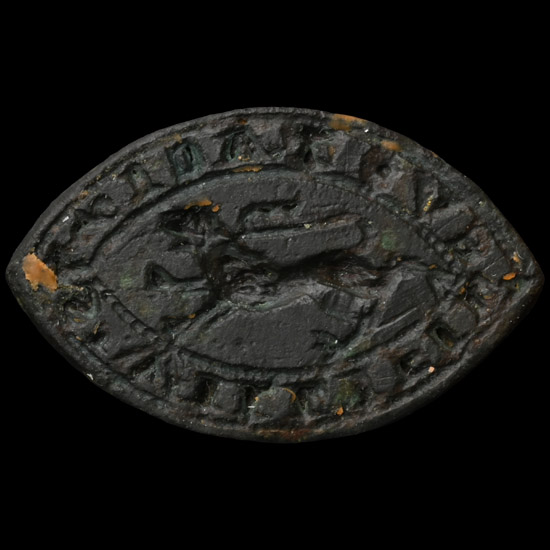
Medieval Bronze Vesica-Shaped Seal Matrix of William
Circa 13th-14th century A.D.Estimate: £150 - 200 (+bp*)
Opening Bid: £75
With central motif of a lion courant, border with legend '* S' VVILL[...]VS[.]ACI'; supplied with an impression. 7.28 grams, 29 mm
Acquired on the UK art market in the 1980s. From an East Anglian private collection. -
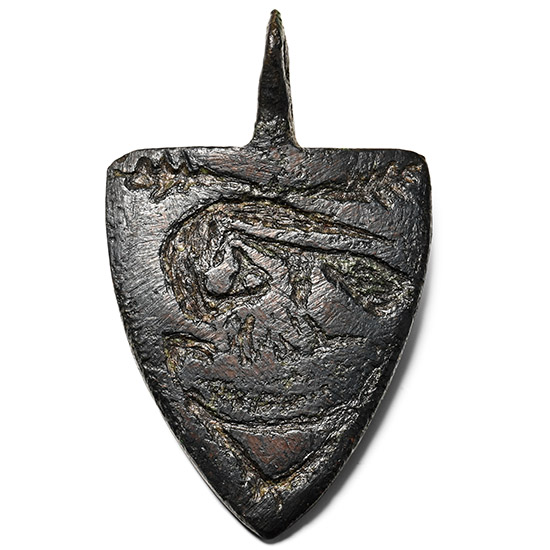
Medieval Knight's Bronze Heraldic Horse Harness Pendant with Pelican
Circa 13th-15th century A.D.Estimate: £80 - 100 (+bp*)
Bids: 2 | Current Bid: £15
Heater-shaped with attachment lug above, an incised motif of 'pelican in her piety'. 11.75 grams, 44 mm
Ex retired East Anglian school teacher, Isle of Wight, Hampshire, UK, 1960s-1980s. -
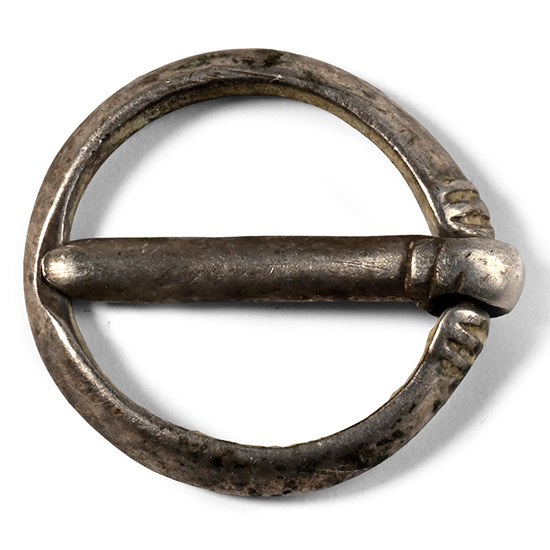
Medieval Silver Annular Brooch with Pin
1200-1700 A.D.Estimate: £40 - 60 (+bp*)
Bids: 1 | Current Bid: £5
The frame circular in plan with a sub-triangular cross-section and convex outer edge, flat reverse; a pair of decorative transverse grooves flanking the pin constriction, recess for the pin-rest; pin coiled around the shank, D-shaped in section and with a rounded point, decorated with three transverse grooves to the obverse. 2.72 grams, 21 mm
Found near Lewes, East Sussex, UK; declared as potential Treasure under the Treasure Act with Treasure reference no.2025T785, subsiquently disclaimed and returned to the finder. Accompanied by a copy of the British Museum's Portable Antiquities Scheme (PAS) report no.SUSS-2465B3.
Annular brooches were used to fasten garments, growing in popularity during the 13th and 14th centuries and continuing into the Post Medieval period. See Egan and Pritchard (2002, pg. 248-255) for examples recovered from Medieval contexts in London. A broadly similar medieval example that has been submitted through the treasure process includes: 2007T343 (SUSS-BC4C47). However, the form is decoratively similar to some early Post Medieval examples such as DOR-3A57FD (2022T442) and GLO-3C6A1A (2022T439), of 16th century date, but on these examples the reverse of the frame is bevelled not flat. Based on the above examples a broad 13th to 17th century date is suggested.
