
Loading, please wait...
_900x900.jpg "Medieval Silver-Gilt Buckle")
_200x200.jpg "Medieval Silver-Gilt Buckle")
.jpg "Medieval Silver-Gilt Buckle")
LOT 1592
Medieval Silver-Gilt Buckle
5TH-13TH CENTURY A.D.
1 in. (6.5 grams, 26 mm).
The oval plate retaining two fixing rivets, articulate round-section head and zoomorphic tongue. [No Reserve]
ProvenanceAcquired on the UK market, 1990s.
Property of a retired academic.
TimeLine Auctions follows a vetting process to ensure the authenticity and legality of all items, reinforcing our commitment to integrity and responsible trading. Each antiquity, antique, and coin lot undergoes thorough examination by a vetting committee of at least ten external specialists, professional trade association members, scientists, and archaeologists: Our Vetting Process
AUCTIONS:
TimeLine is a leading auction house specialising in antiquities, ancient art, collectables, natural history, coins, medals, and books. Our auctions offer museums, collectors, historians, and enthusiasts the opportunity to acquire unique and historically significant pieces.
-
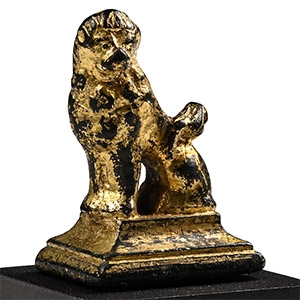
Medieval Gilt Bronze Lion Finial
14th-15th century A.D.Sold for (Inc. bp): £520
Modelled in the half-round standing with head left on a plinth base, rectangular fixing socket to underside. 25.1 grams, 32 mm high
‘The Ancient Menagerie Collection’ formerly the property of a Cambridgeshire lady, collected since the 1990s and acquired from auctions and dealers throughout Europe and the USA, now ex London collection. -
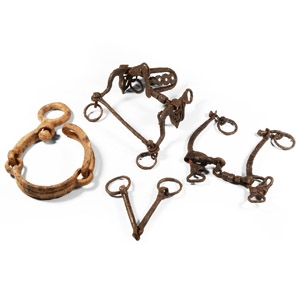
Medieval Iron Horse Bit Group
Circa 15th-16th century A.D.Sold for (Inc. bp): £130
Comprising a complete articulated snaffle-bit with openwork tongue-plate, an articulated curb-bit, and other items. 1.2 kg total, 23-32.5 cm
Acquired 1990s-early 2000s. East Anglian private collection. -
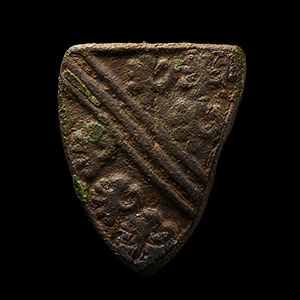
Medieval Knight's Bronze 'De Bohun Family' Heraldic Horse Harness Mount
14th-15th century A.D.Sold for (Inc. bp): £33
Comprising a heater shield with once enamelled arms 'a bend coticed between six lions rampant' (de Bohun family). 9.2 grams, 31 mm
From a Cambridgeshire, UK, collection.
