
Loading, please wait...

LOT 1875
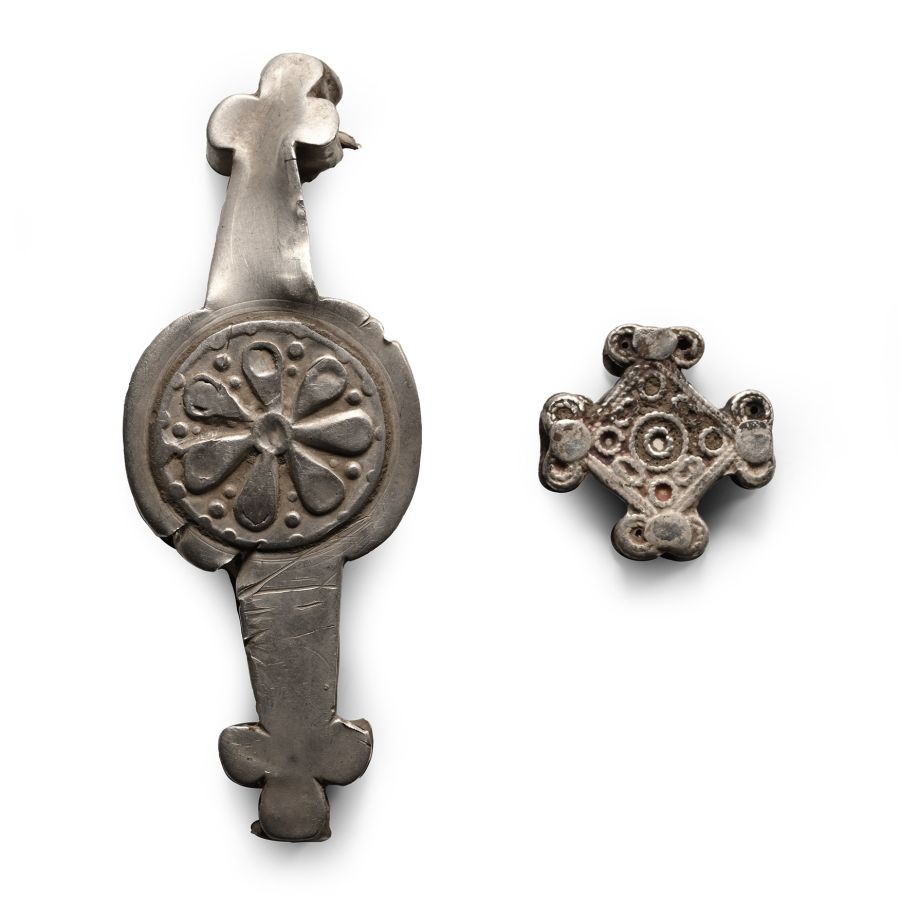
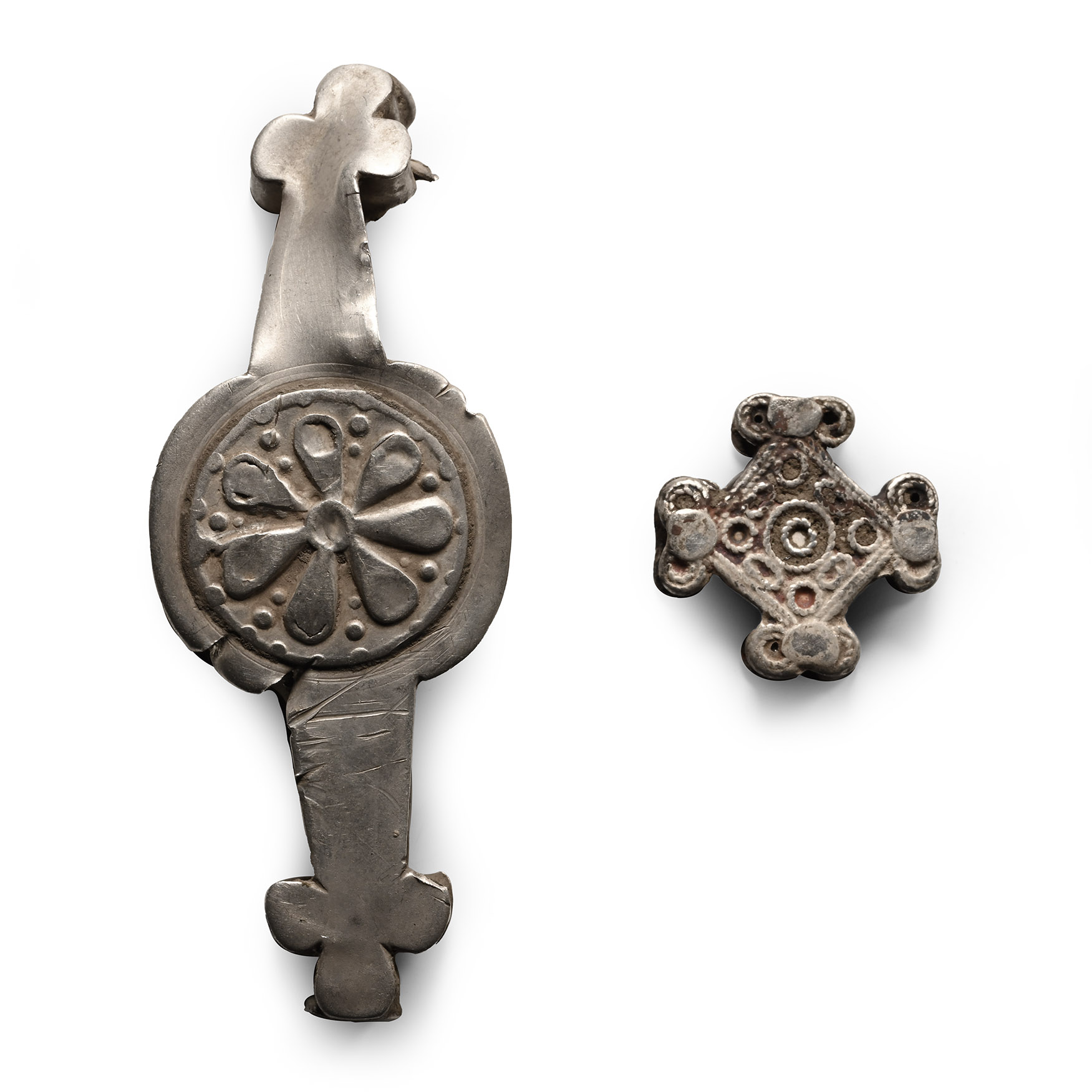
Medieval Silver Belt Mount Group
14TH-16TH CENTURY A.D.
7/8 - 3 in. (24.6 grams total, 22-75 mm).
Comprising: a strap junction formed as two lozengiform plates with lobed finial to each arm, enamel detailing; discoid plaque with rosette detailing, lateral arms with trefoil finials. [2, No Reserve]
ProvenanceUK private collection before 2000.
Acquired on the UK art market.
Property of a London gentleman.
TimeLine Auctions follows a vetting process to ensure the authenticity and legality of all items, reinforcing our commitment to integrity and responsible trading. Each antiquity, antique, and coin lot undergoes thorough examination by a vetting committee of at least ten external specialists, professional trade association members, scientists, and archaeologists: Our Vetting Process
AUCTIONS:
TimeLine is a leading auction house specialising in antiquities, ancient art, collectables, natural history, coins, medals, and books. Our auctions offer museums, collectors, historians, and enthusiasts the opportunity to acquire unique and historically significant pieces.
-
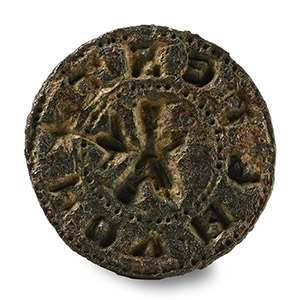
Medieval Bronze Seal Matrix with Clasped Hands
12th-14th century A.D.Sold for (Inc. bp): £20
With central mane-in-fede motif beneath a star, Lombardic script legend '* FOY ME TENT' for 'fidelity sustains me'. 4.37 grams, 20 mm
Ex Stocker collection, Kent, UK, 1955-early 2000s.
This amatory legend is found on other matrices, where the first word is more usually spelled FEI – a similar example is PAS database, SOM-D80124. An impression in the National Library of Wales is attached to a document dated c.1310. For this and similar legends see, Jones, M., The Beautiful Game: Courtly Love Posies in Anglo-Norman Inscribed on Jewellery and Seals, in Journal of the British Archaeological Association 176 (2023), 1-30. -
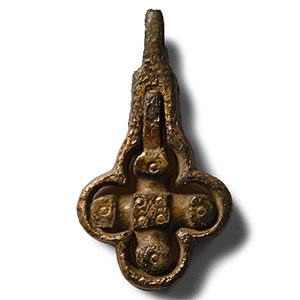
Medieval Knight's Enamelled Gilt Bronze Heraldic Horse Harness Pendant
Circa 14th-15th century A.D.Sold for (Inc. bp): £52
Pendant with pierced lug, voided quatrefoil frame enclosing a separate cross with punched-point detailing to the nodes. 8.06 grams, 34 mm
Acquired on the European art market since the early 2000s. From the private Northern Ireland collection of R.M. -
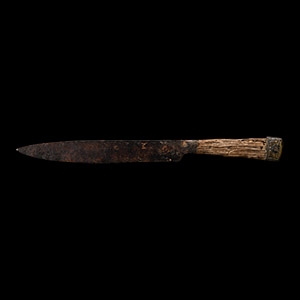
Medieval Iron Knife with Bronze Pommel
Early to mid-15th century A.D.Sold for (Inc. bp): £182
Comprising a single cutting edge and scale tang; bifacial pommel engraved with a foliate motif within a border. 46 grams, 20.5 cm
Acquired 1960s-1990s. Late Alison Barker collection, a retired London barrister.
Knife handles were made of wood, horn, bone or metal. Wood, a cheap, readily available and easily worked material, was by far the most common and most of the species used are both hard and flexible.
