
Loading, please wait...


LOT 0342
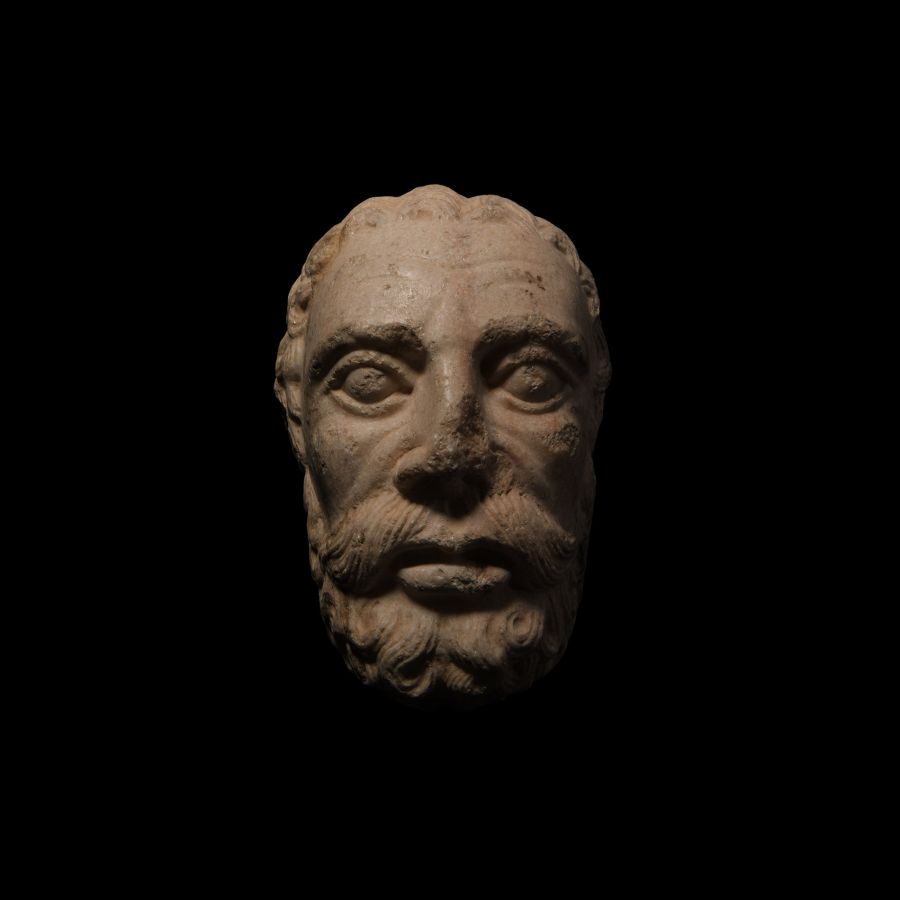
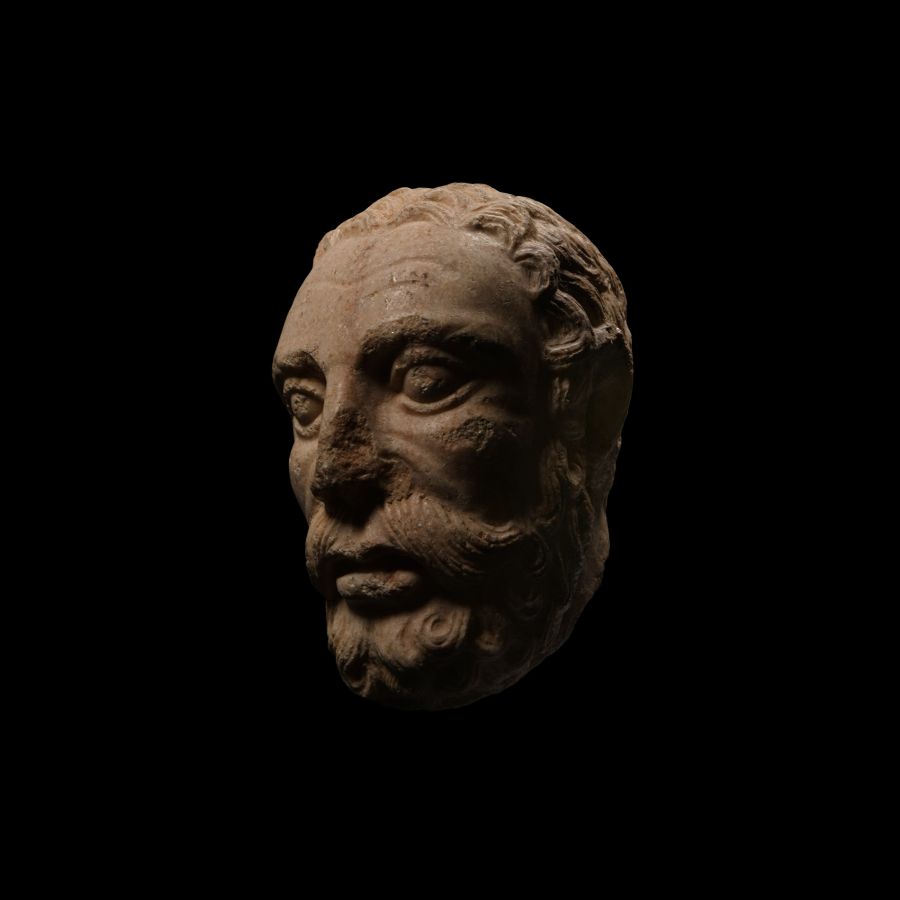
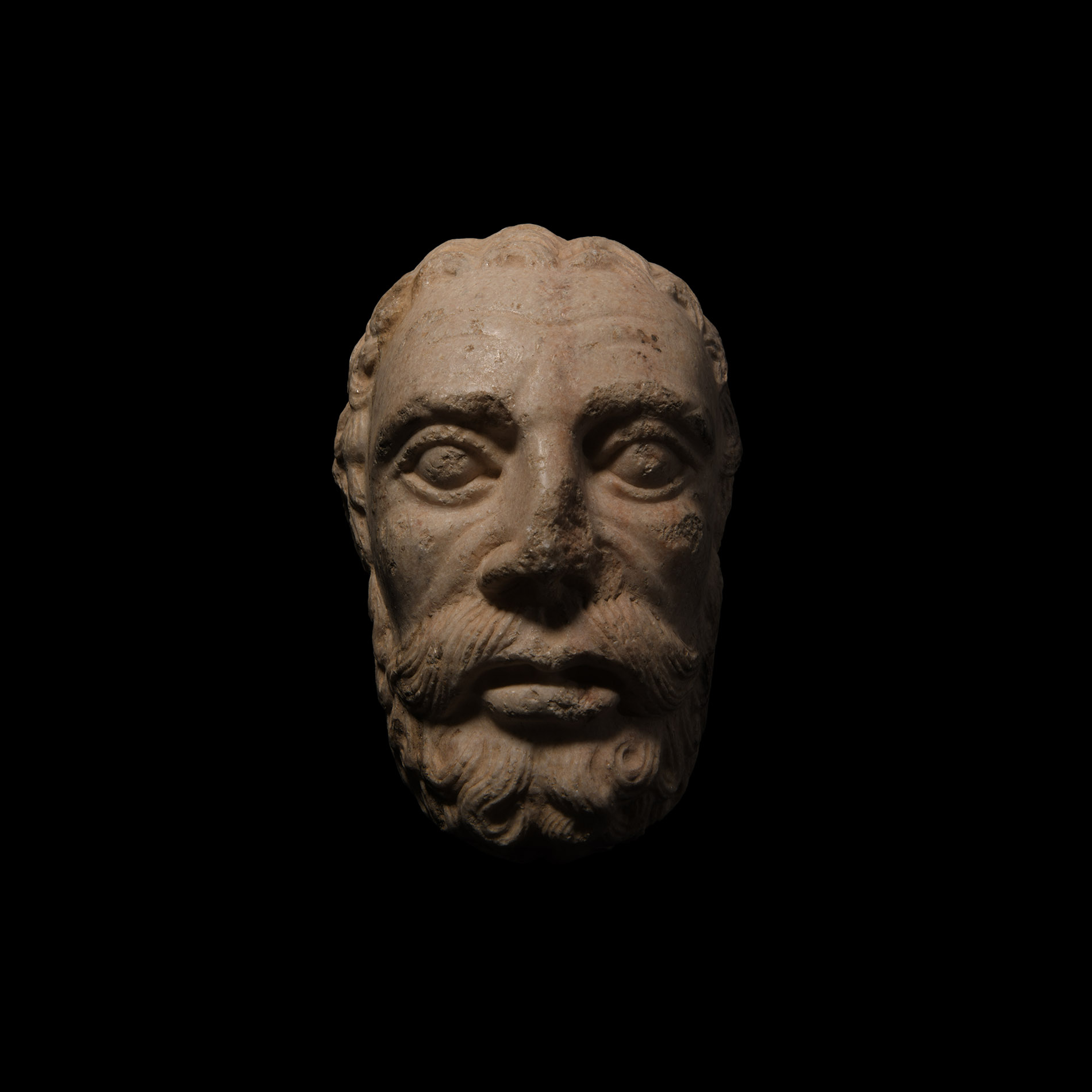
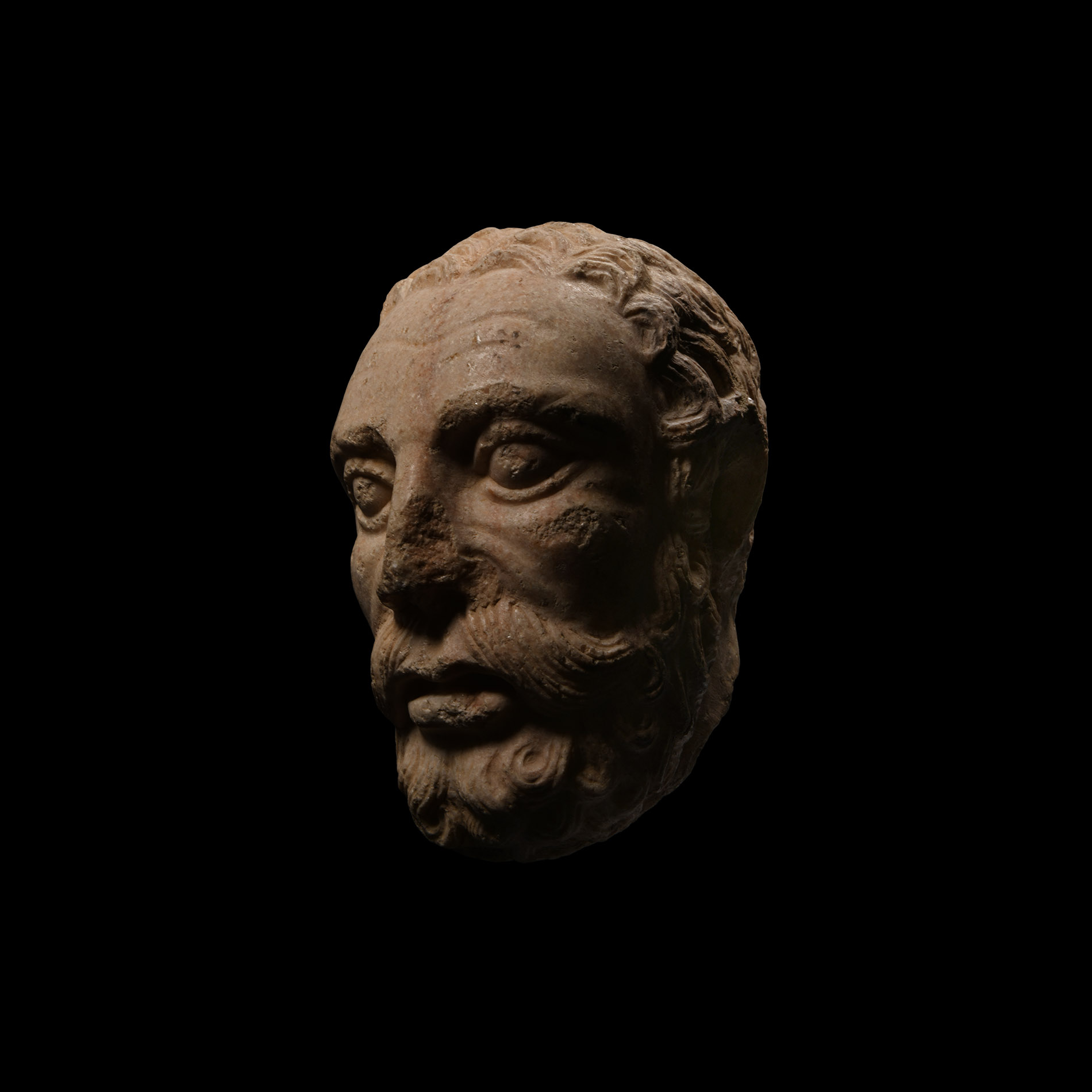
Medieval Romanesque Marble Head of a Saint
LATE 12TH-13TH CENTURY A.D.
7 in. (3.8 kg, 18 cm).
Carved naturalistically in the round as a mature male figure with short wavy hair, full beard and moustache, his brow furrowed and mouth held slightly ajar; repaired.
ProvenanceAcquired in Europe before 1996.
Accompanied by an academic report by Dr Raffaele D’Amato.
This lot has been checked against the Interpol Database of stolen works of art and is accompanied by search certificate no.11809-206816.
See Sauerländer, W., Gothic Sculpture in France 1140-1270, Ambrams, 1972; Cahn, W. and Seidel, L., Romanesque Sculpture in American Collections, 1: New England Museums, New York, 1979; Williamson, P., Gothic Sculpture 1140-1300, Yale University Press, 1995; Fogg, S., 30 Heads, stone heads from the 12th to the 15th century, London-New York, 2018.
FootnotesThe head was carved as an image of a saint, Apostle or a prophet. The accomplished and sophisticated style of carving on this head can be compared to some of the most celebrated Romanesque buildings of Southern France. The carving of the head resembles the representations of heads and faces of 12th century French Romanesque art, for example those of Saint Trophime in Arles. This imposing head once served as an important architectural part of a lavishly decorated church, possibly in western France. Its form and the size suggest that the head was not only decorative but that it would have been structurally important – perhaps part of a row of statues of apostles and prophet like those depicted on the Saint Trophime façade.
CONDITIONTimeLine Auctions follows a vetting process to ensure the authenticity and legality of all items, reinforcing our commitment to integrity and responsible trading. Each antiquity, antique, and coin lot undergoes thorough examination by a vetting committee of at least ten external specialists, professional trade association members, scientists, and archaeologists: Our Vetting Process
AUCTIONS:
TimeLine is a leading auction house specialising in antiquities, ancient art, collectables, natural history, coins, medals, and books. Our auctions offer museums, collectors, historians, and enthusiasts the opportunity to acquire unique and historically significant pieces.
LOT 0342
Medieval Romanesque Marble Head of a Saint
Estimate £5,000 - 7,000€5,800 - 8,120 (for guidance only)$6,750 - 9,450 (for guidance only)
-
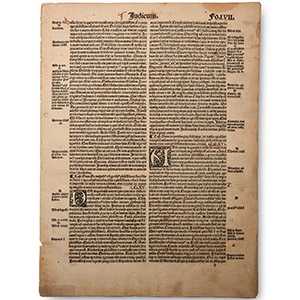
Medieval Judges Bible Page by Johann Gruninger
Printed 1492 A.D.Sold for (Inc. bp): £208
Being a single, double-sided leaf from an early printed paper Latin bible for the Book of Judges, chapters 15-18; the text set in two columns of blackletter type with numerous hand-applied rubrications (embellishments) in red, with foliation and other marks; square woodblock versals; printed by Johann Gruninger of Strasbourg with commentary by Nicholas de Lyra. 11 grams, 33 x 24.5 cm
Ex M Cummings collection, UK, 1990s-2000s. Accompanied by a Vulgate Latin text with English translation.
This portion of the Book of Judges tells of Samson slaying a thousand Philistines with the 'jawbone of an ass' together with the betrayal by Delilah, his loss of strength and capture when his hair was cut and and his eventual death by pulling down the pillars. -
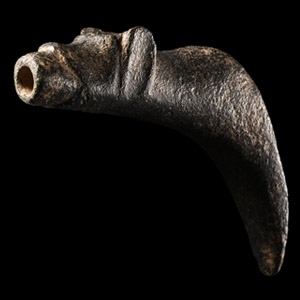
Medieval Bronze Priest Laver Pouring Spout with Dog's Head
14th-15th century A.D.Sold for (Inc. bp): £52
With stylised detailing, mouth closed around a round-section spout, curved round-section neck with section cut away for attachment. 66 grams, 71 mm
Found Somerset, UK.
A priest's laver was a large ceremonial basin used for ritual ablutions. -
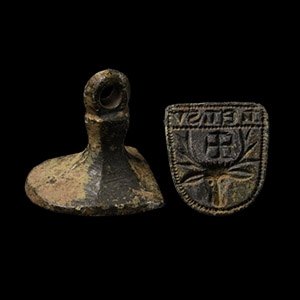
Medieval Bronze Seal Matrix with Stag's Head
13th-15th century A.D.Sold for (Inc. bp): £117
Comprising a shield-shaped die and hexagonal stem with suspension loop at apex, matrix depicting facing stag's head with boxed cross between its antlers and Latin inscription above: 'LELSV' (I am loyal). 6.91 grams, 18 mm
Found Berkshire, UK. Accompanied by a copy of the British Museum's Portable Antiquities Scheme (PAS) report no.BERK-D22C10.
The stag and cross device was used in the heraldic arms of St Eustace and St Hubert of Leige, who reputedly witnessed a stag with a cross between its antlers whilst out hunting.
