
Loading, please wait...
LOT 1324
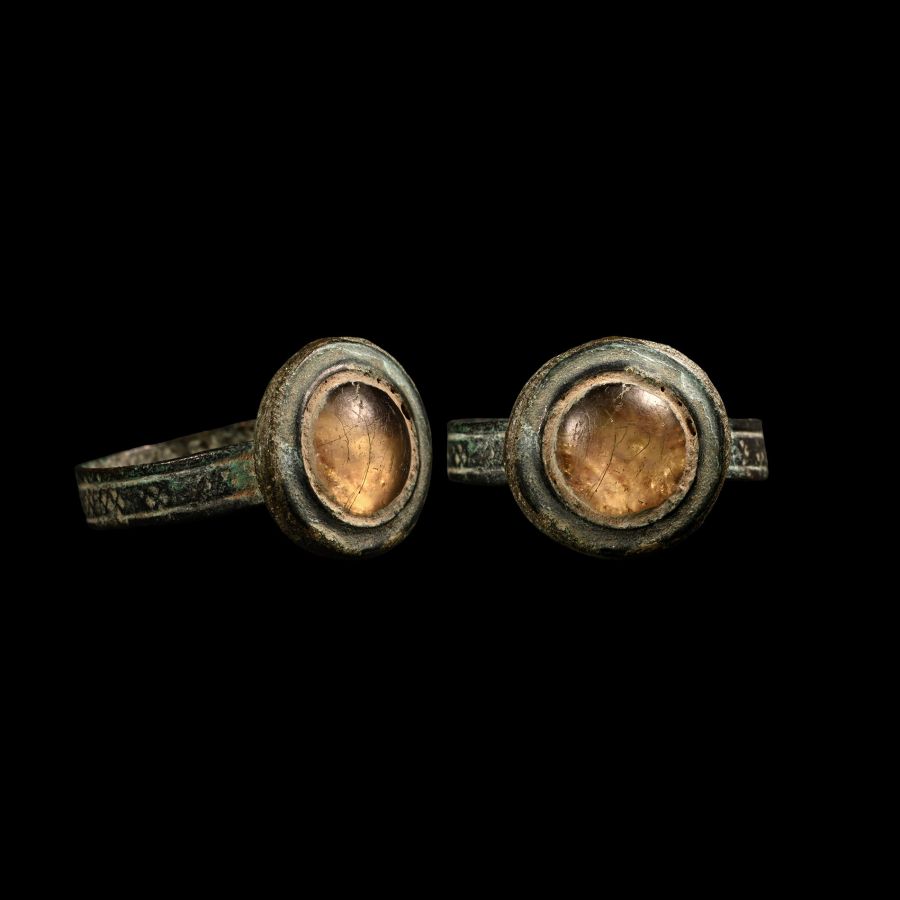
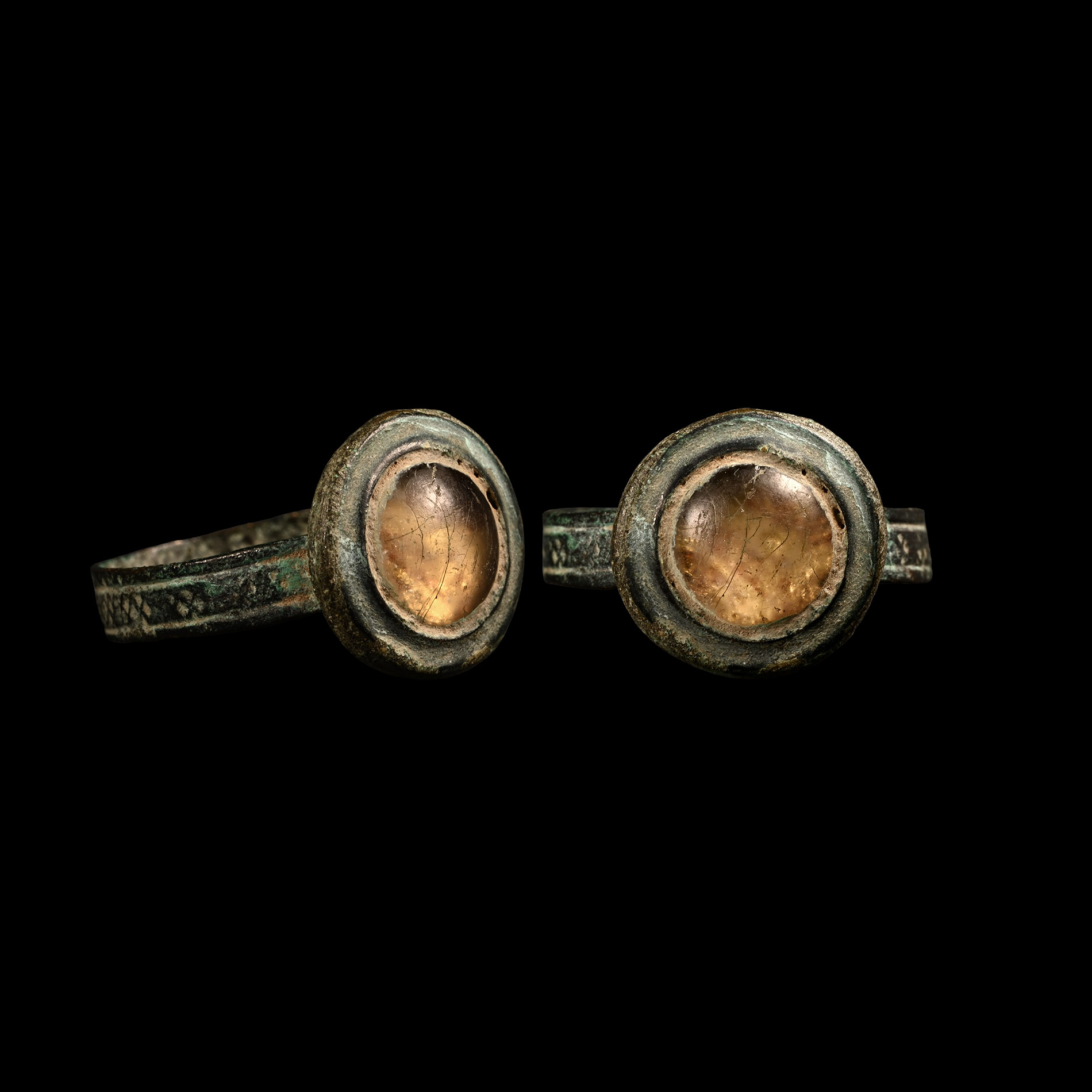
Medieval Ring with Cabochon
CIRCA 15TH CENTURY A.D.
1 in. (2.39 grams, 24.40 mm overall, 20.17 mm internal diameter (approximate size British S, USA 9, Europe 20, Japan 19)).
A ring composed of a flat-section hoop decorated with cross-hatching, supporting a discoid bezel set with a clear glass(?) cabochon with foil backing. [No Reserve]
ProvenanceAcquired in the late 1990s-2000.
Property of an East London gentleman.
TimeLine Auctions follows a vetting process to ensure the authenticity and legality of all items, reinforcing our commitment to integrity and responsible trading. Each antiquity, antique, and coin lot undergoes thorough examination by a vetting committee of at least ten external specialists, professional trade association members, scientists, and archaeologists: Our Vetting Process
AUCTIONS:
TimeLine is a leading auction house specialising in antiquities, ancient art, collectables, natural history, coins, medals, and books. Our auctions offer museums, collectors, historians, and enthusiasts the opportunity to acquire unique and historically significant pieces.
-

Medieval Knife with Bronze Pommel with Initials T.C.
Circa 1500 A.D.Estimate: £200 - 300 (+bp*)
Opening Bid: £100
A tanged knife with iron blade and single cutting edge, openwork bronze handle decorated with stylised foliate forms and X-motifs, lettering (possibly initials) to the hilt, possibly 'TC'. 27.1 grams, 18.7 cm long
Acquired 1960s-1990s. Late Alison Barker collection, a retired London barrister. -

Medieval Steelyard Weight with Heraldic Shields
Circa 1260-1300 A.D.Sold for (Inc. bp): £279
A substantial bronze weight for use with a steelyard balance with lead core, spherical in form with pierced flange for suspension above and hatched band to the shoulder; three heater shields with raised heraldic arms spaced equally around the body, etched geometric band of chevrons above. 379 grams, 54 mm high
Fine condition.
Found by Adrian Gayler, Essex, UK. Property of an Essex gentleman. Accompanied by a copy of the relevant Treasure Hunting Magazine pages where it has been published.
These heraldic steelyard weights were made under the official sanction of Richard (son of King Henry III) or Edmund, Duke of Cornwall on behalf of the King; Edmund died in 1300 A.D. and such weights were banned in 1350 so that this example would most likely to be of the period 1260-1300 A.D.; the Hanseatic League was created in Germany to protect the interests and privileges of merchants in the medieval period, starting in Europe and with influence spreading to England from the 13th century. -
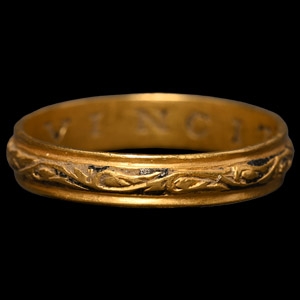
Tudor Gold '+Amor Vincit' Decorated Posy Ring
Circa 16th century A.D.Sold for (Inc. bp): £1,235
A gold posy ring with raised foliate band externally, inscribed '+AMOR VINCIT' for 'Love Conquers' in Roman capitals. 1.72 grams, 17.46 mm overall, 15.47 mm internal diameter (approximate size British I, USA 4 1/4, Europe 7.44, Japan 7)
Acquired on the UK antiques market between 1974-1985. Albert Ward collection, Essex, UK.
Omnia vincit amor, translating to 'Love Conquers All' and abbreviated on this ring, is one of the most famous of all Latin expressions. It is still used today, in the original Latin, in translation and in its alternative version ‘Amor vincit omnia’; the expression originally comes from the Roman poet Virgil, (Publius Vergilius Maro) most famous for his epic Aenid; the phrase appears in his first work, Eclogues.
