
Loading, please wait...
LOT 1656
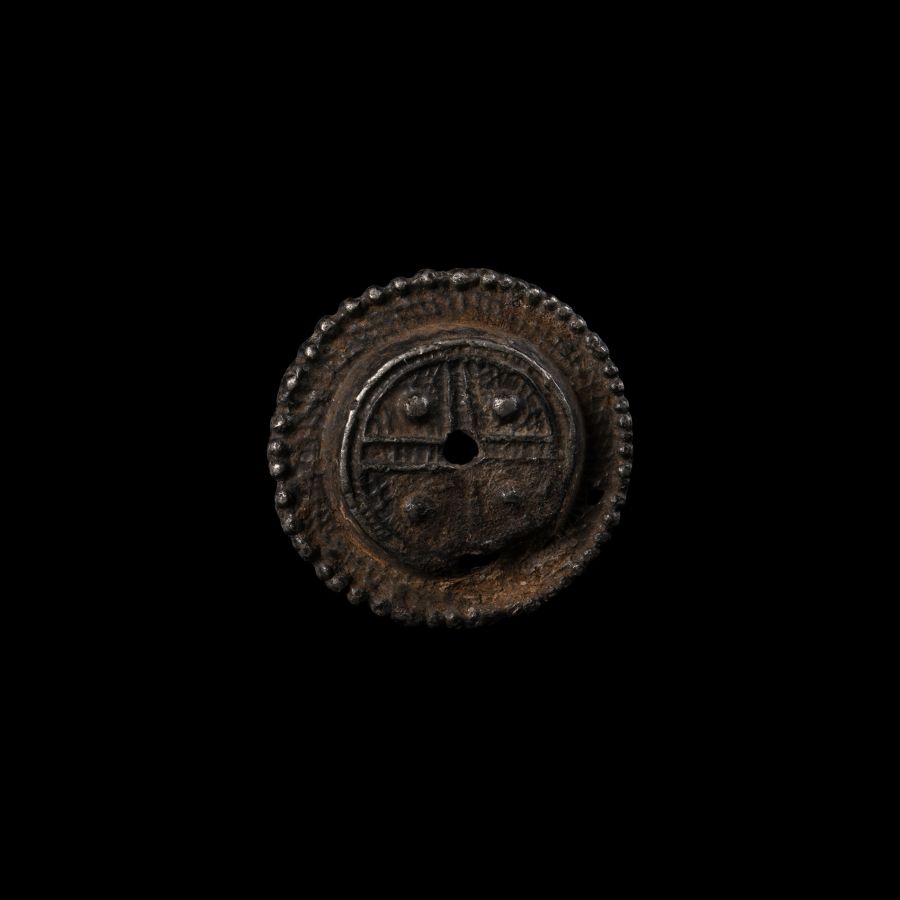
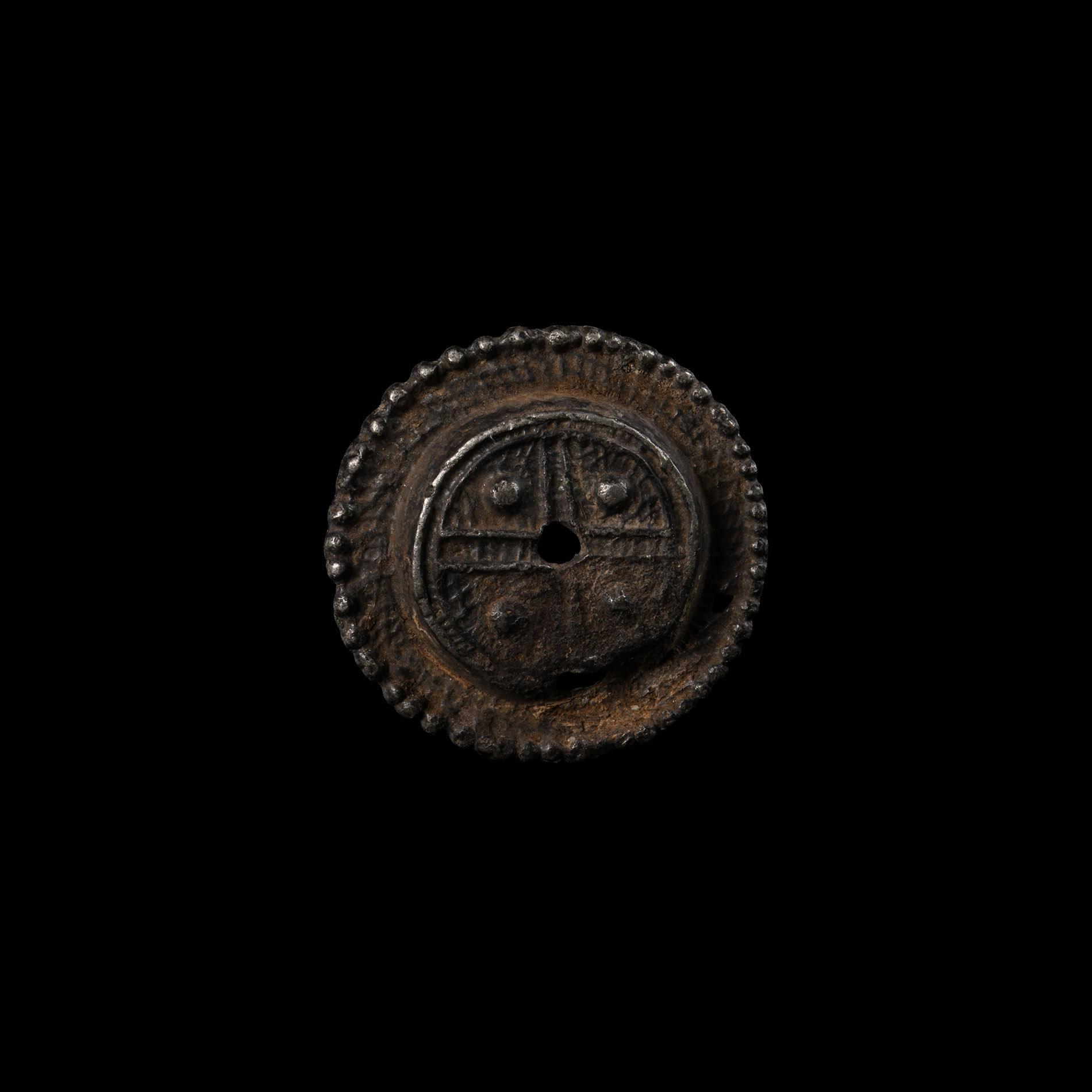
Medieval Pewter Pilgrim's Badge with Voided Cross and Pellets
14TH-15TH CENTURY A.D.
1 1/4 in. (7.31 grams, 31 mm).
Hatched flange rim with border of pellets, raised body pierced at centre and close to rim. [No Reserve]
ProvenanceFrom the collection of a North American gentleman, formed in the 1990s.
LiteratureCf. similar item in the British Museum, London, under accession no.1922,0512.24 (with facing bust rather than geometric design); Mitchiner, M., Skinner, A., ‘English Tokens, c.1200 to 1425’ in British Numismatic Journal, 1983, no.53, pp.29-77, pl.4, nos.34-35.
FootnotesThe medallic form of badge appears to develop during the 15th century. The symbols of the straight cross and annulets are already visible in tokens from London. During the medieval period, pewter and leaden tokens probably served a common purpose throughout England, France and the Low Countries.
CONDITIONTimeLine Auctions follows a vetting process to ensure the authenticity and legality of all items, reinforcing our commitment to integrity and responsible trading. Each antiquity, antique, and coin lot undergoes thorough examination by a vetting committee of at least ten external specialists, professional trade association members, scientists, and archaeologists: Our Vetting Process
AUCTIONS:
TimeLine is a leading auction house specialising in antiquities, ancient art, collectables, natural history, coins, medals, and books. Our auctions offer museums, collectors, historians, and enthusiasts the opportunity to acquire unique and historically significant pieces.
LOT 1656
Medieval Pewter Pilgrim's Badge with Voided Cross and Pellets
Sold for (Inc. bp): £65
-
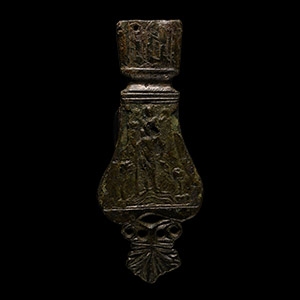
Large Medieval Bronze Strap End with St Christopher
14th-15th century A.D.Estimate: £250 - 350 (+bp*)
Opening Bid: £100
Socket finial to one end, waisted stem, heart-shaped plaque, bar of four rivet holes and shell or leaf-shaped finial, the body displaying Saint Christopher standing on a mound with a young boy on his shoulder and holding a staff in relief, Gothic letters 'ID' to the socket. 45 grams, 90 mm
Acquired early 1990s. From an East Anglian private collection. -
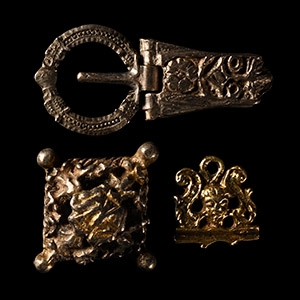
Medieval Silver-Gilt Fitting Group
14th-15th century A.D.Sold for (Inc. bp): £52
Comprising: a lozengiform fitting with raised foliage and central rose, possibly a junction; remains of a buckle with a rose and slender scrolling ornament to the plate; remains of a ring brooch ornamented with pellets and possible animal heads; openwork plate formed as a head or skull between scrolling foliage, bar below and loop above. 11.6 grams total, 13-20 mm
Acquired on the UK market, 1990s. Property of a retired academic. -
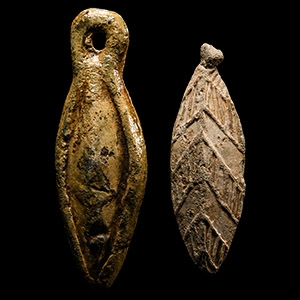
Medieval Plumb Bob Weight Group
Circa 14th-16th century A.D.Sold for (Inc. bp): £13
Each with a lozenge-shaped cross-section, one complete with suspension loop, the other with raised hatched panels. 174 grams total, 64-76 mm
Ex Simmons Gallery, London E11, UK, in the 1990s. From a North London collection.
