
Loading, please wait...


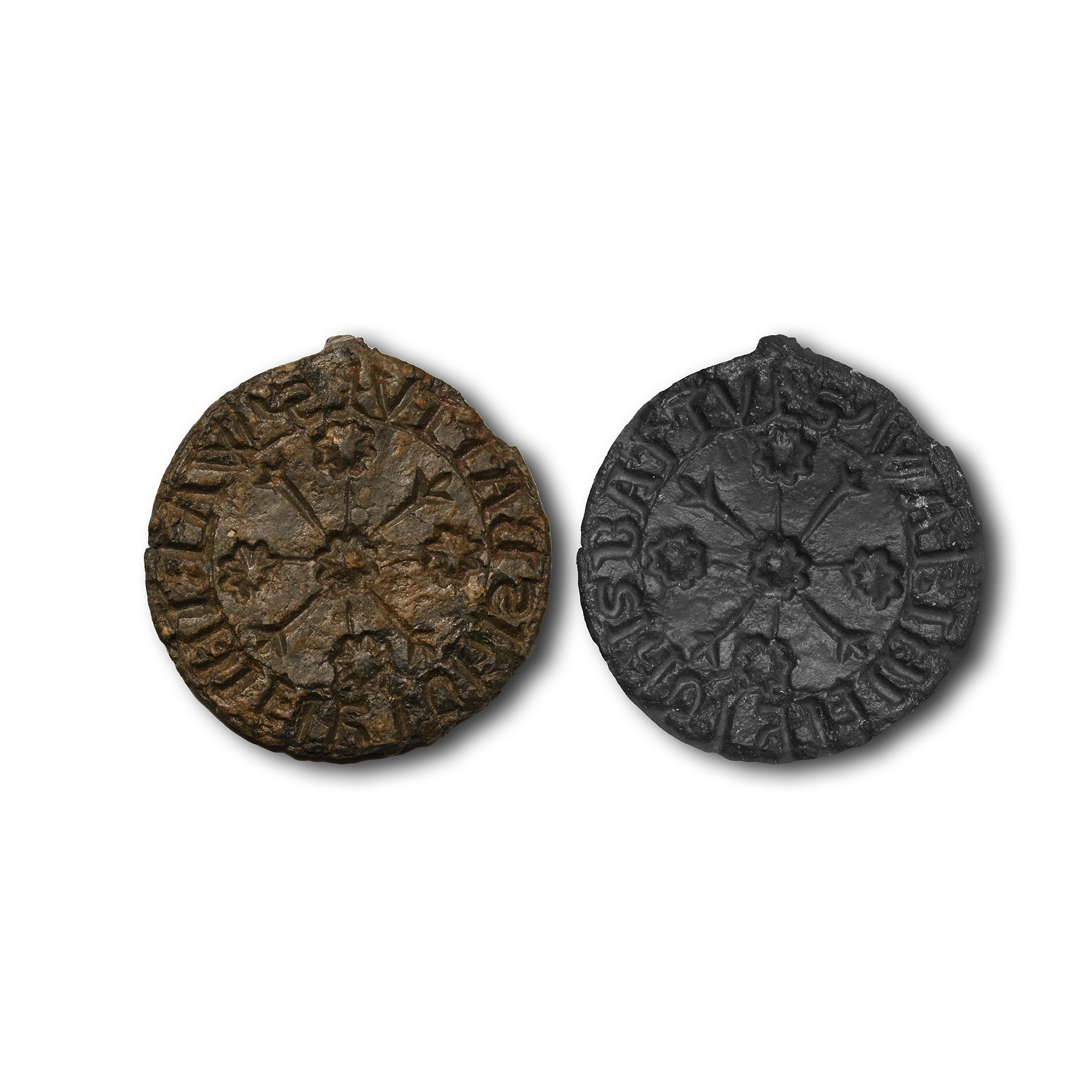
LOT 1802
Medieval Personal Lead Seal Matrix of Warin Son of John Battle
CIRCA 13TH CENTURY A.D.
1 1/4 in. (14.76 grams, 33 mm).
Discoid with remains of a loop, central quincunx of rosettes with crows' feet between; legend to the rim '* S' WA[R]INI FIL IOhIS BATTVL' (seal of Warin son of John [of] Battle). [No Reserve]
ProvenanceEx Paul Moore collection, West Sussex, UK, 1990s-2000s.
Accompanied by a Paul Moore display card.
The name Warin was popular among the Merovingian Franks and a bishop of that name was canonised; it then remained in use as a Christian name into the medieval period.
CONDITIONTimeLine Auctions follows a vetting process to ensure the authenticity and legality of all items, reinforcing our commitment to integrity and responsible trading. Each antiquity, antique, and coin lot undergoes thorough examination by a vetting committee of at least ten external specialists, professional trade association members, scientists, and archaeologists: Our Vetting Process
AUCTIONS:
TimeLine is a leading auction house specialising in antiquities, ancient art, collectables, natural history, coins, medals, and books. Our auctions offer museums, collectors, historians, and enthusiasts the opportunity to acquire unique and historically significant pieces.
LOT 1802
Medieval Personal Lead Seal Matrix of Warin Son of John Battle
Sold for (Inc. bp): £46
-

Large Medieval Bone Weaving Slay
14th-16th century A.D.Sold for (Inc. bp): £91
Long-bone from a large animal trimmed to a narrow triangular blade for use in weaving. 147 grams, 34.2 cm
From a family collection mostly formed in the 1940s-1950s, thence by descent. -

Medieval Bronze Knight's Holy Sepulchre Badge
Circa 13th-14th century A.D.Sold for (Inc. bp): £156
Formed as a cross-crosslet, the symbol of the Knights of the Holy Sepulchre, with punched-point border. 1.42 grams, 23 mm
Found near Bottisham, Cambridgeshire, UK.
The 'Equestrian Order of the Holy Sepulchre of Jerusalem' was an order of knighthood under the protection of the Pope, formed around 1099 A.D. by Duke Godfrey of Bouillon, the leader of the First Crusade. It was established for the protection of pilgrims travelling to the Holy Land and was recognised by a Papal Bull in about 1113 A.D. -
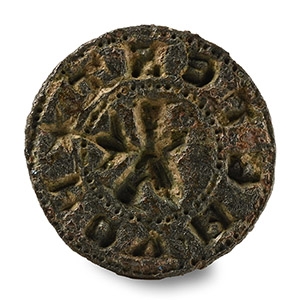
Medieval Bronze Seal Matrix with Clasped Hands
12th-14th century A.D.Sold for (Inc. bp): £20
With central mane-in-fede motif beneath a star, Lombardic script legend '* FOY ME TENT' for 'fidelity sustains me'. 4.37 grams, 20 mm
Ex Stocker collection, Kent, UK, 1955-early 2000s.
This amatory legend is found on other matrices, where the first word is more usually spelled FEI – a similar example is PAS database, SOM-D80124. An impression in the National Library of Wales is attached to a document dated c.1310. For this and similar legends see, Jones, M., The Beautiful Game: Courtly Love Posies in Anglo-Norman Inscribed on Jewellery and Seals, in Journal of the British Archaeological Association 176 (2023), 1-30.
