
Loading, please wait...
LOT 0301
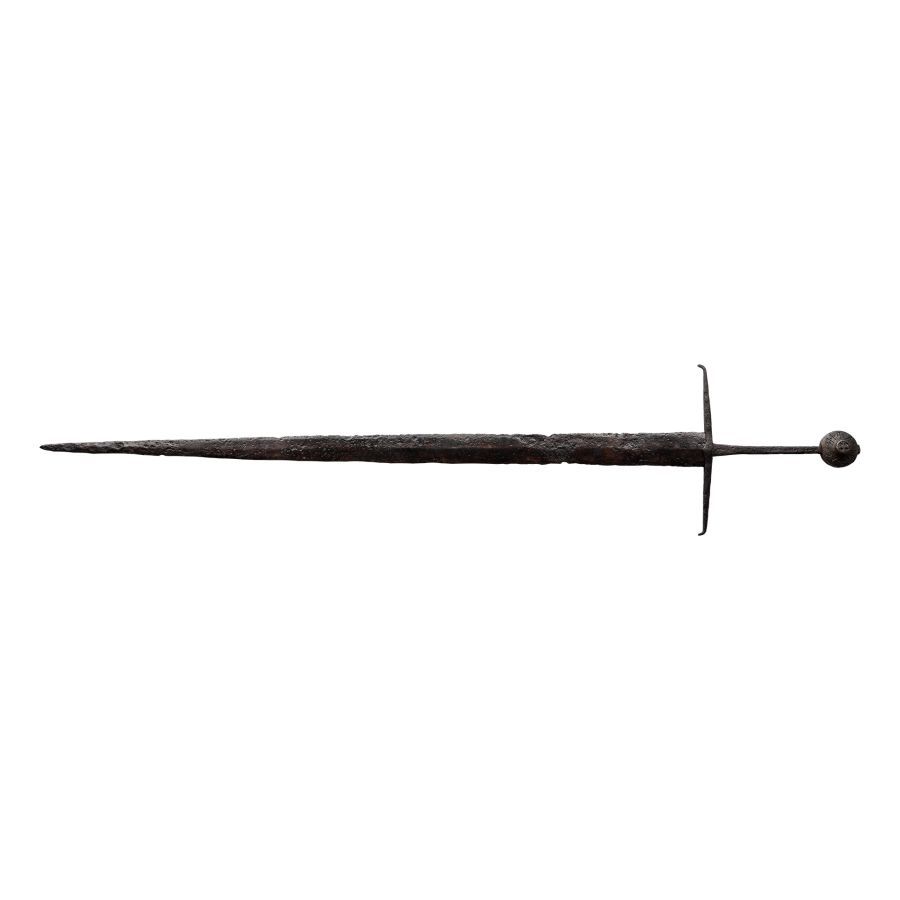
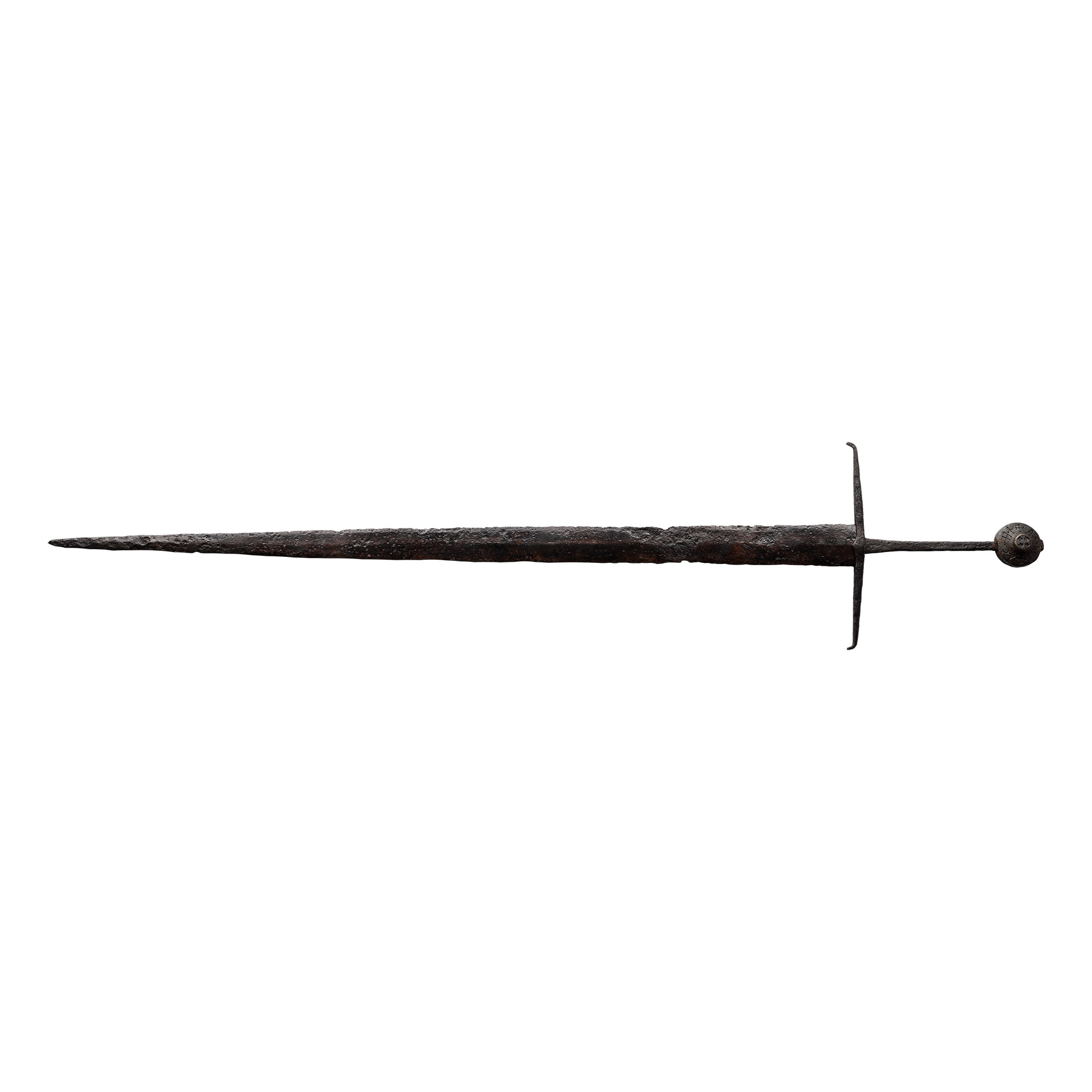
Medieval Knight's Iron Hand-and-a-Half Sword with Inscribed Bronze Pommel
GERMANY, 14TH CENTURY A.D.
44 1/2 in. (1.25 kg, 113 cm).
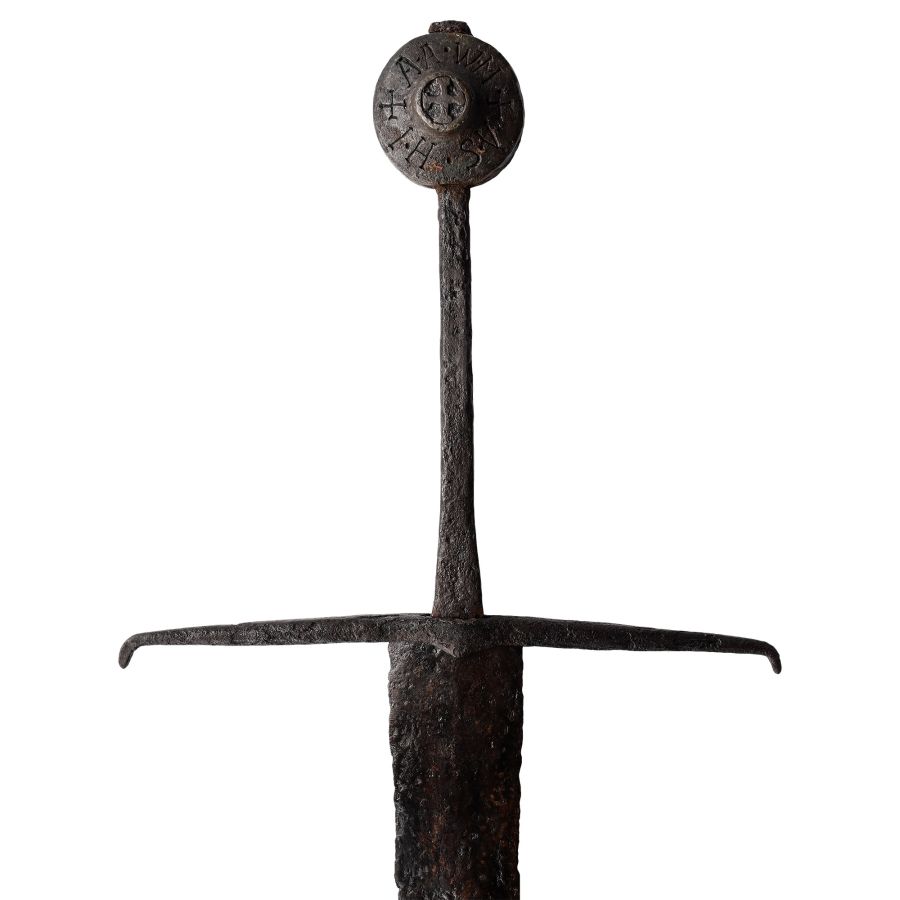
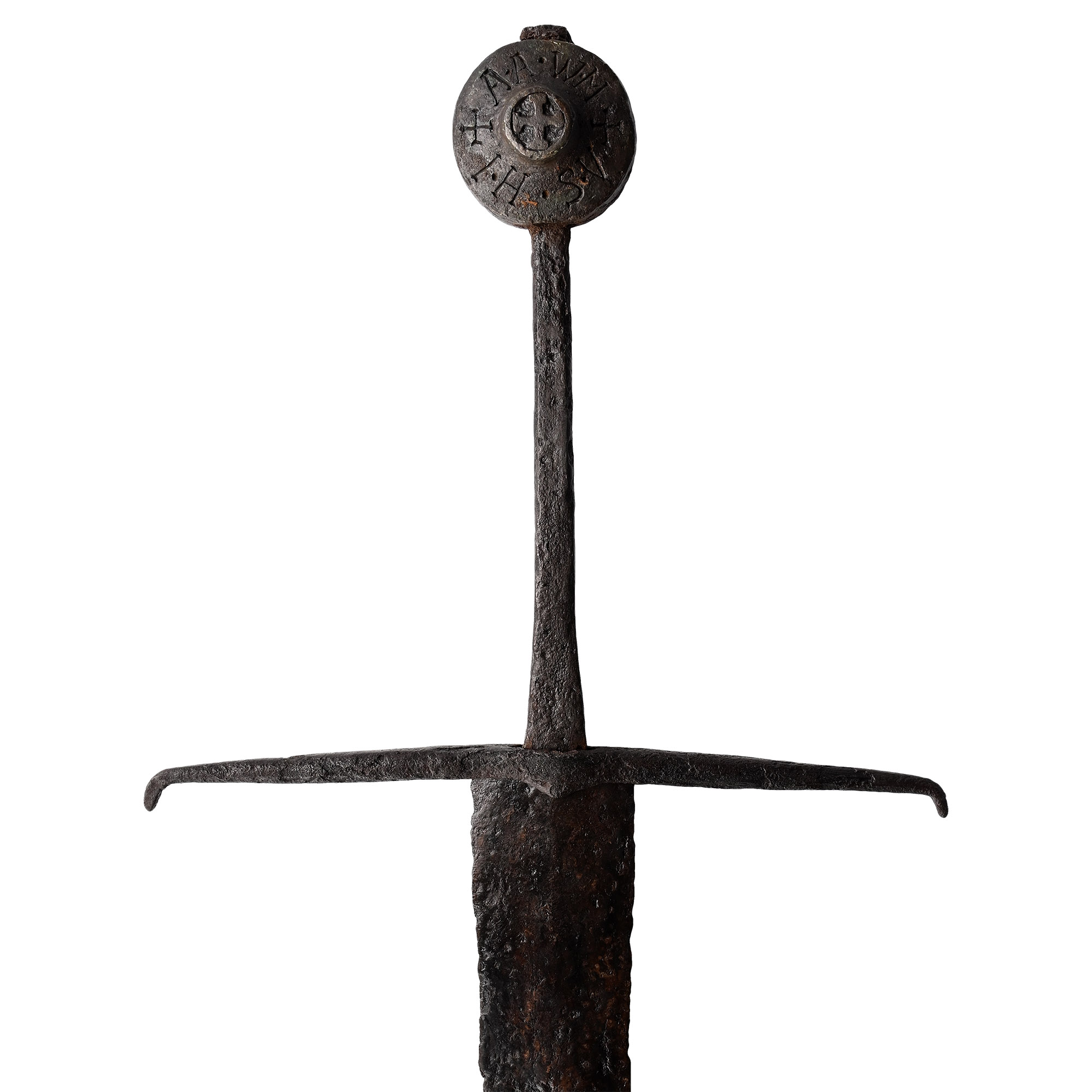
Longsword of Oakeshott's Type XVa, cross style 8, bronze pommel style J (recessed); strongly tapering, pointed blade of ‘flattened diamond’ section, cross style tapering gradually outward to sharply downturned tips; long grip with slight taper, disc pommel with chamfered edges and a potent cross in the centre surrounded by an inscription (on both sides) '+ IH SU + AAWM'. [No Reserve]
ProvenanceFrom the private family collection of a lady, UK; acquired in Germany mid 20th century.
Accompanied by an academic report by Dr Raffaele D’Amato.
This lot has been checked against the Interpol Database of stolen works of art and is accompanied by search certificate number no.13034-24799.
Cf. Oakeshott, R.E., The Archaeology of the weapons, London, 1960; Oakeshott, E., The sword in the Age of the Chivalry, Woodbridge, 1964 (1994); Oakeshott, E., Records of the Medieval Sword, Woodbridge, 1991; Oakeshott, E., Sword in hand, London, 2001 (2007); a similar sample in the Royal Armouries from the former collection of Sir Edward Barry (Oakeshott, 1991, p.140); for a parallel with the pommel see a similar specimen in the London Museum, inv.2018.11.
FootnotesSome wheel pommels of this date have engraved, or inset roundels with armorial or devotional emblems, and a number of sword blades of this date bear religious inscriptions in the form of a prayer. The inscription on the pommel between the two potent crosses is intriguing. The letters 'IH SU' are a clear reference to the name of the Saviour, and can be translated as Ihesu-Jesus, or also Ihesu Merci (Jesus have mercy), a simple prayer for the person carrying the sword. The letters 'A.A. W.M.' could refer to the name of the owner of the sword (WM = Wilhelm) or the maker of the weapon. It is difficult to consider the letters as an abbreviation of the prayer ‘Ave Maria’, usually shortened in the German medieval inscriptions as A.M.
CONDITIONTimeLine Auctions follows a vetting process to ensure the authenticity and legality of all items, reinforcing our commitment to integrity and responsible trading. Each antiquity, antique, and coin lot undergoes thorough examination by a vetting committee of at least ten external specialists, professional trade association members, scientists, and archaeologists: Our Vetting Process
AUCTIONS:
TimeLine is a leading auction house specialising in antiquities, ancient art, collectables, natural history, coins, medals, and books. Our auctions offer museums, collectors, historians, and enthusiasts the opportunity to acquire unique and historically significant pieces.
LOT 0301
Medieval Knight's Iron Hand-and-a-Half Sword with Inscribed Bronze Pommel
Sold for (Inc. bp): £14,300
-
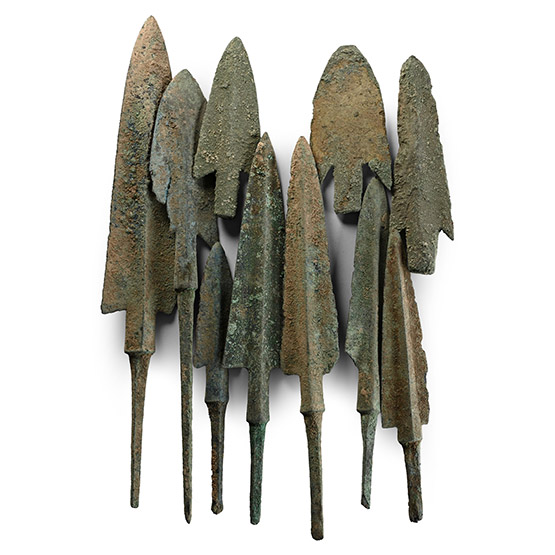
Luristan Bronze Arrowhead Collection
2nd-1st millennium B.C.Sold for (Inc. bp): £124
Mainly barbed and tanged types of slender profile. 287 grams total, 6.2-17.7 cm
Ex London, UK, collection, 1990s. -
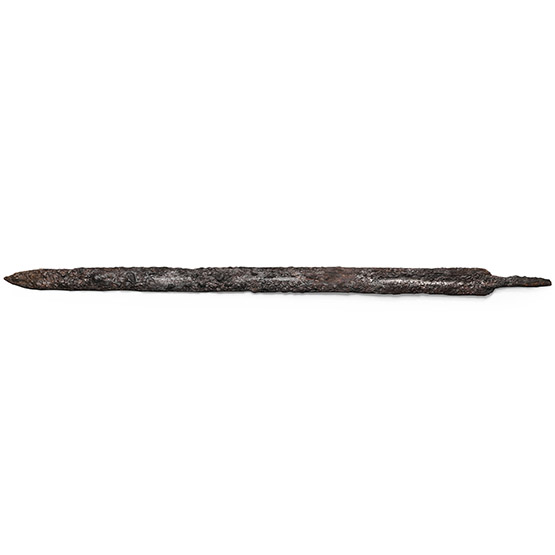
Merovingian Iron Pattern-Welded Sword
Circa 6th century A.D.Sold for (Inc. bp): £975
A double-edged spatha with a lentoid parallel-sided blade and pointed tip; evidence of battle nicks on both cutting edges; long tang and traces of wooden scabbard on the blade; signs of damask pattern running along the length of the blade, especially on the upper part; cleaned and conserved. 694 grams, 86.5 cm
From the private collection of a London gentleman, from his grandfather's collection formed before the early 1970s. Accompanied by an academic report by Dr Raffaele D’Amato. This lot has been checked against the Interpol Database of stolen works of art and is accompanied by search certificate number no.12919-245174.
Usually the term ‘damascened’ is only used for blades, describing the way in which their individual rods are forged to create a desired pattern effect that remained visible on the surfaces of the finished product (technique B.II.1.2.). The shape and regularity of the pattern was essentially dependent on the number and nature of the individual rods and on the skills of the blacksmith. The scholars differentiate on this basis more or less careful and complicated variants (e.g. striped, diamond, herringbone, angular, rosette, mosaic, etc.), in which the individual rods from different iron lamellae, which are parallel or twisted (torsion pattern-welding), were built up often in connection with each other (technique B.II.1.2.1-2). Combining striped rods that were partially straight and partially twisted - clockwise or counter-clockwise - allowed the formation of a very decorative blade. -
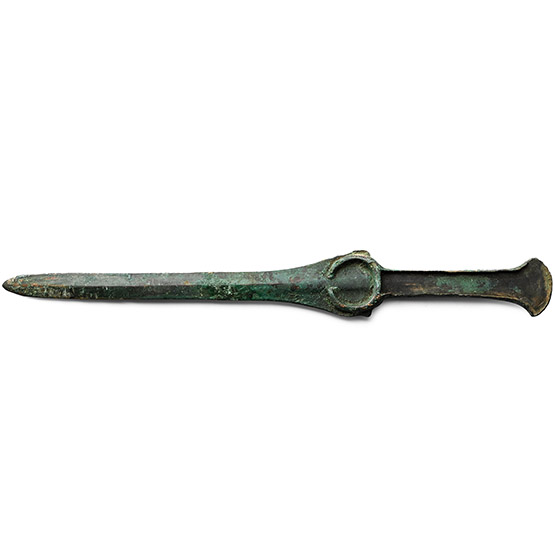
Luristan Bronze Dagger
2nd-1st millennium B.C.Sold for (Inc. bp): £338
Blade with a shallow median rib, crescentic pennannular guard, handle with pommel in the shape of a nail head. 151 grams, 30.5 cm
Ex Abelita family collection, 1980s-2000s.
This is a type of blade rare among Luristan weapons. The simplest type that appeared to J. de Morgan and Godard in the first excavations of Luristan looked like this: a blade always featuring a median groove, a guard decorated with a crescent, and a round hilt with a nail-shaped head. The hilt was usually filled with organic material, such as wood, bone, or ivory.
