
Loading, please wait...
LOT 0430
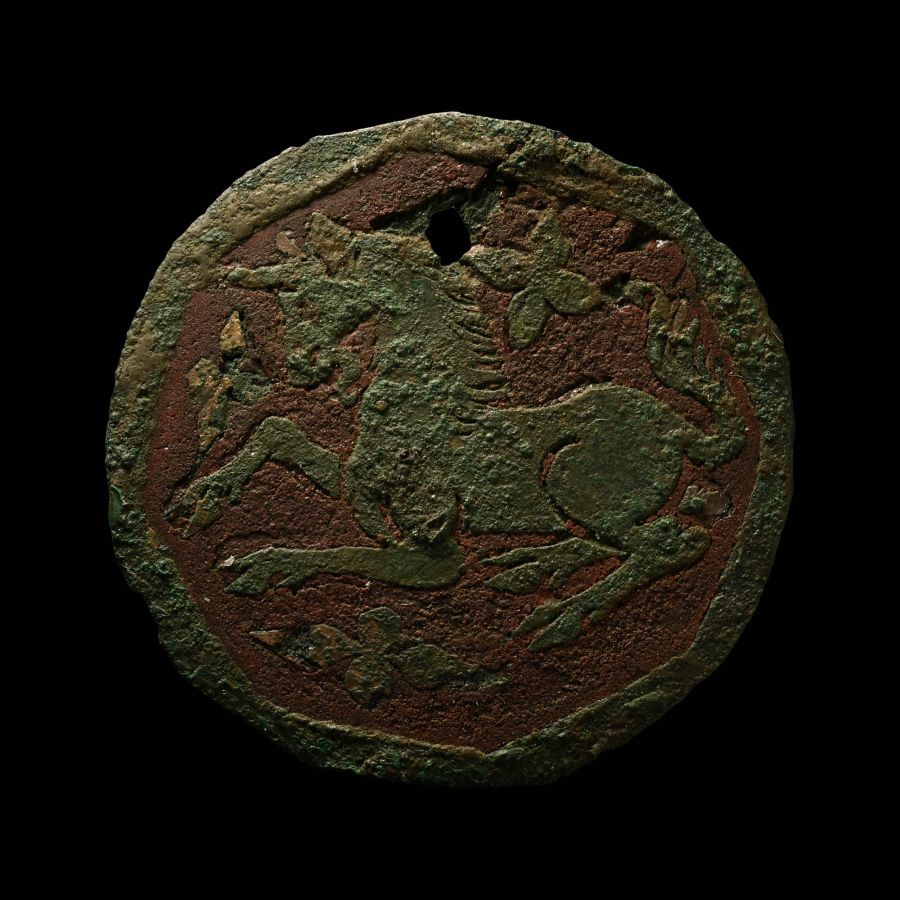
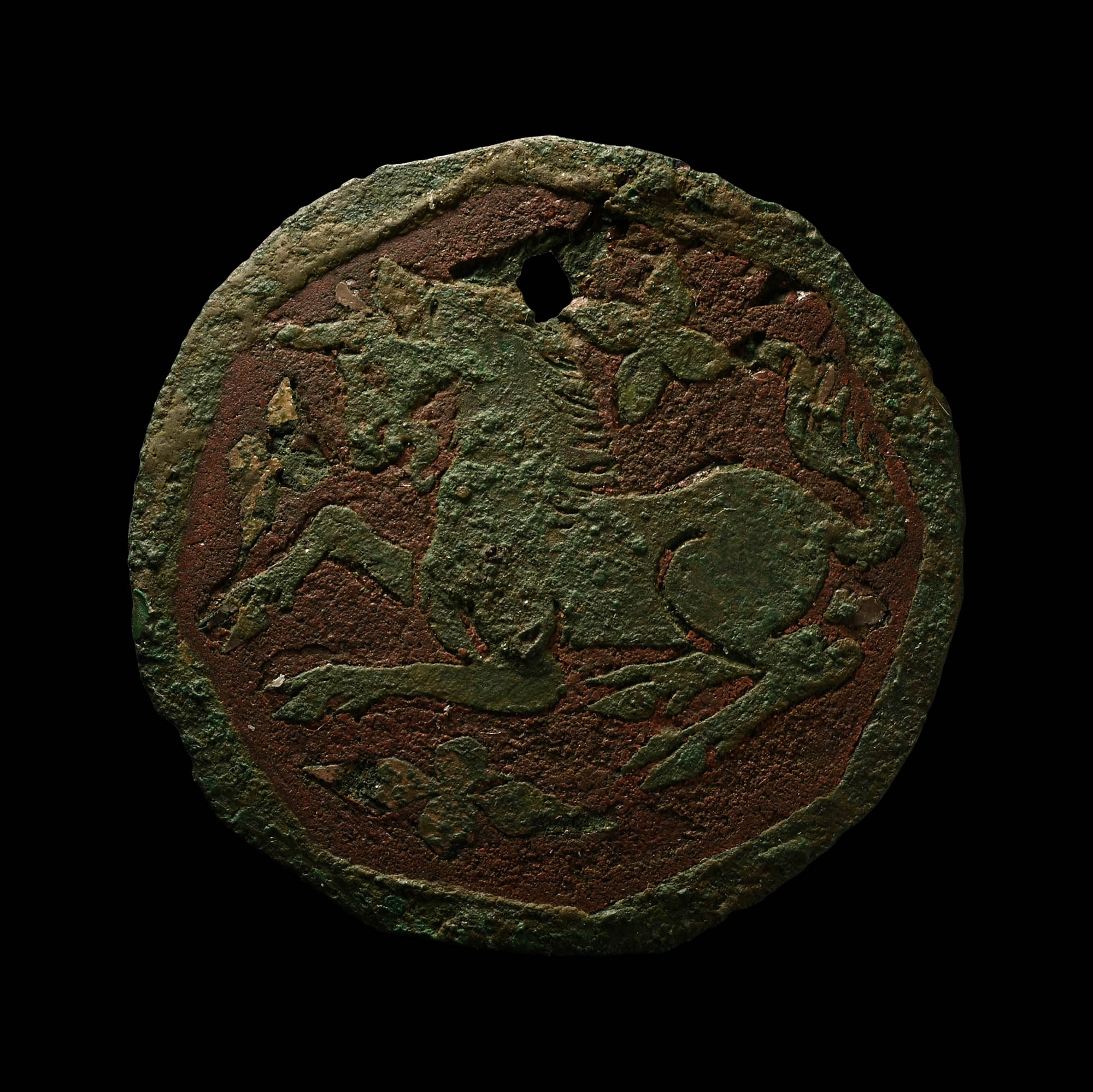
Medieval Knight's Heraldic Red Enamelled Bronze Roundel with Silver Unicorn
15TH CENTURY A.D.
1 5/8 in. (12.29 grams, 42 mm).
A heavily patinated silver plate with red enamel field and reserved unicorn couchant among quatrefoils; pierced for suspension.
ProvenanceFrom a Northants, UK, collection, 1990s.
FootnotesThe design appears to be based on the 'Maid and the Unicorn' tapestry now in the Cluny Museum, Paris, dated to circa 1500 A.D. The field of the tapestry is strewn with numerous flowers which gives the name 'millefleurs' ('thousand flowers') to the type.
CONDITIONTimeLine Auctions follows a vetting process to ensure the authenticity and legality of all items, reinforcing our commitment to integrity and responsible trading. Each antiquity, antique, and coin lot undergoes thorough examination by a vetting committee of at least ten external specialists, professional trade association members, scientists, and archaeologists: Our Vetting Process
AUCTIONS:
TimeLine is a leading auction house specialising in antiquities, ancient art, collectables, natural history, coins, medals, and books. Our auctions offer museums, collectors, historians, and enthusiasts the opportunity to acquire unique and historically significant pieces.
LOT 0430
Medieval Knight's Heraldic Red Enamelled Bronze Roundel with Silver Unicorn
Estimate £400 - 600€460 - 700 (for guidance only)$540 - 810 (for guidance only)
-
.jpg)
Medieval Iron Single-Edged Dagger
14th-15th century A.D.Sold for (Inc. bp): £65
Comprising a slender cutting edge and a long tang. 123 grams, 29.3 cm
Acquired 1960s-1990s. Late Alison Barker collection, a retired London barrister.
From the documentary evidence, the dagger was not a weapon in widespread use. In some sources, daggers are called handsets, presumably originating from the Anglo-Saxon scramasaxes, implying that they were a single-bladed knife rather than a dual-bladed dagger. It is unclear whether such daggers were primarily intended for military or civilian functions; although they may have been used in both, their primary uses were likely to be civilian. -
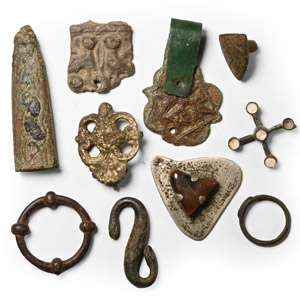
Medieval and Other Bronze Artefact Collection
14th-19th century A.D.Sold for (Inc. bp): £78
Including a dagger chape, heater-shaped heraldic badge, finger ring and other items. 87 grams total, 18-56 mm
Acquired on the European art market since the early 2000s. From the private Northern Ireland collection of R.M. -
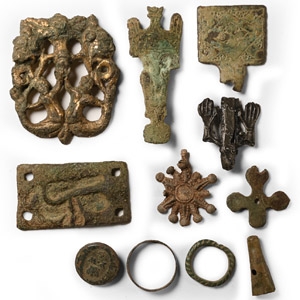
Medieval and Other Bronze Artefact Collection
14th-19th century A.D.Sold for (Inc. bp): £91
Including pilgrim's badges, finger rings, appliqués and other items. 68 grams total, 16-46 mm
Acquired on the European art market since the early 2000s. From the private Northern Ireland collection of R.M.
