
Loading, please wait...
LOT 1949
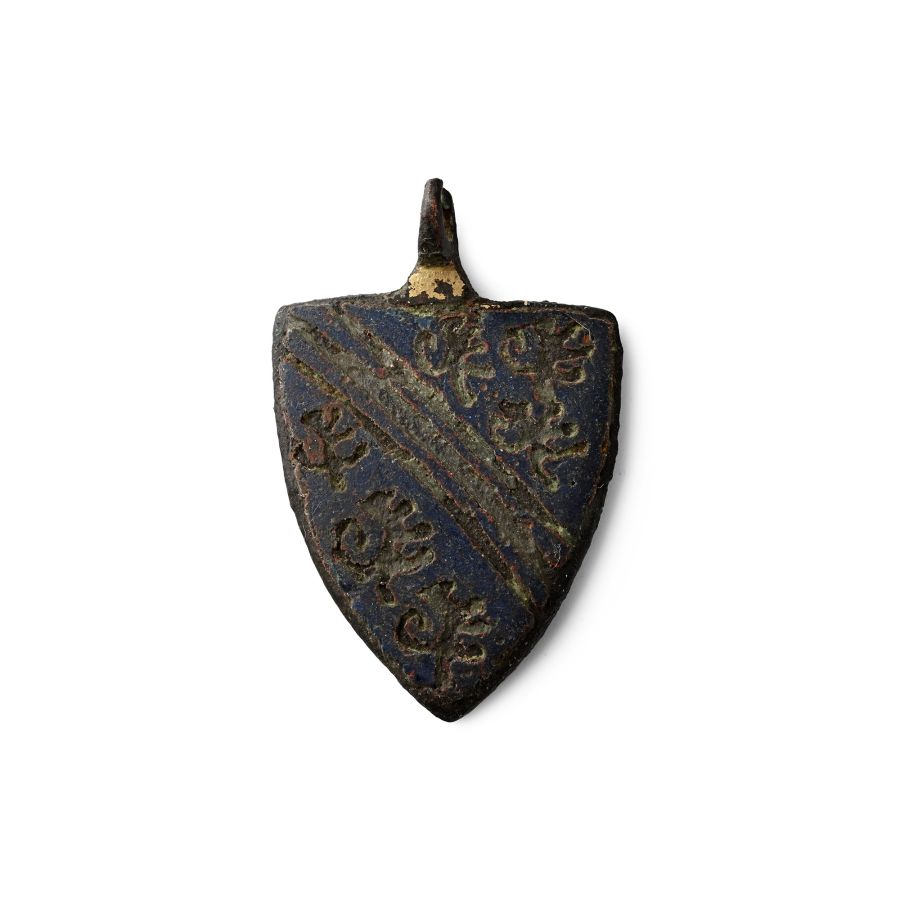
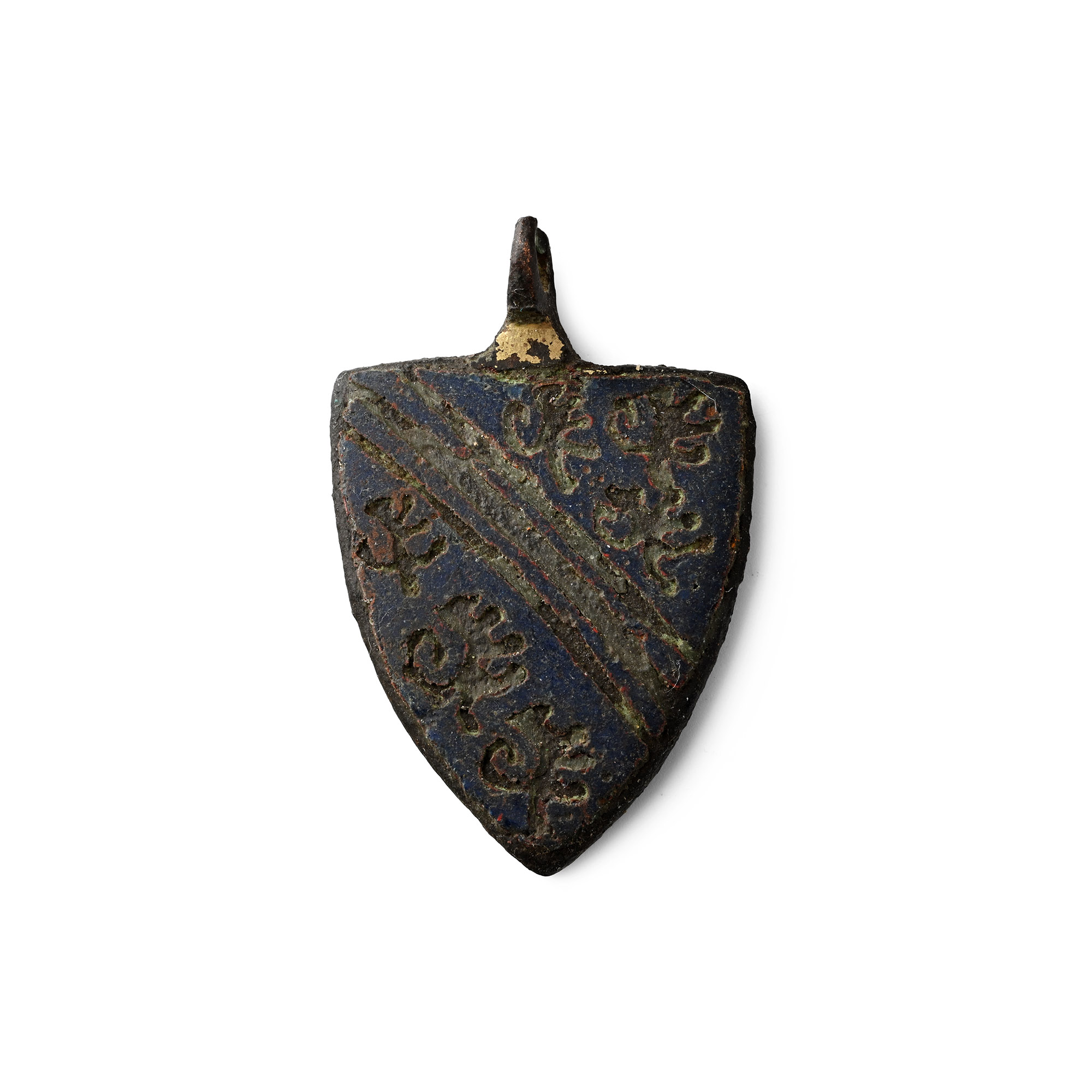
Medieval Knight's Enamelled 'De Bohun Family' Bronze Heraldic Horse Harness Pendant
14TH-15TH CENTURY A.D.
1 5/8 in. (12.8 grams, 41 mm).
Heater-shaped with integral loop above; three diagonal stripes (bends cotised) on a blue field with lions rampant; blazoned 'azure a bend cotised between six lions rampant or', the arms of de Bohun, earls of Hereford and Essex. [No Reserve]
ProvenanceFound East Anglia, UK.
This lot is accompanied by an illustrated lot declaration signed by the Head of the Antiquities Department, Dr Raffaele D'Amato.
Cf. Ashley, S., Medieval Armorial Horse Furniture in Norfolk, East Anglian Archaeology 101, Dereham, 2002, items 80, 81.
FootnotesThe de Bohun family took its name from the region of Bohun in the Cotentin peninsula, Normandy, France. John de Bohun, 5th Earl of Hereford (died January 1336) was born the son of Humphrey de Bohun, 4th Earl of Hereford. After his Humphrey's death at the Battle of Boroughbridge, the family lands were forfeited by John who was only later permitted to succeed to his positions as Earl of Hereford and Essex, Constable of England and Lord of Brecknock.
CONDITIONTimeLine Auctions follows a vetting process to ensure the authenticity and legality of all items, reinforcing our commitment to integrity and responsible trading. Each antiquity, antique, and coin lot undergoes thorough examination by a vetting committee of at least ten external specialists, professional trade association members, scientists, and archaeologists: Our Vetting Process
AUCTIONS:
TimeLine is a leading auction house specialising in antiquities, ancient art, collectables, natural history, coins, medals, and books. Our auctions offer museums, collectors, historians, and enthusiasts the opportunity to acquire unique and historically significant pieces.
LOT 1949
Medieval Knight's Enamelled 'De Bohun Family' Bronze Heraldic Horse Harness Pendant
Sold for (Inc. bp): £208
-

Medieval Bronze Knight's Holy Sepulchre Badge with Pin
Circa 13th-14th century A.D.Sold for (Inc. bp): £104
Formed as a cross-crosslet, the symbol of the Knights of the Holy Sepulchre, with punched-point border, pin in situ verso. 1.23 grams, 21 mm
From the collection of a West Yorkshire, UK, gentleman. This lot is accompanied by an illustrated lot declaration signed by the Head of the Antiquities Department, Dr Raffaele D'Amato.
The 'Equestrian Order of the Holy Sepulchre of Jerusalem' was an order of knighthood under the protection of the Pope, formed around 1099 AD by Duke Godfrey of Bouillon, the leader of the First Crusade. It was established for the protection of pilgrims travelling to the Holy Land and was recognised by a Papal Bull in about 1113 AD. -

Medieval Pope Gregory IX Lead Papal Bulla
1227-1241 A.D.Sold for (Inc. bp): £124
The obverse depicting the busts of St Peter and St Paul each within an inverted pear-shaped compartment defined by pellets; cross pattee supported on a staff between the busts and at the top of the bulla in the centre letters 'SPASPE', abbreviations for St Paul and St Peter; reverse inscribed over three lines 'GRE/GORIVS./PP. VIIII', with an omega above the letters 'PP'; both obverse and reverse faces with a pelletted perimeter. 42.5 grams, 40 mm
Found UK. Property of a Worlingworth, Suffolk, UK, private collector. This lot is accompanied by an illustrated lot declaration signed by the Head of the Antiquities Department, Dr Raffaele D'Amato.
Pope Gregory IX, born Ugolino di Conti, was the 178th Pope of the Catholic Church, reigning from 1227 to 1241. He is known for his strong defence of papal authority, his role in the Crusades, and his establishment of the Papal Inquisition. -
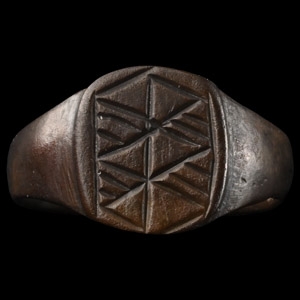
Medieval Bronze Ring with Triangles
14th-16th century A.D.Sold for (Inc. bp): £65
With ellipsoid bezel, incuse pattern of plain and hatched triangles. 4.17 grams, 21.37 mm overall, 18.74 mm internal diameter (approximate size British Q, USA 8, Europe 17.49, Japan 16)
Ex German art market, 2000s. Acquired from an EU collector living in London. From the collection of a Surrey, UK, gentleman. This lot is accompanied by an illustrated lot declaration signed by the Head of the Antiquities Department, Dr Raffaele D'Amato.
