
Loading, please wait...


LOT 1882
Medieval Knight's Enamelled Bronze Heraldic Horse Harness Pendant
CIRCA 14TH-15TH CENTURY A.D.
1 7/8 in. (15.3 grams, 47 mm).
Heater-shaped body with pierced suspension lug; low-relief reserved design of three lions passant gardant on a red-enamelled field, label placed overall in fess designating 'first son' status. [No Reserve]
ProvenanceAcquired on the UK art market.
Property of a Lancashire, UK, collector.
See The Portable Antiquities Scheme, record id. SF-99B4E1, for similar.
CONDITIONTimeLine Auctions follows a vetting process to ensure the authenticity and legality of all items, reinforcing our commitment to integrity and responsible trading. Each antiquity, antique, and coin lot undergoes thorough examination by a vetting committee of at least ten external specialists, professional trade association members, scientists, and archaeologists: Our Vetting Process
AUCTIONS:
TimeLine is a leading auction house specialising in antiquities, ancient art, collectables, natural history, coins, medals, and books. Our auctions offer museums, collectors, historians, and enthusiasts the opportunity to acquire unique and historically significant pieces.
LOT 1882
Medieval Knight's Enamelled Bronze Heraldic Horse Harness Pendant
Sold for (Inc. bp): £286
-
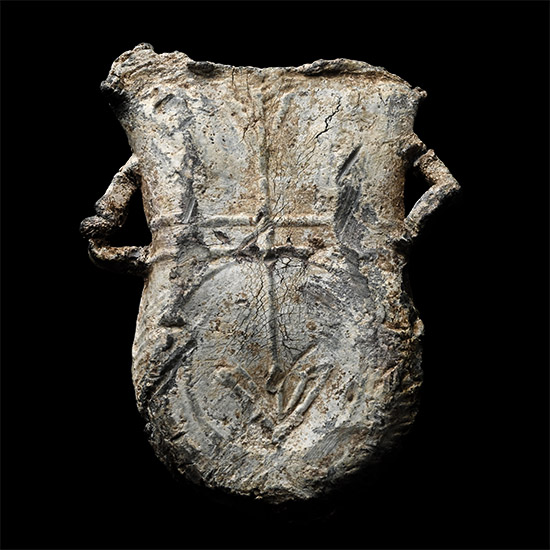
Medieval Lead Walsingham Pilgrim's Holy Water Ampulla
Circa 15th century A.D.Sold for (Inc. bp): £124
With lateral loops and low-profile cross with W to obverse, reverse with a hatched crescent. 31.1 grams, 46 mm
Found Suffolk, UK. Property of a Suffolk, UK, gentleman. -
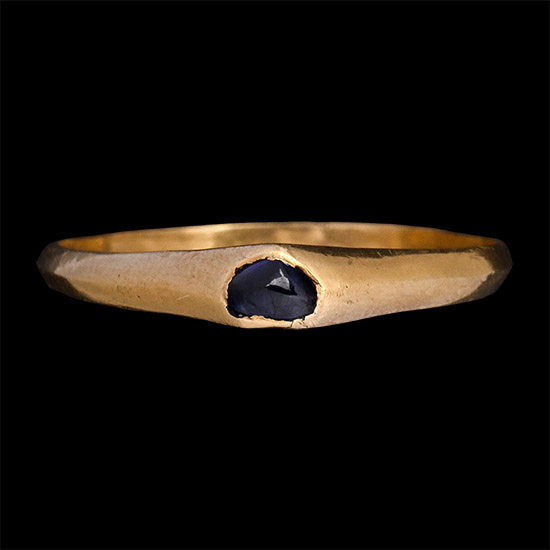
Medieval Gold Stirrup Ring with Sapphire
13th-14th century A.D.Estimate: £2,000 - 3,000 (+bp*)
Opening Bid: £1,000
Slender keeled hoop and a high bezel set with a polished sapphire cabochon. 2.24 grams, 23.70 mm overall, 18.14 x 19.03 mm internal diameter (approximate size British Q, USA 8, Europe 17.49, Japan 16)
Acquired on the European art market. This lot has been checked against the Interpol Database of stolen works of art and is accompanied by search certificate number no.13389-258004.
The style of the ring is known as a stirrup ring due to the resemblance the form has to stirrups on a horse. During the Middle Ages, gemstones were often associated with magical and protective properties that they were believed to possess. Gemstones could protect against evil or poisons, as well as heightening the individual’s characteristics and strengths. Sapphires were frequently worn by Bishops and other clergy due to their ability to promote their bearer’s chastity and piety. Sapphires were believed to be able to change colour if the wearer acted sinfully or lacked faith; it was because of this belief that jewels set with sapphires were worn as symbols of honesty and devout faith. -
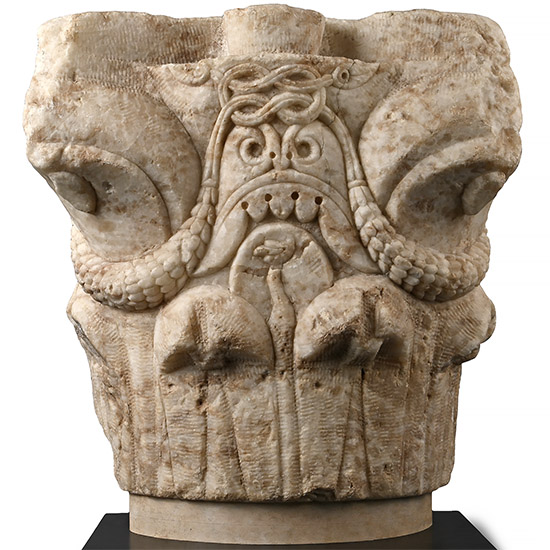
Romanesque Limestone Capital with Reef Knot
Visigothic Style, 12th century A.D.Sold for (Inc. bp): £7,670
Pillar capital for an architectural column or pier decorated with dense vegetation motifs, tapering swags or garlands; reef-knot motif and leaves above; unworked to the reverse. 74 kg total, 51.5 cm high including stand
Ex French collection. Holz Artles, 25 April 2015, no.83. Private collection, Kensington, London. Private collection, UK. This lot has been checked against the Interpol Database of stolen works of art and is accompanied by search certificate number no.13383-259007.
This finely carved capital belongs to a group of Romanesque capitals known as knotwork capitals, widespread in the South of France and North of Spain, where the influence of the architecture of the old Visigothic Kingdom was still strong. These capitals probably originate in one of the most famous sculpture workshops of Romanesque France. The base of the capital is topped by a row of abstractly sculpted acanthus leaves. The dominant section of the capital is decorated with stylised knotwork, composed of ornament that entwine and end in folded acanthus leaves. In between the entwined branches, there is more foliage forming the ‘head of a monster’ which playfully animates the sculpture.
